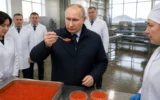
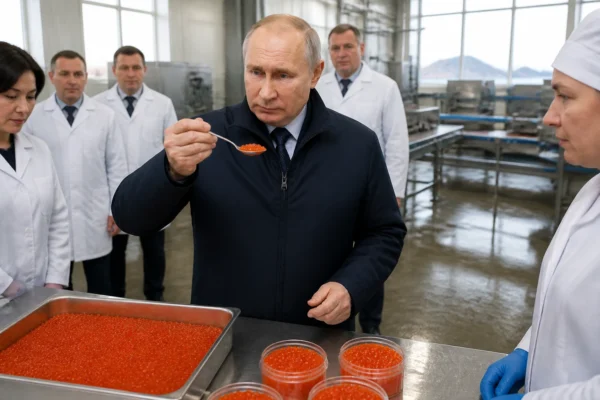
Russian President Vladimir Putin spent August 13, 2026, on Iturup, the largest of the four southern Kuril Islands claimed by Japan. State media called it his first working trip to the chain. He toured a fish plant, hospital and school, tasted caviar and posed with residents while Tokyo lodged an immediate protest.
The visit followed naval drills on nearby Sakhalin and arrived two days before Japan marks the anniversary of its World War II surrender. It turned a long-frozen territorial quarrel into a public assertion of control that Japan cannot reverse and Russia no longer pretends to negotiate.
The choreography was deliberate. A full working day on the largest disputed island, framed by nearby fleet activity and timed against a Japanese national remembrance, left little room for a softer reading. What once might have been cast as a routine regional inspection now reads as a finished political argument delivered on the ground itself.
A Full Day on the Southernmost Isle
TASS, citing the Kremlin press service, reported that Putin completed the entire working day on Iturup. He met Sakhalin Region Governor Valery Limarenko, who told him residents say “everything for victory.” Putin answered that this was “the genetic code of a winner.”
The stops formed a classic working visit:
- Yasny fish-processing complex, where he sampled pink salmon, chum salmon and pollock roe and took some back to Moscow
- Kuril Central District Hospital
- A local school named after Hero of Russia E.D. Norpolov, including its museum
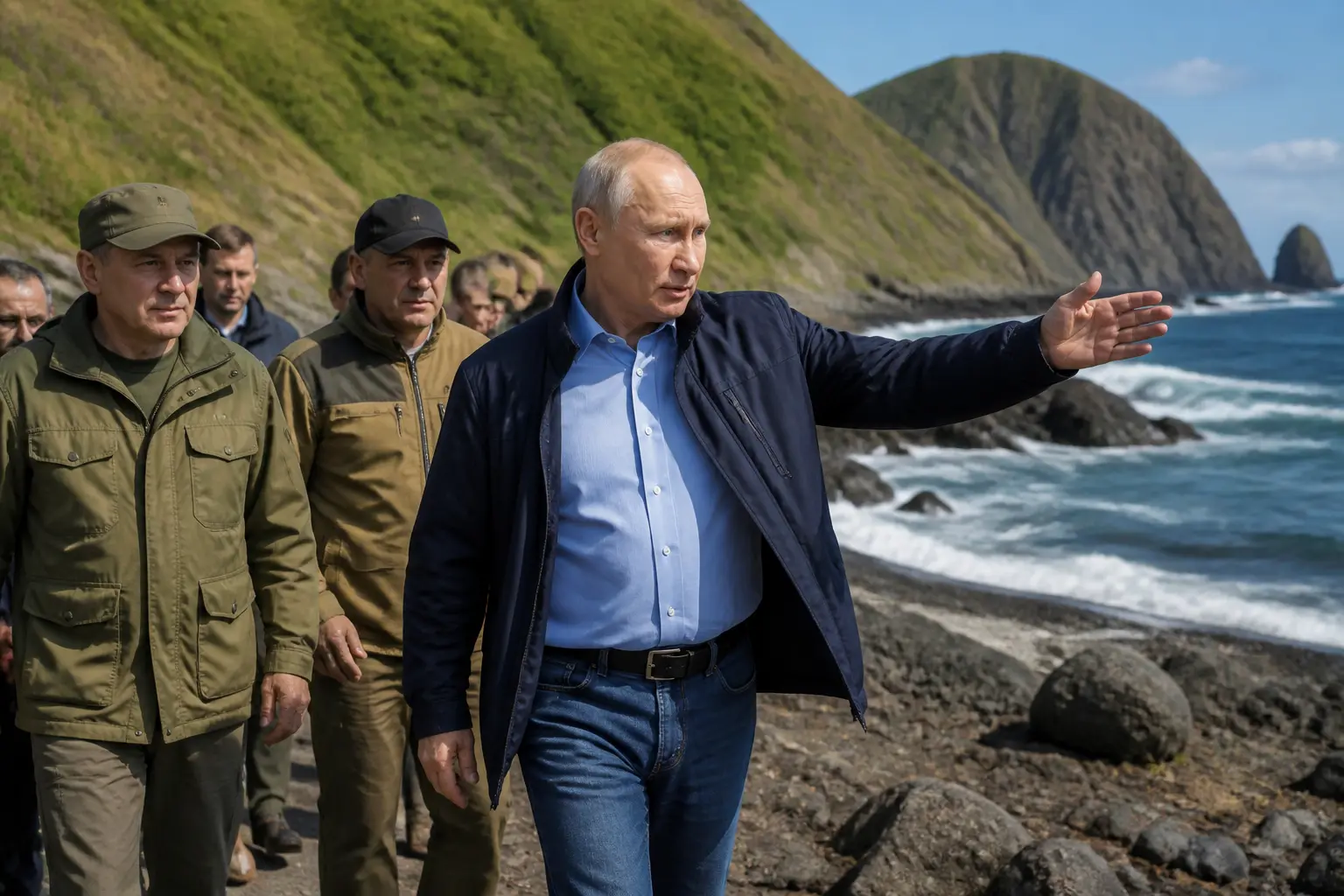
- Informal meetings and photos with Iturup residents in Kurilsk
In a Kremlin video clip he told locals, “What lovely weather you have there, just like a resort!” The tone stayed light. The message stayed heavy: the president of Russia walks the ground Japan calls its own.
Very delicious.
That was Putin’s reported verdict on the local caviar, captured in footage that Russian accounts circulated as a sovereignty flex.
Each stop carried administrative weight beyond the camera shot. A fish plant shows commercial continuity. A hospital and a named school show civilian infrastructure under Russian administration. Informal photos with residents in Kurilsk show a settled population, not a temporary garrison. Taken together, the itinerary presented ordinary governance rather than a military parade, which is precisely why Tokyo read it as a sovereignty claim in civilian clothing.
State media’s insistence that this was a first working trip mattered as much as the itinerary. Previous Russian leaders had visited the chain. None arrived with Putin’s accumulated personal authority after the complete rupture of the diplomatic track that once kept the dispute in a managed freeze.
Tokyo’s Immediate and Familiar Protest
Japanese Prime Minister Sanae Takaichi called the visit “absolutely unacceptable” and said it “hurts the feelings of the Japanese people.” Foreign Minister Toshimitsu Motegi stated that the Northern Territories, including Etorofu (Iturup), “are Japan’s inherent territory both historically and from the perspective of international law.” Motegi summoned Russian Ambassador Nikolai Nozdrev and demanded he report the protest to Moscow.
Key reactions in hours:
- Takaichi: visit offends Japanese sentiment and goes against Japan’s consistent position
- Motegi: strong protest; islands inherent Japanese territory
- Russian Foreign Ministry spokeswoman Maria Zakharova: Takaichi’s words “cause extreme outrage and are absolutely unacceptable”
- Russian embassy in Tokyo: islands integral part of Russia on legitimate international grounds; president’s travel not subject to foreign discussion
Former President Dmitry Medvedev posted that the islands “were, are, and will remain Russian land” and warned of “monstrous consequences” for anyone who fails to understand. The exchange followed the script written decades ago. Only the tone has grown blunter since Japan joined Western sanctions after Russia’s 2022 invasion of Ukraine.
The speed of the protest matched the familiarity of the language. Tokyo restated inherent title under history and international law. Moscow restated continuous administration and rejected any foreign say over presidential travel. Medvedev’s warning added a sharper edge, but the structure of the exchange has not changed for years. What has changed is the absence of any parallel channel in which the two sides still bargain over wording, visits, or economic side deals.
Japan’s tools remain diplomatic: public condemnation, a summoned ambassador, and the annual calendar of remembrance. Those tools document a claim. They do not alter who staffs the hospital, runs the fish plant, or walks the school corridors on Iturup.
Why These Four Islands Still Matter
The disputed group sits at the southern end of the Kuril chain, separating the Sea of Okhotsk from the Pacific and lying just off Hokkaido. Japan calls them the Northern Territories and excludes them from the Kurils proper. Russia administers them as part of Sakhalin Region. Roughly 20,000 Russian citizens live there in a harsh climate. After 1945 the Soviet Union deported about 17,000 Japanese residents.
| Island (Russian / Japanese) | Status in dispute | Key features | |
|---|---|---|---|
| Iturup / Etorofu | Largest, primary military air base | Fish processing, S-300 systems, Bastion missiles | |
| Kunashir / Kunashiri | Closest to Hokkaido | Bal anti-ship missiles, barracks | |
| Shikotan | Smaller, offered in 1956 deal | Fishing, limited infrastructure | |
| Habomai group | Islets, offered in 1956 deal | Strategic straits control |
The islands hold rich fishing grounds, mineral deposits including gold, silver and rhenium, and unconfirmed energy prospects. Their straits give the Russian Pacific Fleet year-round access routes that do not freeze. Control also creates a forward barrier for the Sea of Okhotsk nuclear submarine bastion.
Those interests stack rather than compete. Fishing and minerals give an economic reason to hold the ground. Ice-free straits give the Pacific Fleet operational reach it would otherwise lack in winter. The submarine bastion gives the islands a nuclear-forces logic that outranks local commerce. Japan’s claim runs on history and law. Russia’s hold runs on population, administration, and force posture. The gap between those two logics is why summit language never closed.
- Fishing grounds and mineral deposits, including gold, silver and rhenium
- Unconfirmed energy prospects under and around the islands
- Year-round fleet access through straits that do not freeze
- A forward barrier shielding the Sea of Okhotsk submarine bastion
Geography hardens the standoff. The group lies just off Hokkaido, close enough for Japan to treat every deployment as a near-home threat, and far enough under Russian control that Tokyo has no practical lever short of a crisis neither side has sought. Roughly 20,000 Russian citizens now form the human fact on which administration rests, after the postwar deportation of about 17,000 Japanese residents removed the prior demographic base.
The History That Never Produced a Treaty
Japan’s position rests on discovery, continuous control and the 1855 Treaty of Shimoda, which set the boundary north of Etorofu. The 1875 Treaty of Saint Petersburg later traded the full chain to Japan for southern Sakhalin; Japan regained southern Sakhalin after 1905. The Soviet Union occupied the four islands between late August and early September 1945, after Japan had accepted the Potsdam Declaration. Moscow incorporated them unilaterally and deported the Japanese population by 1949.
- 1855: Treaty of Shimoda confirms Japanese control of the four southern islands
- August-September 1945: Soviet forces occupy the islands after Japan’s surrender announcement
- 1951: San Francisco Peace Treaty; Japan renounces “Kuril Islands” but Soviets do not sign; Japan argues the four are not included
- 1956: Japan-Soviet Joint Declaration ends state of war; Soviets promise Habomai and Shikotan after a peace treaty
- 1993-2019: Tokyo and Moscow declarations and summit attempts under Yeltsin, Putin and Abe fail to close the gap
- 2022 onward: Japan sanctions Russia over Ukraine; Moscow freezes peace-treaty talks and visa-free visits
Japan’s official Northern Territories overview lays out the claim in detail and notes U.S. support for Japan’s position. Russia cites Yalta, the results of World War II and continuous administration. No peace treaty has ever been signed.
The 1956 joint declaration remains the closest the two sides came to a partial formula. It ended the state of war and recorded a Soviet promise to transfer Habomai and Shikotan after a peace treaty. The larger islands stayed outside that offer. Later summit rounds under Yeltsin, Putin and Abe tested variants of the same gap and left it intact. Japan never accepted a two-island outcome as full settlement. Moscow never accepted that the four southern islands fall outside the Kurils renounced in San Francisco, a treaty the Soviets did not sign.
From 2022 the residual machinery stopped. Sanctions met a freeze on peace-treaty talks and the end of visa-free visits for former residents. The legal file did not change. The political will to keep the file open did.
The Militarized Reality on the Ground
Since the mid-2010s Russia has turned the southern Kurils into a fortified zone. Deployments include Bastion coastal defense systems on Iturup capable of threatening much of Hokkaido, Bal systems on Kunashir, Tor and later S-300V4 air defenses, barracks for thousands of troops of the 18th Machine-Gun Artillery Division, and expanded airstrips. Satellite imagery and official announcements track the build-up close to Japanese waters.
A documented Russian military build-up accelerated after Crimea and again after 2022. Moscow’s maritime doctrine explicitly lists protection of the Kuril straits “by all means.” Joint Russia-China naval activity in the region has grown, and Beijing has shifted from historical sympathy for Japan’s claim toward firm alignment with Moscow on sovereignty questions. The islands now function as a strategic role as Sino-Russian bulwark that complicates any Japanese response in a Taiwan contingency.
Crowd reaction on X treated the caviar tasting and school tour as deliberate theater. Russian-aligned accounts celebrated a 26-year presidential first. Japanese and Western voices noted the timing with North Korean missile activity and U.S.-South Korea drills, reading the trip as coordinated pressure rather than a local inspection.
The hardware map is straightforward when set beside the island list:
- Iturup: Bastion coastal defense, S-300 systems, primary military air base, expanded airstrips
- Kunashir: Bal anti-ship missiles, barracks, position closest to Hokkaido
- Force backbone: thousands of troops of the 18th Machine-Gun Artillery Division
- Layered air defense: Tor systems and later S-300V4
Doctrine matches the deployments. Protection of the Kuril straits “by all means” is written into maritime policy, not left as an informal preference. Joint Russia-China naval activity adds a partner dimension that Japan cannot peel away with bilateral protest alone. Beijing’s move from historical sympathy for Japan’s claim toward alignment with Moscow on sovereignty removes a diplomatic pressure point Tokyo once hoped to use.
How the Calendar Sharpened the Message
The visit did not occur in a blank week. It followed naval drills on nearby Sakhalin and landed two days before Japan marks the anniversary of its World War II surrender. That sequence converted a territorial inspection into a timed political signal.
Sakhalin drills showed active force presence in the same theater. The Iturup working day then placed the president inside the disputed zone itself. The surrender anniversary supplied a Japanese audience already primed to hear historical grievance. Russian state media’s label of a first working trip locked the narrative as precedent rather than routine.
None of those elements required a new legal claim. Occupation since 1945, administration inside Sakhalin Region, and the post-2022 freeze already defined the status quo. The calendar simply made the status quo harder to ignore in Tokyo and easier to celebrate in Russian-aligned channels that treated caviar footage as proof of normal life under Russian rule.
Japanese and Western voices on X linked the timing to North Korean missile activity and U.S.-South Korea drills. That reading casts the trip as one pressure point among several in a busy regional week. Even without coordination, the overlap raised the cost of treating the day as a local story alone.
What Sanctions Closed and China Holds Open
Japan’s decision to join Western sanctions after the 2022 invasion of Ukraine did not create the territorial dispute. It did strip away the buffers that once kept the dispute negotiable in form even when it was frozen in substance.
| Channel | Before the rupture | After 2022 |
|---|---|---|
| Peace-treaty talks | Intermittent summit track under multiple leaders | Frozen by Moscow |
| Visa-free visits | Available to former residents | Ended |
| Economic cooperation | Discussed as a possible softener | Dead |
| Chinese posture | Historical sympathy for Japan’s claim | Alignment with Moscow on sovereignty |
Putin framed Japan’s sanctions as unprovoked and insisted Russia threatens no one while Japan holds territorial claims. That framing turns Japanese protest into evidence of hostility rather than a legal reservation. Once talks, visits, and economic projects are off the table, a presidential tour of a fish plant and school becomes the available language of policy.
China’s backing completes the box. Multilateral pressure on Moscow once depended, in part, on Beijing’s willingness to keep some distance from the sovereignty question. Firm alignment removes that residual leverage. Japan still holds U.S. support for its position, recorded in its official Northern Territories overview. Support for a claim is not the same as a mechanism to reverse administration, population, or missile deployments on Iturup and Kunashir.
The practical map is therefore simple. Russia holds the ground, the straits, and the partner. Japan holds the protest record, the historical file, and allied diplomatic backing. The August 13 itinerary did not invent that imbalance. It displayed it without the old cushion of suspended talks.
What the Visit Locks In
Putin framed Japan’s sanctions as unprovoked and insisted Russia threatens no one while Japan holds territorial claims. The practical effect of the August 13 trip is simpler. A sitting Russian president has now personally inspected the facilities, met the people and sampled the products of an island Japan still lists as inherent territory. Previous Russian leaders visited; none carried Putin’s personal weight or arrived after the complete rupture of post-2010s diplomacy.
Peace-treaty talks are frozen. Visa-free visits for former residents are gone. Economic cooperation is dead. China’s backing removes any residual multilateral pressure on Moscow. Japan can continue to protest, summon ambassadors and mark Northern Territories Day. It cannot change the facts on Iturup. The second-order result of Ukraine, sanctions and the no-limits partnership with Beijing is a Pacific frontier that looks permanent. Putin’s day of caviar and school corridors made that permanence visible.
Visibility is the remaining currency. The hospital, the named school, the fish-processing line, and the casual weather remark all serve one administrative point: Russian governance is ordinary life on the island, not a temporary occupation awaiting a treaty. Tokyo’s language of inherent territory and international law continues without a matching presence on the ground. Between those two conditions, the working day on Iturup stands as a finished statement rather than an opening bid.