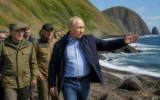
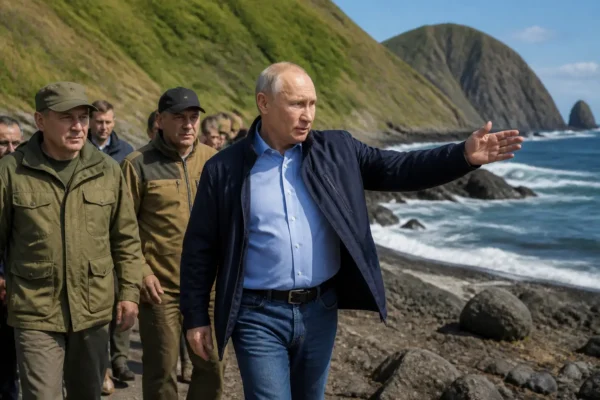
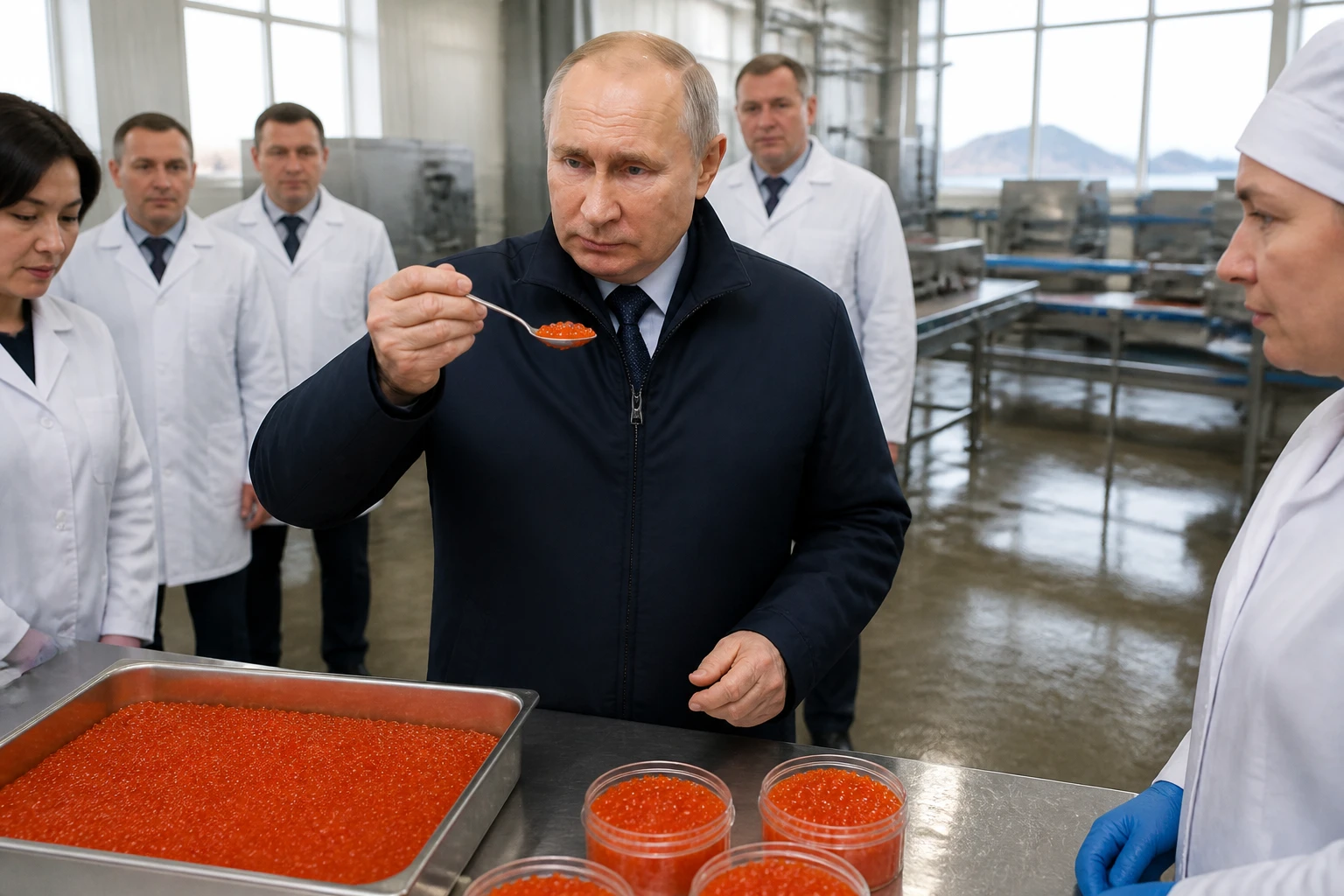
Russian President Vladimir Putin spent August 13 touring Iturup, one of four islands Japan calls the Northern Territories, sampling caviar at a fish plant and posing with residents. Tokyo immediately summoned the Russian ambassador and called the trip utterly unacceptable.
State media framed the stop as his first personal working visit to the Kuril chain after Pacific Fleet drills. The move fits a long Russian habit of showing physical control that has blocked a peace treaty for eight decades.
A Full Working Day on the Island
Putin flew into Iturup after watching naval exercises near Yuzhno-Sakhalinsk. Kremlin video showed him at the Yasny fish-processing complex, where he tasted different types of caviar and took some with him.
- Tour of the Yasny fish-packing factory and product sampling
- Stop at Kuril Central Hospital
- Visit to the secondary school named after Hero of Russia Eduard Norpolov, including its museum
- Meeting and photos with local residents
He told islanders, “What lovely weather you have there, just like a resort!” according to clips carried by Russian outlets and widely shared. TASS reported he visited the Yasny fish-packing factory as the centerpiece of the day.
Former president Dmitry Medvedev had been the first Russian leader to land there in 2010, returning as prime minister in 2015. Putin’s appearance closes the circle for the current leadership.
Tokyo Summons the Ambassador
Japanese Foreign Minister Toshimitsu Motegi reacted within hours. He summoned Russian Ambassador Nikolai Nozdrev and lodged a strong protest against this visit.
The Northern Territories are islands over which Japan has sovereignty and are an inherent territory of Japan. This visit is incompatible with Japan’s consistent position regarding the Northern Territories and is extremely regrettable.
Motegi added that the unilateral trip has an extremely negative impact on already strained Japan-Russia relations caused by Russia’s aggression against Ukraine and offends Japanese sentiments. It is utterly unacceptable.
Prime Minister Sanae Takaichi told reporters the visit hurts the feelings of the Japanese people and is absolutely unacceptable. She hoped Moscow would take the seriousness fully to heart. The Russian Foreign Ministry’s Maria Zakharova shot back that the comments caused extreme outrage and were themselves unacceptable. She insisted the islands form an integral part of Russia.
The Russian embassy in Tokyo replied that the president’s travels inside the country are solely a Russian matter. Medvedev posted that the islands were, are and will remain Russian land, warning of monstrous consequences for anyone who fails to understand.
Four Islands and Two Names
Japan claims Iturup (Etorofu), Kunashir (Kunashiri), Shikotan and the Habomai group as its Northern Territories. Russia administers them as the southern Kurils inside Sakhalin Region. Japan insists the four were never part of the Kurile Islands proper.
| Island (Russian / Japanese) | Key Feature | Claim Status |
|---|---|---|
| Iturup / Etorofu | Largest; military air base and fish plants | Russia controls; Japan claims |
| Kunashir / Kunashiri | Closest to Hokkaido; missile sites | Russia controls; Japan claims |
| Shikotan | Smaller; fishing focus | Russia controls; Japan claims |
| Habomai group | Islets near Hokkaido | Russia controls; Japan claims |
The chain as a whole holds roughly 20,000 people. Fishing and roe production dominate the economy. Iturup also holds rhenium deposits and hosts the headquarters of Russia’s 18th Machine Gun Artillery Division.
How the Claim Locked In After 1945
The modern dispute traces to the final days of World War II. Soviet forces occupied the four islands between late August and early September 1945, after Japan accepted the Potsdam Declaration. Japanese residents, about 17,000, were later deported.
- 1855: Treaty of Shimoda draws the border between Etorofu and Uruppu; Japan holds the four southern islands.
- 1875: Treaty of Saint Petersburg cedes all Kurils to Japan in exchange for Sakhalin.
- 1905: Portsmouth Treaty after the Russo-Japanese War leaves Japan with the Kurils and southern Sakhalin.
- 1945: Soviet occupation under Yalta understandings; Japan loses control.
- 1951: San Francisco Peace Treaty; Japan renounces Kurils but the Soviet Union does not sign and sovereignty is not recognized for Moscow.
- 1956: Japan-Soviet Joint Declaration ends the state of war; Moscow offers Habomai and Shikotan after a peace treaty that never comes.
Japan’s Foreign Ministry states the Northern Territories are an inherent territory of Japan that Russia illegally occupies. The United States has backed that view. Russia cites the Yalta Agreement and the results of the war. Britannica notes the dispute over ownership of the southernmost Kurils remains the main reason the two countries never signed a formal peace treaty after World War II.
Talks under various Japanese prime ministers and Russian presidents produced joint statements and a “new approach” after 2016, including ideas for joint economic activity. Progress stalled after Russia’s full-scale invasion of Ukraine in 2022. Japan joined Western sanctions. Summit momentum vanished.
Why the Islands Still Matter Strategically
Control of the southern Kurils gives Russia ice-free access from the Sea of Okhotsk into the Pacific. The strait between Kunashir and Iturup does not freeze. That route matters for the Pacific Fleet based at Vladivostok.
Russia has steadily militarized the islands. Bastion coastal missiles, Bal systems, S-300 air defenses and new barracks have appeared since the mid-2010s. Estimates put several thousand troops of the 18th division on Iturup and nearby. Construction of more than 50 military infrastructure pieces was announced in earlier years.
For Japan the islands sit just off Hokkaido. Resources include fisheries that once supported Japanese communities and potential energy deposits. Return of even two islands under the 1956 formula would open a path to a treaty and fuller economic ties that both sides once sought.
The visit landed two days before Japan marks the anniversary of its 1945 surrender and a day after a North Korean missile launch into nearby waters. Russian and Chinese ambassadors in Tokyo issued a joint statement opposing any revision of World War II results. The timing was not accidental.
Crowd Takes and On-the-Ground Signals
On X, video of Putin chatting with residents drew strong engagement from accounts sympathetic to Moscow. Many framed the trip as a reminder that Japan should remember who dropped atomic bombs rather than press territorial claims. Others noted the contrast between Putin tasting local roe while Ukraine absorbs Russian strikes.
Japanese voices and Western coverage treated the stop as a calculated snub. The pattern is familiar: each high-level Russian visit produces a protest, a Russian dismissal, and zero movement on the ground. Local residents on Iturup live under Russian administration, attend Russian schools and work Russian plants. Their daily reality undercuts Tokyo’s legal case in practice even as Japan keeps the claim alive in principle.
The Freeze That Outlasts Leaders
Every Russian leader since the Soviet era has treated the islands as settled territory. Every Japanese government has kept the Northern Territories as a national priority and a condition for a peace treaty. The 1956 offer of two smaller islands remains on paper. Joint economic projects floated in the 2010s never overcame the sovereignty gap.
Putin’s caviar stop and school tour add another data point to that record. Japan can protest and summon ambassadors. Russia can film its president walking the factories and chatting under clear skies. Neither step changes who flies the flag or who staffs the bases.
Relations sit at a post-war low because of Ukraine. Sanctions stay. Energy and investment talks stay frozen. The islands stay Russian in fact and Japanese in claim. That is the pattern the visit reinforces.