Polish prosecutors have charged a 36-year-old Georgian-passport holder with the murder of Russian satirical artist Semyon Skrepetsky, shot dead on June 15 in the eastern Polish town of Biała Podlaska. The arrest came within 72 hours of the killing. Polish Prime Minister Donald Tusk has called the death a likely “political murder.”
On the morning of June 15, Russian satirical artist Robert Kuzovkov, who worked under the pen name Semyon Skrepetsky, was shot in a car park in the eastern Polish town of Biała Podlaska, roughly 600 metres from the Belarusian consulate. The 44-year-old died at the scene. Polish prosecutors and the BBC said he was shot five times in the head, chest and back.
He was attacked in the morning. Marcin Kozak, a spokesperson for the District Prosecutor’s Office in Lublin, said an unidentified gunman approached the artist, fired two shots at him, then stepped closer after he fell and fired three more before fleeing on foot. Five shell casings and one Geco 9 mm Luger bullet were recovered from the crime scene. The killing took place in broad daylight in a public area, with witnesses saying the attacker approached the victim and opened fire. A post-mortem examination was scheduled for the day after the shooting.
Across the border in Russia, Kuzovkov had painted caricatures of politicians before leaving in 2021, citing fears of criminal prosecution. He left a wife and five children in Poland.
A 36-Year-Old Suspect With a Georgian Passport
Polish Prime Minister Donald Tusk wrote on X on June 18 that a suspect had been detained by Lublin police and the Internal Security Agency (ABW) in the killing. He said the man was carrying a Georgian passport. Polish Interior Minister Marcin Kierwiński confirmed the document at a Warsaw press conference and identified the suspect as a 36-year-old. The arrest took place that morning in Piastów, near Warsaw, with Polish media giving differing accounts of the precise location.
Prosecutors formally charged the man, identified only as Elnur A., with murder. He has not confessed. They said he had refused to provide explanations during questioning, and a court placed him in three months of pre-trial detention on concerns of flight risk and possible destruction of evidence. Polish authorities initially detained two Belarusian nationals, aged 33 and 37, near the Belarusian consulate, but later released them after no link to the killing could be established. Polish media report that Elnur A. speaks Azerbaijani and had previously lived in Poland.
Polish Officials Call It a “Political Murder”
Tusk spoke on Wednesday. He said the death “everything indicates… was a political assassination,” though he added that authorities were still compiling “evidence and more concrete findings.” He told Politico that “if it turns out that Russia was behind this attack, it would constitute an act of state terrorism.” His tone hardened on Thursday when he wrote on X that services are working to identify the mastermind.
At a Warsaw press conference, Kierwiński said the suspect was suspected of links to organized crime and was being connected by police to other crimes committed in Poland, including offences dating to 2022. He was 36. Minister-Coordinator of Special Services Tomasz Siemoniak said investigators “consider it possible that foreign intelligence services may have been involved.” He added: “Foreign services sometimes hire criminals to carry out operations. We have seen this in previous years. While those cases did not involve murder, criminals were hired to conduct assaults in other countries. We are therefore taking this possibility very seriously.” The Polish government has now framed the killing as both a criminal case and a foreign-influence probe.
Boroń was next. Poland’s Chief Police Commander Marek Boroń told reporters that police are now attempting to identify possible accomplices and trace the suspect’s contacts in Poland. “We know that he certainly did not act alone,” Boroń said.
Tusk escalated. On Thursday, his X post went further, labelling the death a political murder and warning that “if it was commissioned by Russia, then this is also a very serious matter with an international dimension.” Asked about who might have ordered the killing, Siemoniak said the hypothesis “is quite obvious and stems from the activities of the murdered Russian citizen. He was a critic of Putin and Kadyrov, and this was part of his professional activity, so at this stage no special evidence is needed for such a hypothesis.” Investigators are pursuing many different leads, starting with the suspect’s interrogation, the analysis of his correspondence and the tracing of his connections.
The European Pattern of Kadyrov Critics Killed Abroad
The pattern is documented. Skrepetsky’s killing fits a chain of Kadyrov-linked assassinations of dissidents on European soil, a sequence that began more than 17 years ago. Russian artists and commentators in exile have said the killing bore the hallmarks of an operation ordered by Kadyrov, who has built a highly personalised and repressive system in Chechnya. Investigators and human rights groups have linked Kadyrov’s associates to a string of attacks and assassination plots across Europe. The pattern has surfaced in at least four European countries, and the Polish government has not alleged state involvement in Skrepetsky’s case.
Several of those earlier attacks ended in conviction in European courts, and human rights groups have catalogued them across multiple jurisdictions. Others, like the killing of Skrepetsky, remain at the stage of a single suspect in custody. The four most prominent cases span four European countries and stretch from Austria to Poland. In chronological order, they are:
- January 13, 2009: Umar Israilov, Kadyrov’s former bodyguard, shot dead in Vienna.
- August 23, 2019: Zelimkhan Khangoshvili, shot in central Berlin.
- February 4, 2020: Imran Aliev, a Chechen blogger known as Mansur Stary, stabbed in his flat in Lille.
- June 15, 2026: Robert Kuzovkov (Semyon Skrepetsky), shot in Biała Podlaska, Poland.
The pattern is the same. Polish authorities have not yet alleged state involvement in Skrepetsky’s death, only that foreign intelligence services may have been involved, an unusually direct formulation from a sitting government. A deeper look at how Kadyrov’s regime has pursued critics in Europe shows a network of crime-linked figures placed across the continent, ready to act on orders from Chechnya. Siemoniak in Warsaw described the same approach in a single sentence: foreign services sometimes hire criminals to carry out operations.
A Public Footprint in the Days Before the Killing
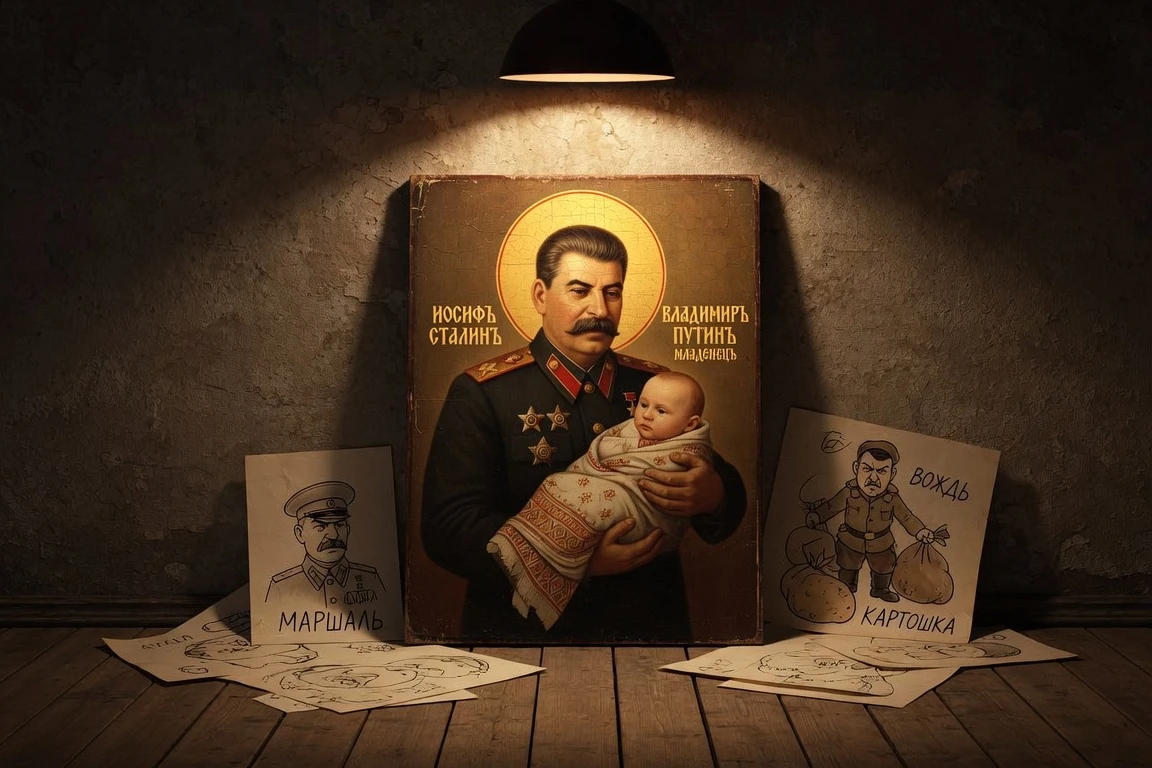
Three days before his death, Skrepetsky travelled to Berlin for Russia Day on June 12 and staged a protest outside the Russian embassy, video posted on social media shows. He carried a painting of Putin cradled in the arms of Soviet dictator Joseph Stalin, and a Russian flag tied to the back of his trousers that dragged along the road. On June 14, the day before the killing, he published a drawing of Ramzan Kadyrov and his son Adam with pig snouts, ears and hooves, after Adam was awarded the renewed title of Hero of Chechnya. Hours before the attack, he warned his Telegram followers. He wrote that he had received threats from “Russian patriots,” and posted a screenshot of one threat allegedly made in the name of Kadyrov and Putin. His work spanned a wider range of Russian and post-Soviet political figures, and across his Telegram and YouTube channels his most-shown caricature subjects also included:
- Belarusian leader Alexander Lukashenko as Adolf Hitler with a bucket of potatoes
- Russian opposition figure Alexei Navalny
- Ukrainian president Volodymyr Zelenskyy
- Ordinary Ukrainians
His address was leaked. His address in Biała Podlaska had been published online shortly before the killing, first on a website presenting itself as a Ukrainian project exposing pro-Russian propaganda, then on the Myrotvorets (“Peacemaker”) site, according to the Russian outlet iStories. A friend, Bulat Subkhankulov, told the BBC he had repeatedly warned Skrepetsky: “they’re going to come for you, they’re going to come for you… Please be prepared, always stay alert.” “Eventually I realised there was no point. That’s just the kind of guy he was: completely reckless and stubborn,” Subkhankulov said.
The murder of an artist is a terrible event. I hope there will be an investigation, although I’m almost certain it was one Chechen “Don”.
Why Poland Says the Stakes Are International
He wrote online. Marat Gelman, a prominent Russian art collector living abroad, posted those words on social media, with the “Don” a reference to Kadyrov’s trademark honorific. In the days since the killing, several Russian émigrés have made the same case, and Kadyrov has been accused by investigators and human rights groups of pursuing critics beyond Russia’s borders, with his associates linked to attacks across Europe.
It is documented. Across the border in Poland, the case is being read as a hybrid of criminal and foreign-influence probe, with Russia’s role as a hub for military supplies to Ukraine making the country a target for spies and saboteurs. The Caucasus influence context is well documented: the US Caucasus influence bill targeting Russian and Chinese intelligence recently passed the House, mandating a report on Russian intelligence activity in Georgia. The suspect’s Georgian passport puts a fresh data point on that map. Siemoniak on Thursday stopped short of naming any state behind the killing, but said the working hypothesis was “quite obvious” given Skrepetsky’s criticism of Putin and Kadyrov.
On Thursday, Polish officials said the Internal Security Agency and police had repeatedly contacted Skrepetsky, warning that the threats against him were serious and offering him protection, which he declined. “We have the main suspect, and undoubtedly his interrogation, the analysis of his correspondence and the analysis of his connections will provide answers to these questions,” Siemoniak said. The Lublin prosecutor’s office now holds the file.