Tbilisi has cleared a private developer to demolish the Rike Concert Hall, the Fuksas-designed auditorium that has sat empty on the Kura River for fourteen years. The permit, confirmed by Tbilisi City Hall on July 13, gives the owner until December 25, 2026 to finish the job.
The building cost roughly 40 million euros in public money and was meant to announce Georgia’s pivot toward Europe. It has never hosted a single concert. Mayor Kakha Kaladze, a former AC Milan defender who now runs Tbilisi for the Georgian Dream party, calls the demolition a simple private property matter.
The Cultural Heritage Council Signs Off
Tbilisi City Hall’s Architecture Service approved the demolition plan in late June, after Georgia’s Cultural Heritage Protection Council gave it a positive assessment. City Hall made the permit public on July 13, alongside the December 25 deadline for finishing the work.
Locals call the building the Rike Tubes, or sometimes the Rike Jugs, for its shape: two curved, tubular metal volumes joined by a shared structure built into Rike Park’s retaining wall. Studio Fuksas designed and built it between 2010 and 2012. The northern tube holds a 566-seat auditorium, a foyer, and backstage space. The southern one was meant as an exhibition hall, entered by a long ramp. The architects described the raised foyer as a kind of periscope, framing views of Old Tbilisi’s hillside across the river.
The complex sits on a 14,591-square-meter plot beside the Kura River, at the edge of one of Tbilisi’s most visited parks. Heritage advocates have been flagging Tbilisi’s demolition habits for years, pointing to listed buildings bulldozed despite official protection.
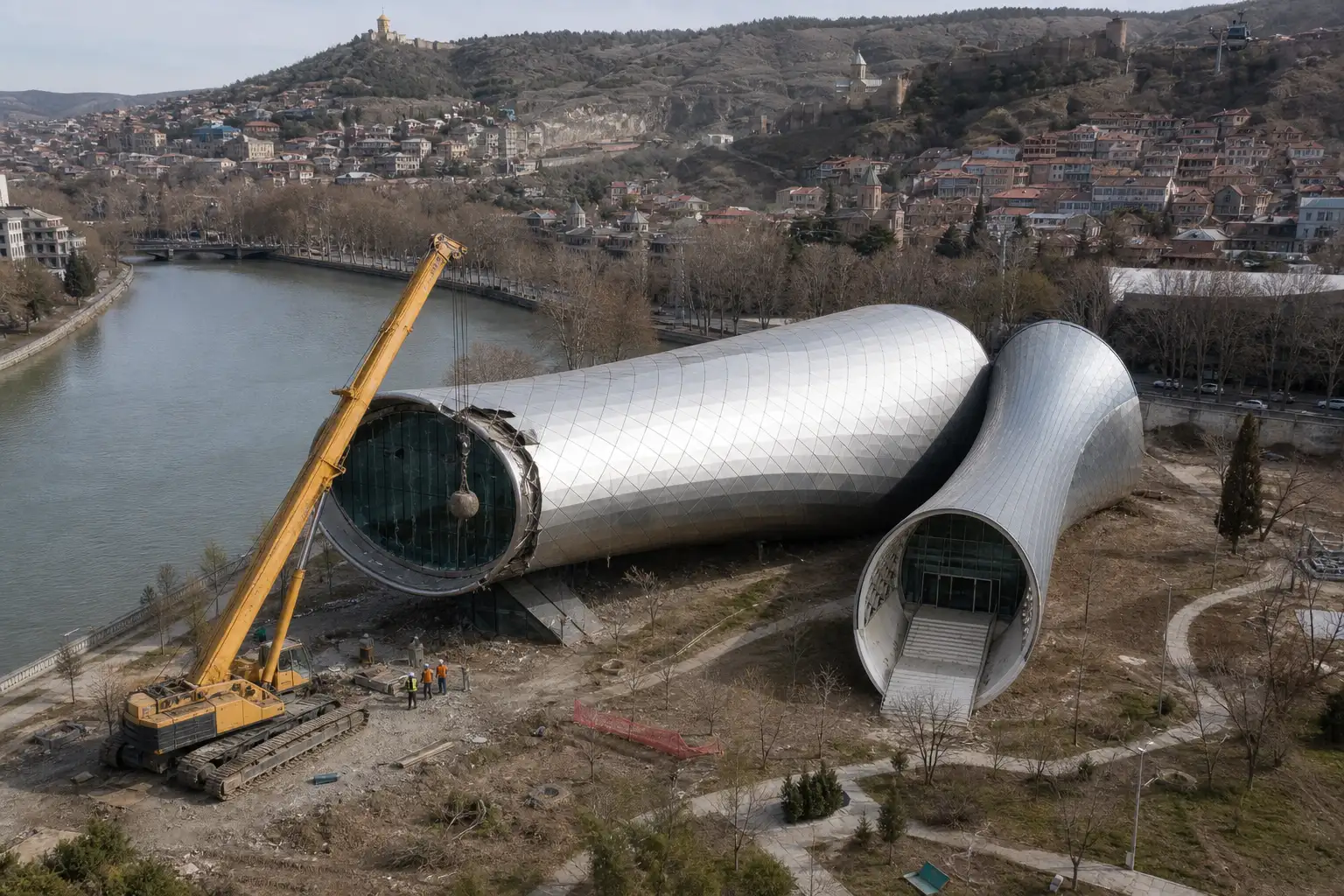
Why Does Tbilisi’s Mayor Call It a Dump?
Kaladze says the hall became unsafe and unusable after fourteen years of neglect, and that a teenager’s accidental death on the site in January 2025 forced the issue. Critics counter that the ruling party wanted this particular landmark gone long before anyone got hurt.
Kaladze told the Georgian newspaper Inter Press News the hall had become “a garbage dump, one might say, in a very bad condition.” He said the building was “functionally unjustified” and that the private owner had decided on its own to tear it down.
The mayor’s language hasn’t shifted much since May 2025, when he first floated demolition after the teenager’s death. Prime Minister Irakli Kobakhidze weighed in that same month, telling reporters the building’s ugliness did the capital no favors. Neither man dwelled on the hall’s origins as a showcase of Georgia’s westward ambitions under former president Mikheil Saakashvili, whose United National Movement lost power in 2012, the same year construction wrapped.
Opposition figures have already taken bigger complaints about the current government to Brussels, appealing to the EU after Kavelashvili’s election to the presidency last year.
Ownership Runs Through Georgian Dream’s Orbit
That single word, private, covers a chain of ownership Georgian outlets have spent the past year trying to untangle.
The state finally sold the site in 2022, after six failed auction attempts, for 10.02 million lari, according to the Tbilisi-based outlet Georgia Today. The buyer was Global Victory Trust, a company owned by Davit Khidasheli, described by Georgian media as a businessman close to Georgian Dream founder Bidzina Ivanishvili. Under those 2022 terms, Khidasheli had to invest at least 20 million lari and build a museum devoted to wine, digital art and technology within three years. That museum was never built.
Khidasheli sold the property in 2025, telling reporters his own project had stalled because of what he called an “unstable investment climate” in Georgia. Control passed to Rike Dom, whose director, Mikheil Tkeshelashvili, also works inside the office of Georgia’s Business Ombudsman, a government post meant to mediate between the state and private investors.
What We Know
- Rike Dom LLC, tied to developer Maqro Property, has held the site since 2025 and must invest at least 44 million lari under revised terms.
- Davit Khidasheli, the previous owner, is described by Georgian outlets as close to Georgian Dream’s founder and has also surfaced as a witness in Georgia’s border dispute with Azerbaijan.
What’s Unconfirmed
- The NGO Civil Participation Center alleges Rike Dom’s director manages business shares belonging to Georgian Dream MP Giorgi Barvenashvili.
- The construction firm Archi Group denies any connection to the property, after a separate ownership claim named one of its financial managers.
Here’s how the price and terms shifted as the site changed hands.
| Year | Owner or Event | Price or Terms | Outcome |
|---|---|---|---|
| 2012 | Tbilisi city government | About 40 million euros in construction costs | Building completed, never opened to the public |
| 2022 | Global Victory Trust (Davit Khidasheli) | 10.02 million lari, after six failed auctions | Required to invest 20 million lari and build a museum; never completed |
| 2025 | Rike Dom LLC (Maqro Property) | Required to invest at least 44 million lari | Hotel project announced; no design filed yet |
| 2026 | Demolition permit issued | Not applicable | Deadline of December 25 to complete demolition |
No public tender has followed since the Cultural Heritage Protection Council signed off, and Rike Dom has not said who its ultimate owners are beyond Tkeshelashvili’s name on the paperwork.
Kutaisi Wrote This Script First
Georgian Dream has left other Saakashvili-era landmarks to rot instead of renovating them. Ten years after construction began, Saakashvili’s showcase parliament building in Kutaisi stands all but abandoned, according to Radio Free Europe/Radio Liberty. Georgian Dream moved the legislature’s real business back to Tbilisi almost as soon as it won power in 2012, the same year the Rike hall was completed.
The parliament project began by dynamiting a Soviet-era war memorial, killing two civilians in the blast. In 2021, Georgian Dream had that memorial’s bronze horseman pulled from storage and installed on a new plinth. The reinstalled monument now faces the parliament building that replaced it.
Georgia’s early-2000s building boom produced several other landmarks that still divide opinion:
- Kutaisi Parliament: a glass-domed legislature building Georgian Dream stopped using within its first term, largely empty a decade later.
- Bridge of Peace: a glass-and-steel pedestrian span across the Kura in Tbilisi, still open and still nicknamed for its unfortunate resemblance to a sanitary pad.
- Public Service Hall: another Studio Fuksas project in Tbilisi, finished around the same time as the concert hall, still functioning as a government building today.
- Rike Concert Hall: never opened, now scheduled for demolition by December 25.
The Italian design magazine Domus has already asked what happens to landmark architecture once the political project behind it ends. One Georgian architecture critic went further, telling the magazine that abandoning state-funded buildings whenever government changes hands wastes public money no matter what anyone thinks of the design. Foreign critics had catalogued Saakashvili’s buildings as vanity projects years before Georgian Dream targeted this one. The pattern fits a wider trend: Georgia’s prosperity score keeps climbing even as its freedom score keeps sliding, per one index tracking both.
Fuksas Asks for a Conversation That Never Came
Studio Fuksas, the Rome-based practice founded by Massimiliano and Doriana Fuksas, spent the past year trying to reach Tbilisi’s government and the hall’s owners. Nobody answered.
“Over the past months, the studio repeatedly offered to work with the Georgian authorities to explore alternative solutions that could preserve and repurpose this iconic building, avoiding what we believe would be a premature and irreversible demolition,” the firm said in a statement sent to the design outlet Dezeen. “Unfortunately, these proposals have received no response.”
The studio also disputes the economics. It says the hall was built with public money and that tearing it down will cost more than fixing it up. In more than sixty years of practice, the firm said, this is the first time it has faced the demolition of one of its own buildings without ever being invited to discuss alternatives.
Tbilisi still has the opportunity to transform an unfinished project into a symbol of regeneration, innovation and international openness.
The studio’s founders wrote that in their statement, urging the city not to waste it. Even as one concert hall heads for the wrecking crews, Russian performers have kept filling other Tbilisi stages, part of a cultural push that has arrived through concerts rather than diplomats.
No design has been filed for whatever replaces the Rike Tubes. A hotel remains the only idea anyone has floated publicly. The building that was supposed to announce Georgia’s future now has a firm date for its own end: December 25, 2026.
Frequently Asked Questions
Why Was the Rike Concert Hall Never Opened?
Georgia’s government changed hands in October 2012, just as construction wrapped, and the incoming Georgian Dream administration shelved the opening indefinitely. Even Salome Zourabichvili, a pro-European president who served from 2018 to 2024, never revived the project during her time in office.
What Was Originally Planned for the Site Before the Hotel?
When the state first sold the property in 2022, the winning bidder had to invest at least 20 million lari and build a museum dedicated to wine, digital art and technology within three years, according to Georgia Today. That museum was never built, and the terms were later rewritten around a hotel instead.
Has Studio Fuksas Built Anything Else in Georgia?
Yes. The Rome-based firm also designed Tbilisi’s Public Service Hall, a government building completed around the same time as the concert hall. Unlike the Rike Tubes, the Public Service Hall opened on schedule and remains in daily use.
What Do Locals Call the Building?
Tbilisi residents nicknamed it the Rike Tubes or the Rike Jugs, sometimes the Rike Docks, references to its two curved, tube-shaped volumes on the riverbank.