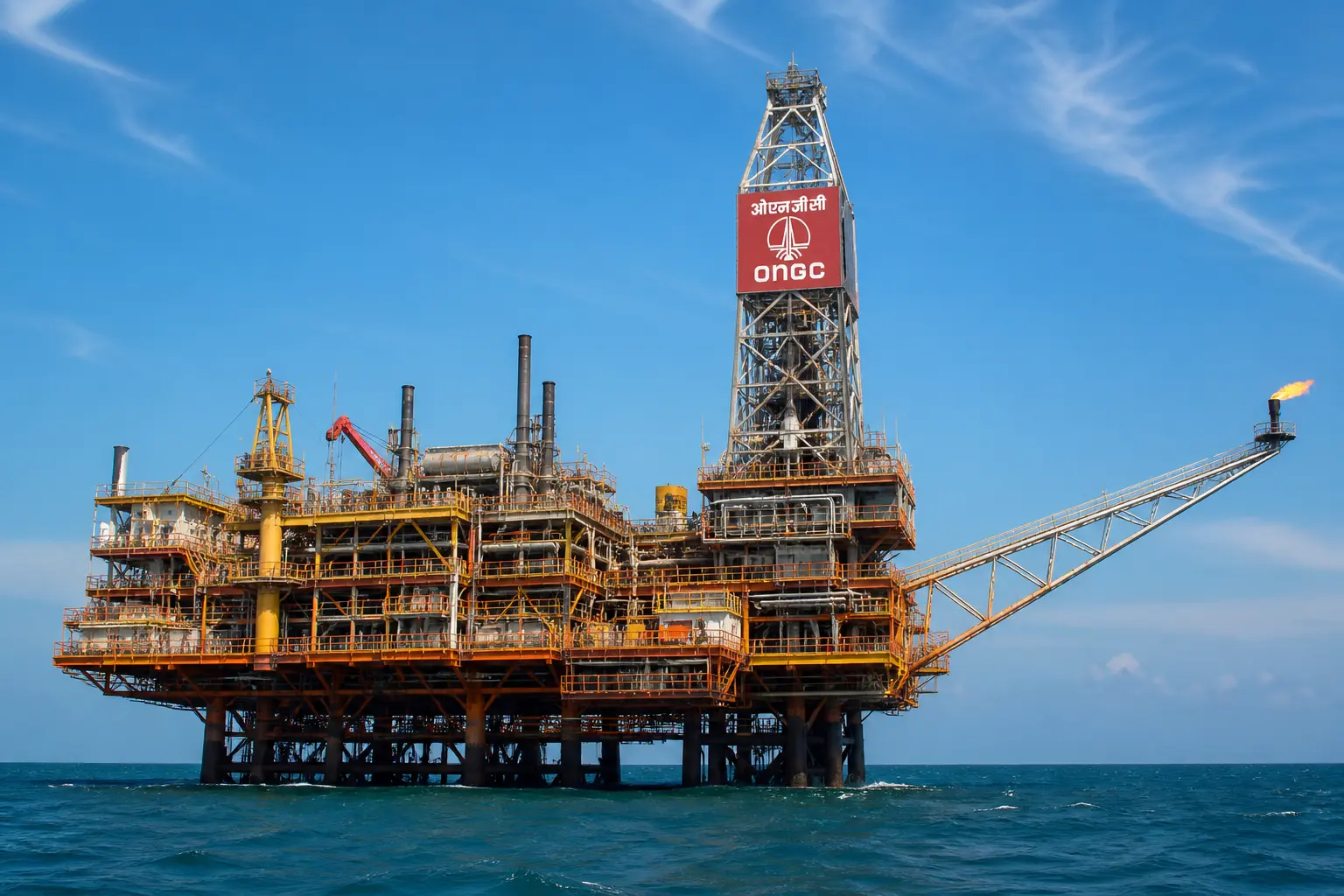
ONGC’s standalone net profit more than doubled to ₹17,034 crore in the quarter ended June 2026 as crude realisations jumped more than 50 percent and new-well gas prices soared, more than offsetting a modest production dip. Revenue climbed 45 percent to ₹46,460 crore and the explorer posted its highest-ever quarterly profit before tax of ₹22,848 crore.
The windfall arrived courtesy of the same Middle East disruption that forced India to lean harder on Russian barrels and left refining subsidiary HPCL with a multi-thousand-crore loss. Higher prices gave the state giant the cash to push strategic storage and the biggest Western Offshore redevelopment programme in years.
Standalone Numbers Hit a Fresh Peak
Net profit rose 112.3 percent from ₹8,024 crore a year earlier and 156 percent from the March quarter. Gross revenue reached ₹46,460 crore. Operational EBITDA more than doubled sequentially to ₹28,355 crore, lifting the margin to 61 percent from 35 percent.
| Metric (Standalone) | Q1 FY27 | Q1 FY26 | Change |
|---|---|---|---|
| Net Profit | ₹17,034 cr | ₹8,024 cr | +112% |
| Gross Revenue | ₹46,460 cr | ₹32,003 cr | +45% |
| Crude Realisation (nominated) | $99.45/bbl | $66.13/bbl | +50.4% |
| Crude Production | 4.452 MMT | 4.683 MMT | -4.9% |
| Gas Production | 4.756 BCM | 4.846 BCM | -1.9% |
The board recorded the highest quarterly PBT on record. Shares closed near ₹242 after the release.
Price Windfall From a Disrupted Market
Crude oil net realisation from nominated fields climbed 50.4 percent year on year to $99.45 per barrel. Joint-venture fields fetched $103.34, up 52 percent. New-well gas prices rose 61.5 percent to $13.31 per mmBtu and generated ₹3,998 crore of revenue, including an incremental ₹1,897 crore over administered prices. That stream now accounts for roughly 38 percent of nomination gas revenue.
- Brent in 2Q26: averaged $103 per barrel according to the U.S. Energy Information Administration, far above year-earlier levels after the Hormuz disruption.
- Rupee effect: a weaker currency further lifted rupee realisations on every dollar of oil and gas sold.
- Legacy vs new gas: legacy fields still rose 5.4 percent in earnings while deepwater and new-well volumes delivered the bigger percentage lift.
The Brent averaged 103 dollars a barrel in the second quarter as the U.S.-Iran conflict throttled Persian Gulf flows for months. Prices have since eased after a June memorandum of understanding, yet the April-June average locked in the windfall for ONGC.
Production Held Near Flat While Projects Catch Up
Standalone oil and gas output stayed roughly level with the strong March quarter but slipped versus a year earlier. Crude fell to 4.452 million tonnes and gas to 4.756 billion cubic metres. Company statements list several temporary factors rather than a permanent collapse of the resource base.
- Reservoir complexities at the KG-98/2 block in the Eastern Offshore.
- Inclement swell in the Western Offshore in April and May that delayed pipeline replacement work.
- Temporary well closures during pre-commissioning of major projects.
- Lower offtake from small isolated fields after disruptions at customer facilities.
Management said Western Offshore momentum from the prior quarter provides a base for growth. Benefits from more than ₹40,000 crore of projects under implementation, including the bp technical services programme across the entire Western Offshore portfolio, are expected from FY28 onward.
HPCL Losses Cut the Group Result in Half
Consolidated net profit fell 43 percent to ₹6,554 crore. The drop was driven almost entirely by HPCL’s consolidated net loss of ₹12,265 crore. Other subsidiaries such as ONGC Videsh and MRPL contributed positively and consolidated revenue still rose 26 percent to more than ₹2 lakh crore.
The ONGC Group’s consolidated Profit After Tax for the quarter was significantly impacted by HPCL’s consolidated net loss of ₹12,265 crore, primarily on account of under-recoveries on petroleum products arising from the sharp increase in crude oil prices following the West Asia crisis.
ONGC said the statement itself. Downstream under-recoveries absorbed the consumer-facing pain while upstream captured the price spike. That transfer is the quiet arithmetic behind the mixed group print.
Import Dependence Made the Vulnerability Obvious
ONGC still supplies about two-thirds of India’s domestic oil and more than half its gas. The country nevertheless imports nearly 90 percent of the oil it burns and roughly half its gas. When the Middle East war disrupted crude and cooking-fuel flows, the thin buffer became impossible to ignore. Russian crude imports hit a record 2.8 million barrels per day in July and accounted for 55.5 percent of total Indian imports.
Earlier episodes when oil prices surged on Iran strikes and the broader global oil supply shock through Hormuz had already shown how quickly tanker routes and fuel availability can tighten. The June-quarter results arrived after that pressure had already reshaped buying patterns.
Cash Flows Straight Into Storage and Fields
ONGC is directing part of the surplus into security assets the government has requested. The company plans a 1.75 million tonne (roughly 13 million barrel) storage facility at Mangaluru, with half reserved for strategic stocks. India’s existing strategic petroleum reserves total 5.33 million tonnes, enough for only about nine and a half days of crude requirement on older consumption benchmarks. The new capacity will lift the national cushion.
The Ministry of Petroleum and Natural Gas has pushed for faster reserve build-out after the recent disruption. ONGC’s board approved the 1.75 MMT Mangaluru strategic expansion as the first time the explorer itself funds a strategic cavern project. Parallel capital is already flowing into Western Offshore redevelopment with bp as technical services provider, reservoir management, water injection upgrades and pipeline replacements.
- Late February 2026: conflict begins, Strait of Hormuz effectively closed, global inventories start large draws.
- April-June 2026: Brent averages $103, ONGC realisations peak, production dips on temporary operational hits.
- June 18 2026: U.S.-Iran memorandum of understanding signed, tanker traffic resumes, prices ease.
- July 2026: Russian crude imports set fresh record; ONGC board advances Mangaluru storage.
- August 2026: Q1 results released, highest-ever standalone PBT confirmed, project pipeline reaffirmed.
Two discoveries were declared in the quarter and the first deepwater exploratory well was spudded in the Mahanadi basin under the Samudra Manthan initiative. Management expects the production trajectory to improve once current projects start contributing.
The irony sits in plain numbers. The shock that revealed how few days of cover India held and how hard OMCs can be hit by under-recoveries is the same shock that handed the country’s main explorer the largest quarterly cash generation in its history. That cash is now being converted into caverns and offshore iron that will matter the next time tanker traffic stalls.