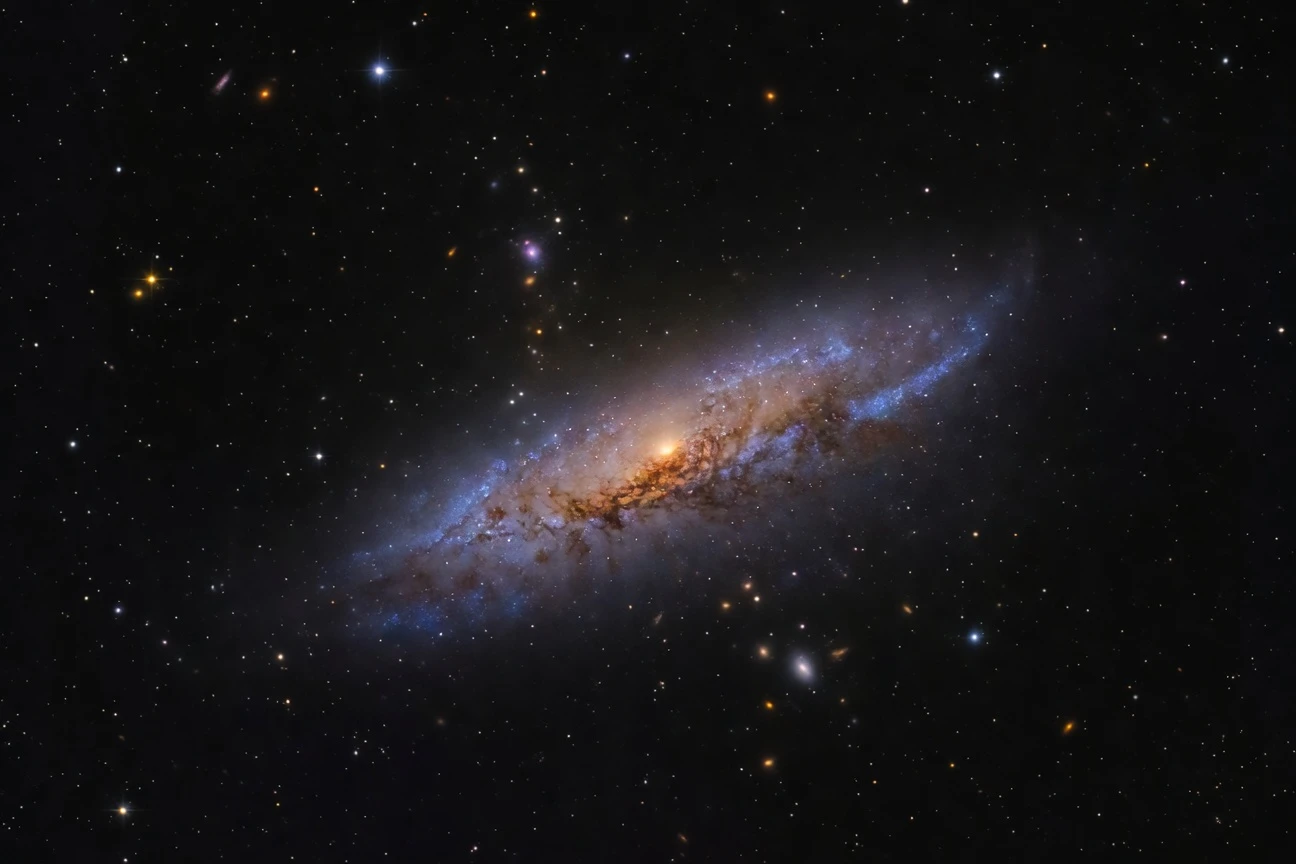
About 100 million light-years from Earth in the constellation Eridanus, NGC 1266 is dying in slow motion. The lenticular galaxy looks almost ordinary in the latest NASA Hubble Space Telescope release: a bright core, a tease of spiral structure that never resolves, brown dust draped across a flattened disk. The picture cannot show the violence underneath, where a black hole is blowing molecular gas out of the disk fast enough to starve the next generation of stars.
Astronomers have traced that outflow to a minor merger about 500 million years ago, the event that ignited the central black hole and turned the galaxy into one of the best living laboratories for a slow puzzle in cosmology: why some galaxies keep building stars while others quietly go dark.
Hubble’s Latest Look at a Galaxy That Stopped Growing
The new image, processed by K. Alatalo of the Space Telescope Science Institute and G. Kober of NASA Goddard and Catholic University of America, places NGC 1266 in front of a field of more distant galaxies that shine through its haze like scattered grains. You can find the full version in the latest Hubble release on NGC 1266.
At first glance, the galaxy reads as a spiral. The central bulge is bright, and the inner disk hints at arms. Look longer and the arms refuse to unfurl. Astronomers classify NGC 1266 as a lenticular galaxy, a category that sits between spirals and ellipticals: a recognizable disk of stars wrapped around a swollen core, with little of the gas-rich outer structure that gives true spirals their shape.
The release draws on Hubble data extending back to October 2023, layered with archival exposures from the Wide Field Camera 3. What sits on top of the disk is the most striking feature. Reddish-brown filaments of cold dust block light across the inner half of the galaxy, the visual signature of a system that still holds a serious reservoir of cool material. In an ordinary lenticular, that dust would be thin. Here it clumps and clouds.
Why Post-Starburst Galaxies Are a One-Percent Club
Galaxies in the post-starburst phase make up less than one percent of nearby systems, which is part of what makes NGC 1266 a prized target. The category names what it describes. The galaxy lived through a fast, intense round of star formation in the recent cosmic past, and then stopped. The young stars from that round are still glowing in blue and ultraviolet. The factories that made them are dark.
For comparison, the three galaxy types most often catalogued near the Milky Way break down like this:
| Type | Stellar disk | Spiral arms | New star formation |
|---|---|---|---|
| Spiral | Yes | Yes | High |
| Elliptical | No | No | Very low |
| Lenticular | Yes | No | Low |
| NGC 1266 (post-starburst lenticular) | Yes | Hint only | Suppressed by 50 to 150 times |
NGC 1266 sits in an awkward seat at that table. The shape says lenticular. The young stellar population says recent starburst. The cold-gas reservoir says spiral. Take any one feature in isolation and the galaxy looks like a different class.
That is why it matters. Astronomers want to know how gas-rich spirals transition into the red, quiet ellipticals that dominate massive clusters, and the transition runs fast enough in cosmic time that catching a galaxy in the middle of it is rare. Post-starbursts are the snapshots from the middle of that crossover. Most sit too far away for instruments like Hubble to resolve internal structure. NGC 1266 is close enough to show the dust.
A Collision 500 Million Years in the Rear-View Mirror
The trigger for everything strange about NGC 1266 is an event that finished in the deep past. Using Hubble data extending back to October 2023, researchers have traced the galaxy’s current state to a minor merger about 500 million years ago, when a smaller companion fell into the lenticular’s gravitational well and was pulled apart over several orbital passes.
A minor merger is the polite term for an unequal collision. The larger galaxy keeps most of its shape. The smaller one is shredded, its stars folded into the bulge and its gas funneled inward by gravitational torques. In NGC 1266’s case, that gas had two jobs. It fueled a sharp burst of new star formation that built up the central bulge, and it streamed down to the supermassive black hole at the galactic center, which had previously been quiet.
Researchers think the burst itself lasted only briefly in cosmic terms. Within tens of millions of years, the densest star-forming regions had either exhausted their cold gas or had it cleared out by the side effects of black-hole feeding. That is when the galaxy became a post-starburst object. The young stars from that single burst are still visible today, giving astronomers a stellar fingerprint precise enough to date the event with reasonable confidence.
The Black Hole Doing the Quenching
The active galactic nucleus (AGN, a supermassive black hole that is actively swallowing matter) ignited by the merger has done more to define NGC 1266 than any other single feature. Its accretion disk pours out enough radiation to outshine the rest of the host galaxy. NGC 1266’s AGN sits at the lower end of the luminosity scale, a long way from the runaway quasars of the early universe, yet it has reshaped its surroundings.
Very Long Baseline Array radio observations have pinned the black hole’s compact core to a diameter under 1.2 parsecs, with a high brightness temperature consistent with active accretion. A separate molecular disk, less than 200 parsecs across, sits around it. The combination is small in galactic terms and powerful in local terms.
Most of the AGN’s effect on the galaxy comes through mechanical energy rather than direct radiation. Winds and jets driven by the black hole push outward along the rotation axis, ramming into the cool molecular gas the collision left behind. Shock fronts compress and stir that gas. Some of it heats up. Some is launched out of the disk at hundreds of kilometers per second.
The result is a mass-loaded molecular outflow, first cataloged by a team led by Katherine Alatalo in a 2011 study. A follow-up using Gemini and SAURON integral-field spectrograph observations from the William Herschel Telescope mapped the outflow the next year, confirming that the gas being driven outward carries both molecular and ionized components.
What the outflow does not do, importantly, is escape. Only a small fraction of the launched material reaches galactic escape velocity. Most of the gas falls back, returning to the disk in a slow circulation that stays hot enough to resist collapse into new stars.
How Fast the Gas Is Leaving the Disk
The most recent measurements of the outflow come from Atacama Large Millimeter Array (ALMA, the radio observatory on the Chajnantor plateau in northern Chile) data published in a December 2025 study led from Johns Hopkins by Justin Atsushi Otter and collaborators. Their work placed an upper bound on the cold-gas outflow rate and reinforced how thoroughly the AGN is throttling its own host.
The numbers behind that picture are stark when set side by side:
- Up to 110 solar masses per year of molecular gas pushed out of the inner disk, per the 2014 analysis of star-formation suppression
- About 85 solar masses per year as the cold-gas upper bound from the 2025 ALMA work
- Roughly 2 solar masses per year actually escaping the galaxy’s gravity
- Suppression factor of 50 to 150 in star-formation efficiency compared with the gas reservoir’s expected output
- 450 million years or longer as the timeline for the AGN to fully drain the remaining molecular fuel
The gap between gas pushed out and gas escaping is what keeps NGC 1266 alive as a research target. The vast majority of the outflow does not leave the galaxy. It circulates, dumping turbulence into the interstellar medium and keeping the cold gas warm enough that it cannot collapse into new stars. The galaxy is being quenched from inside by its own recycled fuel.
That recycling also explains why the depletion timeline runs so long. If the AGN were ejecting gas cleanly, NGC 1266 would have exhausted its star-forming material long ago. The slow churn extends the timeline and gives astronomers something rare in extragalactic work: a quenching mechanism caught in the act, on a live target, rather than reconstructed from ruins.
What NGC 1266 Tells Astronomers About Galactic Death
The reason astronomers keep coming back to this galaxy is that most systems that look like it sit too far away to study in detail. By the time a post-starburst object has completed its transition, it has cooled into a red, quiet elliptical and the evidence of what shut down its star formation is gone. NGC 1266 is close enough to dissect.
The galaxy has helped settle one open question in particular. For years, astronomers assumed that only the most luminous quasars produced enough feedback to alter a host galaxy’s evolution.
Even relatively common, low-power AGNs are able to alter the evolution of their host galaxies.
That conclusion, from the original 2011 discovery paper on the molecular outflow, has aged well. A modest AGN, fed by a single collision half a billion years back, has stalled the star formation of an entire 25-billion-solar-mass galaxy. The implication for cosmology is the harder question. If feedback from low-luminosity AGNs is doing real work across the local universe, then models of galaxy growth have to account for a class of quenching that does not require dramatic events. Most quiet galaxies might owe their silence to black holes that never made it into a quasar catalog.
The collision that started everything ended deep in cosmic prehistory. The black hole it lit is still working, and on current trends NGC 1266 has at least another 450 million years before its gas runs out. Hubble has caught the galaxy roughly halfway through.