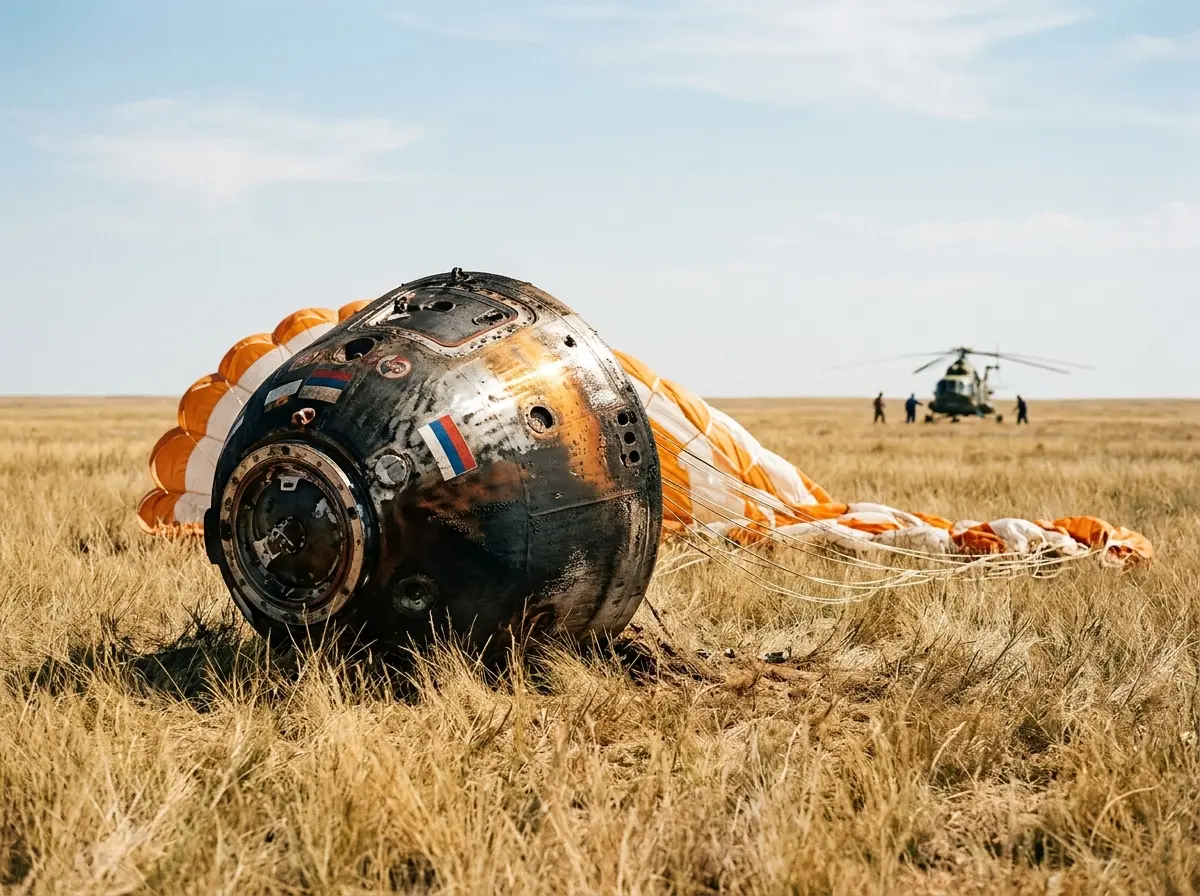
A Soyuz descent module carrying one American and two Russians parachuted onto the Kazakh steppe on Sunday, closing out a 241-day mission to the International Space Station. NASA astronaut Chris Williams and Roscosmos cosmonauts Sergei Kud-Sverchkov and Sergei Mikaev landed southeast of Dzhezkazgan, the same steppe where Soyuz crews have touched down for decades.
The landing barely registered outside space circles. Days earlier, at the same Baikonur Cosmodrome the crew had launched from in November, NASA and Roscosmos leadership quietly locked the partnership’s future into 2030. The extension survived four years of war in Ukraine, sanctions and diplomatic freezes that shut down nearly every other channel between Washington and Moscow.
From Undocking to Touchdown
The return followed the same script Soyuz crews have used for decades: undock, a short free flight, a deorbit burn, then a parachute descent onto open ground. The sequence, according to NASA:
- November 27, 2025: Soyuz MS-28 launches from Baikonur Cosmodrome on Thanksgiving Day and docks with the station about three hours later.
- July 14, 2026: A fresh three-person crew arrives at the station, beginning the handover with the outgoing trio.
- July 26, 2026, 3:02 a.m. EDT: Soyuz MS-28 undocks from the Rassvet module.
- July 26, 2026, 5:27 a.m. CDT: The capsule parachutes down onto the steppe southeast of Dzhezkazgan, 3:27 p.m. local time in Kazakhstan.
Over 241 days, the trio circled Earth 3,856 times and covered more than 102 million miles, NASA said. Sunday’s descent covered the trip home in roughly three and a half hours.
NASA and Roscosmos Strike a New Deal at Baikonur
The crew that arrived July 14 included NASA astronaut Anil Menon, flying under the same barter arrangement that sent Williams up in November. NASA Administrator Jared Isaacman and Roscosmos Director General Dmitry Bakanov met at Baikonur around that launch and used the visit to settle a question that had lingered for years: how long Russia would keep flying the mission.
Russia had committed to station operations only through 2028, two years short of the date NASA, Europe, Japan and Canada had already penciled in. At Baikonur, Bakanov agreed to bring Russia into line with the rest through 2030 and to keep the seat-swap flights going. The arrangement runs on a straight swap: NASA seats send American astronauts up on Russian Soyuz capsules, and Roscosmos seats send Russian cosmonauts up on SpaceX’s Crew Dragon. No money changes hands. It exists for redundancy. If one vehicle is grounded for months, as both Soyuz and Dragon have been at different points, at least one American and one Russian stay aboard regardless.
Who Flew Home in Soyuz MS-28
Three people came home: NASA flight engineer Chris Williams, Roscosmos commander Sergei Kud-Sverchkov and Roscosmos flight engineer Sergei Mikaev. It was the first spaceflight for Williams and Mikaev and the second for Kud-Sverchkov, who commanded the descent. All three had spent 241 days aboard the station as part of Expedition 74, call sign Gyrfalcon.
| Crew Member | Space Agency | Role | Spaceflight Count |
|---|---|---|---|
| Chris Williams | NASA | Flight Engineer | 1st (debut) |
| Sergei Kud-Sverchkov | Roscosmos | Soyuz Commander | 2nd |
| Sergei Mikaev | Roscosmos | Flight Engineer | 1st (debut) |
Williams’s path to the hatch was unusual. He is a board-certified medical physicist trained at Harvard Medical School, holds a Ph.D. in astrophysics from MIT, and worked as a volunteer firefighter and emergency medical technician before NASA selected him as an astronaut candidate in 2021. His research specialty has had its own moment at the agency recently: NASA’s Webb telescope dated the interstellar comet 3I/ATLAS to 10-12 billion years old, among the oldest objects ever measured up close.
A Partnership the War Could Not Break
Russia invaded Ukraine in February 2022. Sanctions followed, then the near-total collapse of diplomatic contact between Washington and Moscow. Space stayed the exception. Soyuz launches kept carrying NASA astronauts to the station, and SpaceX’s Crew Dragon kept carrying Roscosmos cosmonauts back. The seat-swap flights kept getting extended, again and again, even as almost every other channel between the two countries stayed frozen.
The station’s original deorbit plan was itself a casualty of the invasion. NASA had planned to lean on three Russian Progress cargo ships, firing their engines in sequence to push the station out of orbit at the end of its life. The war forced a rethink. NASA instead awarded SpaceX a contract worth up to $843 million to build a dedicated United States deorbit vehicle, a one-off spacecraft that will guide the station toward a remote stretch of the South Pacific known as Point Nemo once its mission ends.
Next Stop, 2030
The station does not go short-handed. The trio that arrived July 14, Menon among them, remains aboard and takes over station operations, keeping the outpost fully staffed through the handover. Three tasks now stand between the station and its retirement:
- Finishing the seat-swap flights already mapped through 2027, alternating Soyuz and Crew Dragon seats between the two agencies.
- Keeping the station’s orbit stable with periodic reboosts while SpaceX finishes building the dedicated deorbit vehicle.
- Flying whatever final crew rotations NASA and Roscosmos schedule before the controlled descent toward Point Nemo begins.
Williams, Kud-Sverchkov and Mikaev are done with this rotation. Their Soyuz seat has already been reassigned, under the same barter deal that just bought itself four more years.
Frequently Asked Questions
What Is the NASA-Roscosmos Seat-Swap Schedule Through 2027?
Beyond the broad 2030 commitment, the two agencies have penciled in specific flights: a second set of integrated crew missions in 2025, one more set in 2026, and a SpaceX Dragon flight carrying a Roscosmos cosmonaut in 2027. Williams’s seat on Soyuz MS-28 was part of that earlier manifest.
Will NASA Keep Flying Astronauts on Russian Soyuz Rockets?
Roscosmos has said the seat-swap flights will continue for as long as the space station stays operational, which under the new agreement means at least through 2030. NASA has not signaled any plan to end the practice earlier.
What Time Did Soyuz MS-28 Launch and Dock at the Station?
Soyuz MS-28 lifted off at 4:27 a.m. ET on November 27, 2025, Thanksgiving Day, atop a Soyuz 2.1a rocket from Baikonur Cosmodrome, then docked with the station about three hours later, at 7:34 a.m. EST.