Astronomers have measured the chemistry of interstellar comet 3I/ATLAS and concluded it formed 10 to 12 billion years ago, during the universe’s peak era of star birth. The finding, published 22 June 2026 in the journal Nature, predates the 4.5-billion-year age of our Sun by a wide margin. 3I/ATLAS is only the third interstellar object ever confirmed passing through the inner solar system. The lead author, astrochemist Martin Cordiner of NASA Goddard, framed the result as direct sampling of galactic deep time.
The catch came from the James Webb Space Telescope, which turned its NIRSpec instrument on the comet in December 2025 as 3I/ATLAS swung away from the Sun. Webb measured deuterium and carbon ratios nowhere near anything found in solar system comets. The combination of those two isotopes carries the age that orbital mechanics alone could only suggest.
12 Billion Years in the Making
Webb’s NIRSpec instrument, used in December 2025 as the comet moved away from the Sun, captured detailed measurements of 3I/ATLAS’s chemical makeup. The Near-Infrared Spectrograph measured deuterium at about 30 times the levels in solar system comets. Deuterium, the heavy form of hydrogen, records how cold a comet’s birth cloud was, and the high reading signals an origin in a deeply frozen, radiation-saturated environment. NIRSpec also showed only traces of carbon-13 against the common isotope carbon-12.
Together those two ratios carry the age. Carbon-13 is slowly cooked inside massive stars and recycled into the galaxy as those stars die through supernovae and stellar winds. After enough generations, the cosmic carbon pool becomes enriched in carbon-13 relative to carbon-12. The Sun formed 4.5 billion years ago from already-enriched material, and its planets and comets carry the modern ratio.
This was a unique opportunity to study an ancient object from the distant Galaxy, probably pre-dating our Sun and Solar System. On the one hand, we get direct insight into that distant time and place, and on the other, we learn something about how unusual our own Solar System may be.
Stefanie Milam, a co-author and also at NASA Goddard, signed the release.
- Estimated formation: 10 to 12 billion years ago
- Deuterium ratio: about 30x solar system comets
- Sun’s age: 4.5 billion years
- Speed at perihelion: more than 68 km/s
- Paper: Nature, 22 June 2026
Walk the numbers backward and 3I/ATLAS sits in the universe’s “cosmic noon,” a window a few billion years after the Big Bang when galaxies were producing stars at rates ten times today’s level. Its parent system most likely now inhabits the Milky Way’s “thick disk,” a population of ancient stars that formed long before our Sun’s neighborhood. Related chemistry from the same campaign, including the methanol and cyanide findings from ALMA, fits the picture of an unusually organic-rich object.
The Cordiner paper was published under the title “Isotopic evidence for a cold and distant origin of 3I/ATLAS,” and a companion study led by Cyrielle Opitom at the University of Edinburgh used the European Southern Observatory’s Very Large Telescope to confirm carbon and nitrogen signatures in the same comet. The two papers converge on the same age estimate from independent instruments, a point the full Webb release on 3I/ATLAS’s ancient origin makes clear.
How Isotopes Work as a Galactic Clock
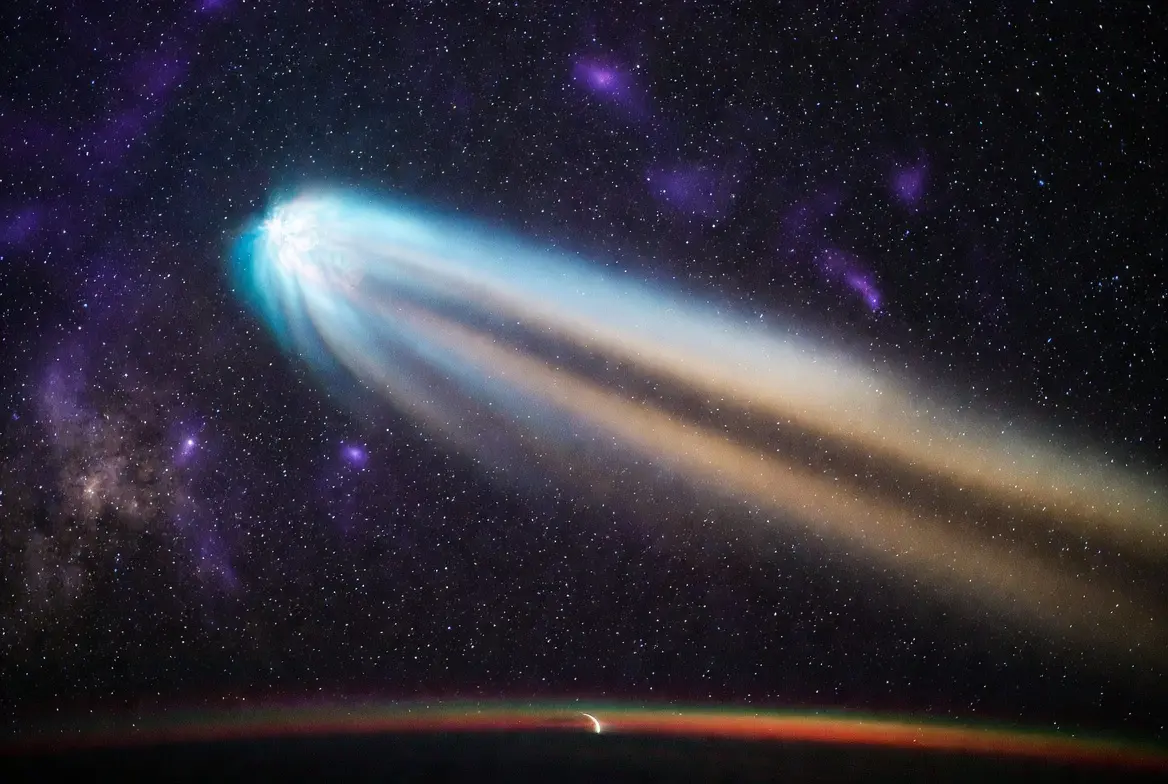
A comet’s isotope ratios behave like a clock for the galaxy’s carbon cycle. Almost every carbon atom in the Milky Way was forged inside stars more massive than the Sun, then released into the next generation of stars and planets. Inside those stellar interiors, a slow churning process called “hot bottom burning” converts some of the common carbon-12 into the heavier isotope carbon-13. As billions of years pass and more stars live and die, the fraction of carbon-13 in the galaxy creeps upward. A comet with very little carbon-13 must have formed when the galactic carbon pool was less enriched, which points to an earlier window.
“Cosmic noon” places that window roughly 10 billion years after the Big Bang, when galaxies were producing stars at rates an order of magnitude above today’s. To have formed in that era, 3I/ATLAS had to be ejected from its birth system long before the Sun existed. Ejection comes naturally: planetary systems fling their leftover building blocks into interstellar space through the gravitational pull of giant planets and passing stars. The comet has been wandering the galaxy ever since, until one pass brought it close to the inner solar system on 1 July 2025.
The Spaceship Claims vs. the Chemistry
The comet’s discovery also made headlines for reasons that had little to do with chemistry. Throughout 2025 and into 2026, a parallel debate has run about whether 3I/ATLAS’s unusual brightness and trajectory could fit an artificial origin. NASA and most working astronomers have kept the natural-comet reading as their working interpretation. The new Webb chemistry now supplies the controlled test those debates have been asking for.
For us as scientists, finding these rare isotopes is fascinating, but the bigger picture here is looking at the possibilities of prebiotic chemistry elsewhere in the galaxy. So far, we know of only one place in the vast cosmos where chemical ingredients led to life – our Solar System, our Earth. Analysis of these interstellar objects is a major step towards learning how common, or uncommon, the conditions for the evolution of life are in the Universe.
Stefanie Milam of NASA Goddard, a co-author on the Cordiner paper, put the work in those broader terms for reporters when the paper released.
The isotope ratios give a clean natural-comet reading. A spacecraft would not be expected to carry deuterium at 30 times the levels in Earth’s water, the data shows. The carbon-13 to carbon-12 fingerprint independently contradicts a solar-system manufacture. Three independent measurements from one telescope, all pointing in the same direction, are the kind of converged evidence that closes off side readings. The chemistry also reinforces what the Harvard-camp arguments have struggled to explain, and the broader case is laid out in the Harvard alien-craft case for 3I/ATLAS.
The Three Interstellar Visitors So Far
Three confirmed interstellar objects have swept through the inner solar system since 2017. Each behaves differently, and none match each other closely. The full population of rocks and ices drifting between the stars is thought to be vast, but only a handful come close enough for our telescopes to spot.
| Object | Year | Key feature |
|---|---|---|
| 1I/’Oumuamua | 2017 | First confirmed interstellar object |
| 2I/Borisov | 2019 | First confirmed interstellar comet |
| 3I/ATLAS | 2025 | Predates the solar system by billions of years |
3I/ATLAS sits in a third category, a normal active comet whose chemistry nothing in our solar system matches. Its precursor ‘Oumuamua showed no active gas release and made the broader “what is this” debate unavoidable in 2017. Borisov behaved more like a textbook comet two years later. The trio together proves that interstellar objects are a heterogeneous class.
All three objects are now beyond practical reach for follow-up. Their useful observing windows were measured in weeks, not years. The next chance for fresh data sits with future visitors yet to be discovered.
Each discovery has rewritten expectations. ‘Oumuamua in 2017 proved interstellar objects arrive in the inner solar system at all. Borisov in 2019 confirmed they can carry icy cometary material. 3I/ATLAS in 2025 shows they carry galactic history in their isotope ratios. Population studies will require dozens more, not three, and the field is built around closing that gap.
Rubin Observatory’s Hunt for the Next Dozen
The Vera C. Rubin Observatory sits on a mountaintop in northern Chile and is built to multiply these discoveries. Its 8.4-meter telescope carries the largest digital camera ever built for astronomy, a 3.2-gigapixel sensor that scans the visible sky every few nights. That combination makes it unusually good at catching faint, fast-moving objects before they pass.
How many? Scientists have modeled the catch. Michele Bannister at the University of Canterbury in New Zealand, a member of the Rubin LSST Solar System Science Collaboration, calls the early projections an “explosive period of discovery.” Her own playful bet is 21 detections across the survey’s 10 years. Reporting on the 3I/ATLAS chemistry has separately projected “dozens” of interstellar objects in the decade ahead, and a parallel write-up at the Rubin Observatory project on interstellar objects documents the case. The NASA account of the 12-billion-year result lands at the same time as the survey begins full operations. Astronomers will go from studying three individuals to studying a population, and the chemistry of those new visitors will begin to fill in the map of how star systems built themselves across the galaxy’s history.
Frequently Asked Questions
When was 3I/ATLAS discovered?
The comet was discovered on 1 July 2025 by the NASA-funded ATLAS survey telescope in Rio Hurtado, Chile. The ATLAS acronym stands for Asteroid Terrestrial-impact Last Alert System, a network designed to catch near-Earth objects before they reach us.
How old is 3I/ATLAS?
The team led by Martin Cordiner at NASA Goddard’s Space Flight Center estimates 3I/ATLAS formed between 10 and 12 billion years ago, during the universe’s peak era of star formation. Our Sun, by contrast, formed about 4.5 billion years ago from material already enriched in heavy isotopes.
What is the alien spacecraft claim?
Some commentators have argued since 3I/ATLAS’s discovery that its unusual brightness and trajectory fit an artificial origin. The carbon-13 and deuterium ratios measured by JWST do not match that reading; both numbers point to a natural comet that formed in a deeply frozen ancient cloud.
How many interstellar objects has the solar system seen?
Three confirmed visitors: 1I/’Oumuamua in 2017, 2I/Borisov in 2019, and 3I/ATLAS in 2025. Cataloging more is the core purpose of the Vera C. Rubin Observatory’s 10-year sky survey in Chile, which is designed to catch faint, fast-moving objects of this kind.