Zaza (Gela) Mikadze has spent more than three decades running Georgian infrastructure, from a Black Sea port to the country’s largest mall. Now, as Chairman of the Supervisory Board of Global Lifestyle, he is putting that track record behind a single wager: that abandoned palaces and Soviet sanatoriums can be converted into the foundations of a new Georgian tourism economy.
Three projects, in Borjomi, Sadgeri, and Tskaltubo, are testing that bet. The flagship, a restored 19th-century Persian-consul palace, already operates as the four-star Golden Tulip Borjomi. The second, a planned 88-room forest retreat in Sadgeri, is still on the drawing board. The third, the conversion of Tskaltubo’s Soviet-era Hotel Metalurgi into a five-star property with around 120 rooms, depends on a state partner Mikadze says is essential to making the math work.
A Palace of Turquoise Returns in Borjomi
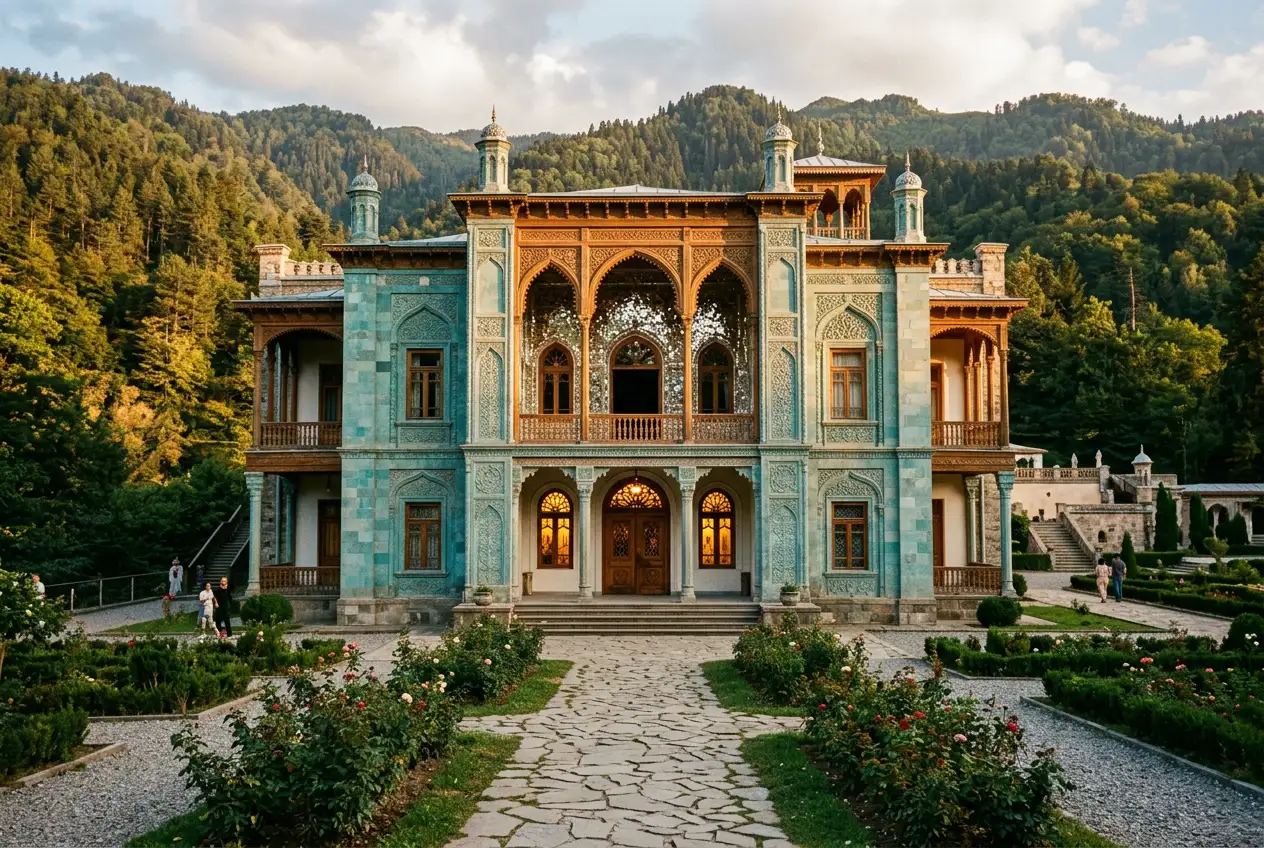
The Borjomi project begins with a diplomat. In 1891, Mirza Reza Khan, Iran’s consul in Tiflis, used a portion of his consulate’s funds to buy a plot at the entrance to Borjomi’s Mineral Water Park. By 1892 he had built a residence he called Firuze, the Persian word for turquoise, in a hybrid style that mixed Persian, Georgian, and European architecture. An open balcony above the main entrance was faced with mirror fragments that caught the mountain light, and pointed wooden arches and carved window frames lined the river-facing front.
After Reza Khan’s departure, the villa ran as a guesthouse, then a hotel, then, from 1950, a sanatorium. The sanatorium closed in 1989, and in the 1990s the government repurposed the building to house internally displaced people, a stretch that left it damaged and stripped. Restoration work in 2011 and 2012 brought Georgian and Iranian specialists together on a structure the heritage site notes is one of only three similar buildings in the world, a 2018 account of the building’s history that traces its construction and restoration in detail.
Mikadze’s hospitality interest, he says, dates to 2011, the same period the Firuza restoration wrapped, and the Borjomi site became the model for his work in hotels. Cultural heritage specialists, historians, and architects rebuilt the interior and exterior almost to their original form, using materials and furniture imported from Europe. About $2 million was invested in the conversion, and the four-star Golden Tulip Borjomi’s official hotel page lists 17 boutique rooms in the restored building, alongside a restaurant, a fitness centre, and a spa with a swimming pool. The hotel employs about 50 local people.
It is not the only heritage site in the country to have been restored as a working hotel.
It is important the building was reconstructed in a way so it kept its historic appearance and cultural value, Georgia’s Economy Minister Dimitry Kumsishvili said at the hotel’s opening.
Villa Firuze: A Timeline
- 1892: Iranian consul Mirza Reza Khan completes the Firuze palace at the entrance to Borjomi’s Mineral Water Park.
- 1950: The structure becomes part of the Firuze sanatorium.
- 1989: The sanatorium ceases to function.
- 1990s: The government repurposes the building to house internally displaced people.
- 2011-2012: Georgian and Iranian specialists restore the building under archival research.
- 2016: The building opens as the four-star Golden Tulip Borjomi.
The Mikadze Track Record Beyond Hospitality
Mikadze’s authority in Georgian development predates the hotel pivot. From 2007 to 2011, he ran the modernization of Poti Port, replacing Soviet-era cranes with German-manufactured Gottwald cranes and bringing in digital systems the port had not previously used. He also developed the Poti Free Industrial Zone in 2008, a logistics and customs terminal built from scratch on roughly ten hectares of marshland, and began construction on Poti International Airport, a project he says was not completed.
The Tbilisi Mall project that followed was, by Mikadze’s own measure, his largest. Approximately 256,000 square meters were developed in a short build, financed in part by the International Finance Corporation, with 3,000 to 4,000 workers on site daily at peak. Mikadze also helped broker the Georgian entry of the Al Hokair Group, which operates Zara and Massimo Dutti stores in the country, and was involved in the early discussions that brought Carrefour to Georgia. Conversations about a future Starbucks presence in the country, he says, began as early as 2011.
The transition to hospitality happened almost by accident, after a gap in food and beverage operators at Tbilisi Mall forced him to develop his own concepts, he said in Mikadze’s interview about his three-decade career. Borjomi’s Firuza, restored that same period, became the template. The wider pattern, of a private developer taking on a culturally loaded building and handing the running of it to an international brand, is a model a heritage hotel in Samtskhe-Javakheti is also pursuing at a smaller scale.
Today, I serve as Chairman of the Supervisory Board of Global Lifestyle. Looking back, my career has involved a wide variety of sectors and projects, many of which have played an important role in Georgia’s economic development, Mikadze said in the interview.
Sadgeri’s 88-Room Forest Village Plan
The second Global Lifestyle project sits in Sadgeri, a village the company has identified for a different kind of build. The plan calls for 88 rooms laid out in wooden cottage-style structures designed to blend with the surrounding forest. Mikadze has framed the property as an ecologically balanced, premium-class hotel that will share unified management and branding with the Borjomi operation. At this stage, administrative procedures and final land status regulations are still being resolved, after which construction work will begin.
The wider Georgian hotel market is expanding alongside Mikadze’s portfolio, with an 85-room branded hotel in Kakheti wine country among the international properties now operating outside the capital.
Global Lifestyle’s Three Projects
| Project | Location | Scale | Status | Brand |
|---|---|---|---|---|
| Golden Tulip Borjomi | Borjomi, central park | 17 rooms, 4-star | Operating | Golden Tulip (Louvre Hotels Group) |
| Sadgeri forest retreat | Village of Sadgeri | 88 rooms | Land and planning stage | Under unified brand with Borjomi |
| Hotel Metalurgi Tskaltubo | Tskaltubo, Western Georgia | Around 120 rooms, 5-star | Building vacated, reconstruction preparing | Under evaluation |
Tskaltubo’s Soviet Anchor Awaits Its Five-Star Future
The third project is the largest by scale and the most exposed. Global Lifestyle plans to convert Hotel Metalurgi Tskaltubo, one of the city’s best-known Soviet hotel and sanatorium complexes, into a five-star destination hotel with around 120 rooms. The building has already been vacated, and preparations for a full-scale reconstruction are underway. The project envisions preserving the property’s historic architectural character while adding contemporary design and modern hospitality standards.
Mikadze has framed the Tskaltubo project as one of the most important tourism initiatives in the region, with the potential to re-establish the city as one of Western Georgia’s leading destinations. He has also been explicit that private capital alone is not enough. According to the investor, success requires not only private investment but also state involvement in infrastructure development and regional promotion. The Tbilisi Mall build showed the company can deliver at scale, but Tskaltubo, a Soviet shell in a town whose wider tourism infrastructure has yet to be rebuilt, is a different kind of test.
Until the state piece is in place, the largest of the three conversions is a question of timing rather than of design.
A Shared Formula Across All Three Projects
What the three projects share is a single operating model. Global Lifestyle takes a culturally loaded site, restores it with archival research and imported materials, and hands the running of it to a recognised international hotel brand. The Borjomi conversion is the proof of concept. Sadgeri tests whether the formula works on a new build. Tskaltubo tests whether it works on a Soviet shell in a town whose wider tourism infrastructure has yet to be rebuilt.
The branding question for Sadgeri and Tskaltubo remains open. Mikadze has said Global Lifestyle is evaluating both the introduction of an international hotel brand and the creation of a proprietary hospitality brand for its expanding portfolio, with a decision still to come. All current and future developments are being designed to meet five-star hospitality standards, regardless of the final choice. What the model still requires, Mikadze argues, is a state partner. The Tbilisi Mall build showed the company can deliver at scale; the Tskaltubo conversion will test whether the Georgian state can match the international partners Global Lifestyle has already brought to the table.
Frequently Asked Questions
Who is Zaza (Gela) Mikadze?
Zaza Mikadze is the Chairman of the Supervisory Board of Global Lifestyle, a Georgian development group that has been involved in infrastructure, retail, and hospitality projects for more than three decades.
What is the Golden Tulip Borjomi?
Golden Tulip Borjomi is a four-star, 17-room boutique hotel in Borjomi, Georgia, operated under the Golden Tulip brand of the Louvre Hotels Group. The hotel operates inside the restored 1892 Firuze palace, originally built for Iran’s consul in Tiflis, Mirza Reza Khan.
What is Hotel Metalurgi Tskaltubo?
Hotel Metalurgi Tskaltubo is one of Tskaltubo’s best-known Soviet-era hotel and sanatorium complexes. Global Lifestyle plans to convert the building into a five-star destination hotel with around 120 rooms. The project requires state involvement in regional infrastructure and promotion, Mikadze has said.
How is Mikadze’s heritage-to-hospitality model different from typical hotel development?
Mikadze’s approach centres on restoring culturally significant buildings with archival research. The restored sites are handed over to recognised international hotel brands to operate. Materials and furniture are imported from Europe for the projects. The model has so far produced one operating hotel, the four-star Golden Tulip Borjomi.
What role is the Georgian government expected to play in Global Lifestyle’s projects?
Mikadze has said state involvement in infrastructure development and regional promotion is essential. The Tskaltubo project, the largest of the three, depends on this partnership. The Borjomi project was supported by a state decision to transfer the heritage building. The Sadgeri project requires final land status regulations to be resolved. Global Lifestyle is independently managing its investment portfolio across all three sites.