India’s first flex-fuel production car arrived on June 4, 2026, as Maruti Suzuki launched the Wagon R Flex Fuel in New Delhi with two Union ministers on stage. The car handles any ethanol-petrol blend from E20 to E85, adapting its engine automatically to whatever blend fills the tank. Prices have not been announced, and the car ships to commercial fleet customers initially.
Petroleum Minister Hardeep Singh Puri confirmed from the stage that roughly 50 to 100 ethanol dispensing stations exist across the entire country today. The government’s 5,000-station target runs to end-2027.
A Car That Runs on Farmer Crops
The launch at Taj Palace’s Durbar Hall in New Delhi carried the theme “Fuelling the Vision of Atmanirbhar Bharat,” held one day before World Environment Day. Nitin Gadkari, Union Minister for Road Transport and Highways, served as Chief Guest. Flex-fuel vehicles draw on ethanol fermented from sugarcane, surplus rice, and broken grain, crops grown by Indian farmers and processed at domestic distilleries, displacing imported crude from Gulf wells.
Managing director and chief executive Hisashi Takeuchi, speaking for Maruti Suzuki India Limited, opened with the policy stakes:
India has two national objectives: reduce dependence on imported crude oil and reduce carbon emissions. Flex-fuel meets both. It is truly Atmanirbhar and clean.
Takeuchi, Maruti Suzuki India Limited managing director and chief executive, at Taj Palace’s Durbar Hall, New Delhi, June 4, 2026.
Per Maruti Suzuki’s India Goes Flex official announcement, the car is technically compatible with E100 pure ethanol but homologated to E85 under the Central Motor Vehicles Rules, 1989, which define flex-fuel as E20 to E85. Certification came from JATO Dynamics (an automotive data and market intelligence firm), dated May 29, 2026.
Maruti Suzuki holds roughly 41 percent of the domestic passenger vehicle market. The Wagon R is the company’s highest-volume hatchback, purchased across income brackets by first-time buyers, fleet operators, and urban commuters.
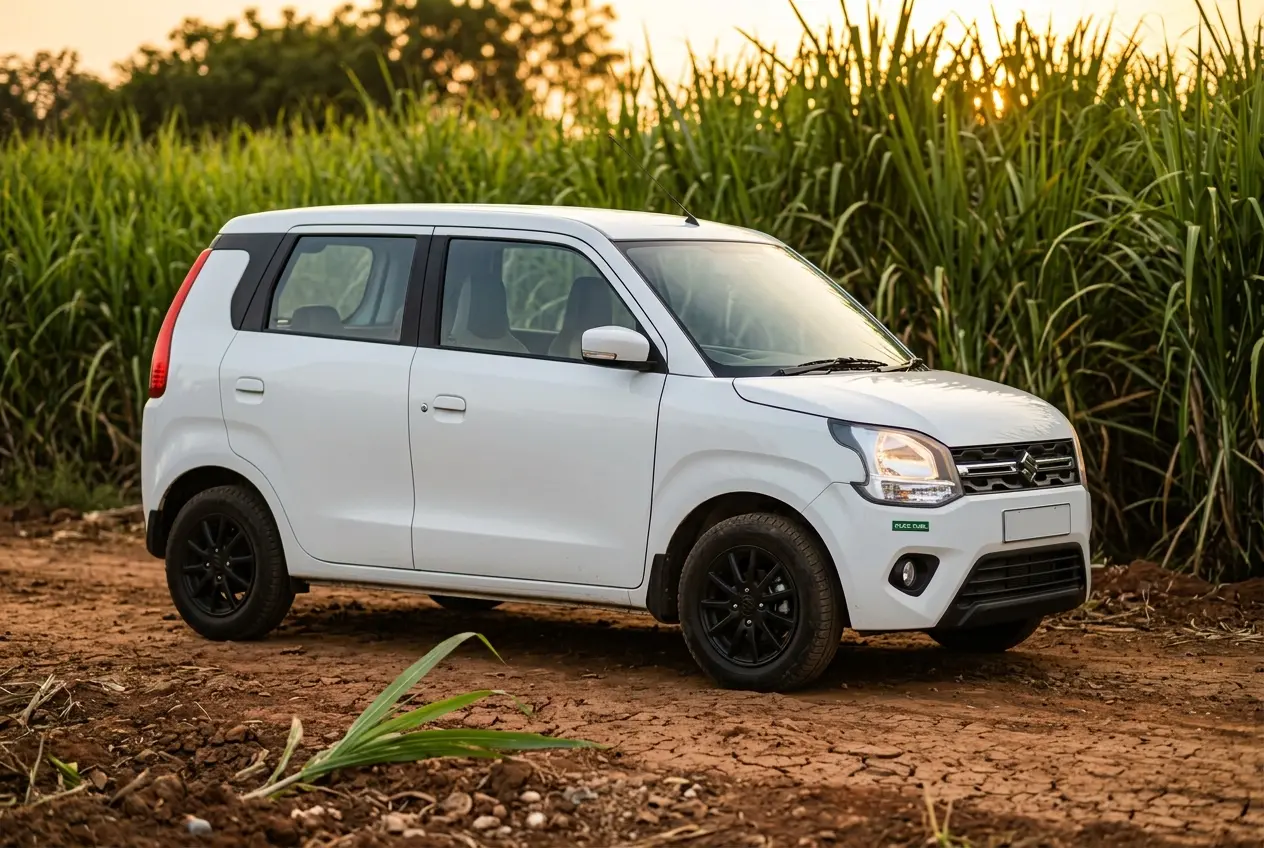
The exterior retains the tall-boy silhouette unchanged from the standard Wagon R platform in production since 2019. Side decals, a “BioFlex” badge on the lower tailgate, and black-painted 14-inch alloy wheels distinguish the variant externally. Inside: dual-tone beige-and-black dashboard, a 7-inch touchscreen with wired Android Auto and Apple CarPlay, analogue-digital instrument cluster with orange MID backlight, and a three-spoke steering wheel with silver lower spoke trim.
Safety includes six airbags, ABS with EBD (Anti-lock Braking System with Electronic Brakeforce Distribution), ESC (Electronic Stability Control), HHA (Hill Hold Assist), rear parking sensors, and seatbelt reminders for every passenger.
What the K12N Engine Now Handles
The car carries Maruti’s K12N 1.2-litre four-cylinder engine, reengineered for variable ethanol content. Flex-fuel requires hardware changes at several points in the fuel system. Upgraded fuel injectors handle ethanol’s corrosive properties. A sturdier fuel pump tolerates prolonged alcohol exposure. New fuel lines replace components that would degrade under sustained ethanol contact. A recalibrated ECU (Engine Control Unit) adjusts ignition timing and air-fuel ratio continuously, while a dedicated ethanol sensor reads blend concentration in real time and feeds the ECU on every injection cycle.
Ethanol is hygroscopic, meaning it absorbs moisture from the atmosphere and can trigger phase separation in fuel systems not rated for it. The upgraded components address that failure mode specifically. Ethanol also burns at a different stoichiometric air-fuel ratio than petrol, making the ECU recalibration a substantive engineering change.
Transmission is a 5-speed manual. No AMT (Automated Manual Transmission) variant has been confirmed for the flex-fuel model. Power and mileage figures remain undisclosed. On E85, efficiency typically drops by approximately 15 percent against standard petrol, consistent with ethanol’s lower energy density. Ethanol carries roughly 30 percent less energy per litre than petrol; the ECU’s adaptive calibration compensates by increasing injection volume but can’t recover the full thermodynamic shortfall.
| Feature | Standard Wagon R (Petrol) | Wagon R Flex Fuel |
|---|---|---|
| Engine | K12N 1.2-litre petrol | K12N 1.2-litre, ethanol-modified |
| Fuel range | Petrol (E20 compliant) | E20 to E85 (E100 compatible) |
| Fuel system | Standard injectors and pump | Upgraded injectors, pump, ethanol-rated lines |
| Engine management | Standard ECU calibration | Adaptive ECU plus real-time ethanol sensor |
| Transmission | 5-speed MT or AMT | 5-speed MT |
| Production cost premium | n/a | ~Rs 50,000-70,000 (industry estimate) |
| Ex-showroom price | Confirmed, multiple variants | Not yet announced |
Where Do You Fill This Up?
On launch day, commercial buyers placing orders had fewer than 100 fuel stations to choose from. Puri gave the count from the stage: 50 to 100 ethanol dispensing stations are operational today, clustered in Delhi-NCR, Pune, Mumbai, and Nagpur. A separate May 2026 tracking count found approximately 215 E100-capable pumps across India, concentrated in Uttar Pradesh, Maharashtra, Karnataka, and Punjab, the states with active sugarcane and grain-distillery clusters.
India’s ethanol blending programme context makes clear why production geography drives pump geography: dispensing infrastructure tracks where the distilleries are. Outside those clusters, the flex-fuel capability is inert; the car simply runs on E20, the same blend available at every ordinary pump.
An early E85 test in Pune, conducted ahead of the launch, found that locating fuel required calling three stations in advance before setting out. Until the network reaches several hundred stations, the flex-fuel benefit is most practical for fleet operators who can plan routes around confirmed dispensing points.
The government’s expansion timeline for the ethanol retail network:
- Today: 50-100 dispensing stations in Delhi-NCR, Pune, Mumbai, and Nagpur
- End of 2026: 500 stations across major urban corridors (Indian Oil, Bharat Petroleum, and select private dealers)
- End of 2027: 5,000 stations nationwide
The draft amendments to the Central Motor Vehicles Rules, 1989 formally accommodate E85, E100, B100 biodiesel, and hydrogen-CNG combinations across vehicle categories, giving the regulatory framework time to catch up with the physical network being built.
Ten Years From 1.5 Percent
This car exists because of a decade of policy and supply-side work. India’s Ethanol Blended Petrol (EBP) programme, overseen by the National Biofuel Coordination Committee (NBCC), started at 1.5 percent blending in 2014. The government set 20 percent as the target for 2030. It reached that number in 2025, five years early. Since April 2026, every petrol pump in India sells E20 as the mandatory baseline.
India’s 20 percent ethanol blending achievement, announced by Petroleum Minister Puri, was accompanied by a production surge: output grew from 38 crore litres in 2014 to 661.1 crore litres by June 2025. Press Information Bureau data on India’s ethanol capacity expansion shows total capacity at nearly 20 billion litres, well above what E20 alone requires. That surplus is what a scaling flex-fuel fleet would eventually need to absorb.
The geopolitical incentive for pushing further is sharp. India routes 90 percent of its crude oil imports through the Strait of Hormuz, the chokepoint that has generated acute supply anxiety this year. The Maruti Suzuki austerity measures prompted by the West Asia oil disruption this past month illustrated how that Hormuz exposure translates into operational decisions at India’s largest carmaker. Ethanol, grown domestically, bypasses that exposure entirely.
The EBP programme’s foreign exchange savings since 2014 total approximately $19.3 billion.
Fleets Before Families
Commercial customers get first access: fleet operators, cab aggregators including Ola and Uber, and corporate fleets, with retail sales to private buyers following as the ethanol network expands. Maruti has not set a public timeline on that retail transition.
The commercial-first logic is practical. Fleet operators in ethanol-producing states, Uttar Pradesh and Maharashtra chief among them, run fixed routes, know their fuel stops, and can calculate whether the running-cost advantage justifies the production premium. A private buyer in a city without E85 access faces a different arithmetic: industry estimates peg the production cost premium at Rs 50,000 to Rs 70,000 over the standard petrol Wagon R, and without high-blend fuel available nearby, that premium has no operating payoff. The government administers ethanol procurement prices; if E85 is priced below petrol on a per-kilometre basis, cost recovery shortens considerably, but pricing parity for consumers has not yet been publicly established.
Maruti entered passenger-car production first. Toyota and Tata Motors each showed flex-fuel prototypes before this car reached production; neither made it to the manufacturing stage. Taking a concept to homologated production took Maruti itself over two years from the Bharat Mobility Expo showing in early 2024 to the June 2026 launch, reflecting the complexity of aligning vehicle certification, fuel-system changes, and regulatory frameworks simultaneously.
Hero MotoCorp, India’s largest two-wheeler manufacturer by volume, unveiled its first flex-fuel motorcycle in New Delhi on June 3, 2026. Hero launched the day before the Wagon R.
The Farmer Math Behind the Launch
India’s main ethanol-producing states, principally Uttar Pradesh, Maharashtra, Karnataka, and Punjab, are also where the densest E100 pump coverage exists today. The crop-to-fuel chain explains why: ethanol comes primarily from sugarcane molasses, surplus rice, and maize, domestic feedstocks that direct fuel spending toward Indian farmers and distilleries.
Rahul Bharti, Executive Director for Corporate Affairs at Maruti Suzuki India Limited, put numbers on the potential scale: if 50 percent of new two-wheelers and four-wheelers produced over the next decade use flex-fuel engines, India could absorb 311.8 crore litres of additional ethanol demand, generate Rs 12,403 crore in additional farmer income annually, and eliminate 66.4 lakh metric tonnes of CO2 emissions. Those are ten-year projections.
India’s annual fossil fuel import bill runs to approximately USD 120 billion. The National Biofuel Policy framework governing the programme positions farmers, oil marketing companies, distilleries, vehicle manufacturers, and financial institutions as co-dependent links in a chain that only moves if each one holds.
The minister framed the agricultural angle at the launch with the phrase “annadatas to urjadatas,” food providers becoming energy providers.
The government’s 5,000-station target runs to end-2027. The car is already on the road.