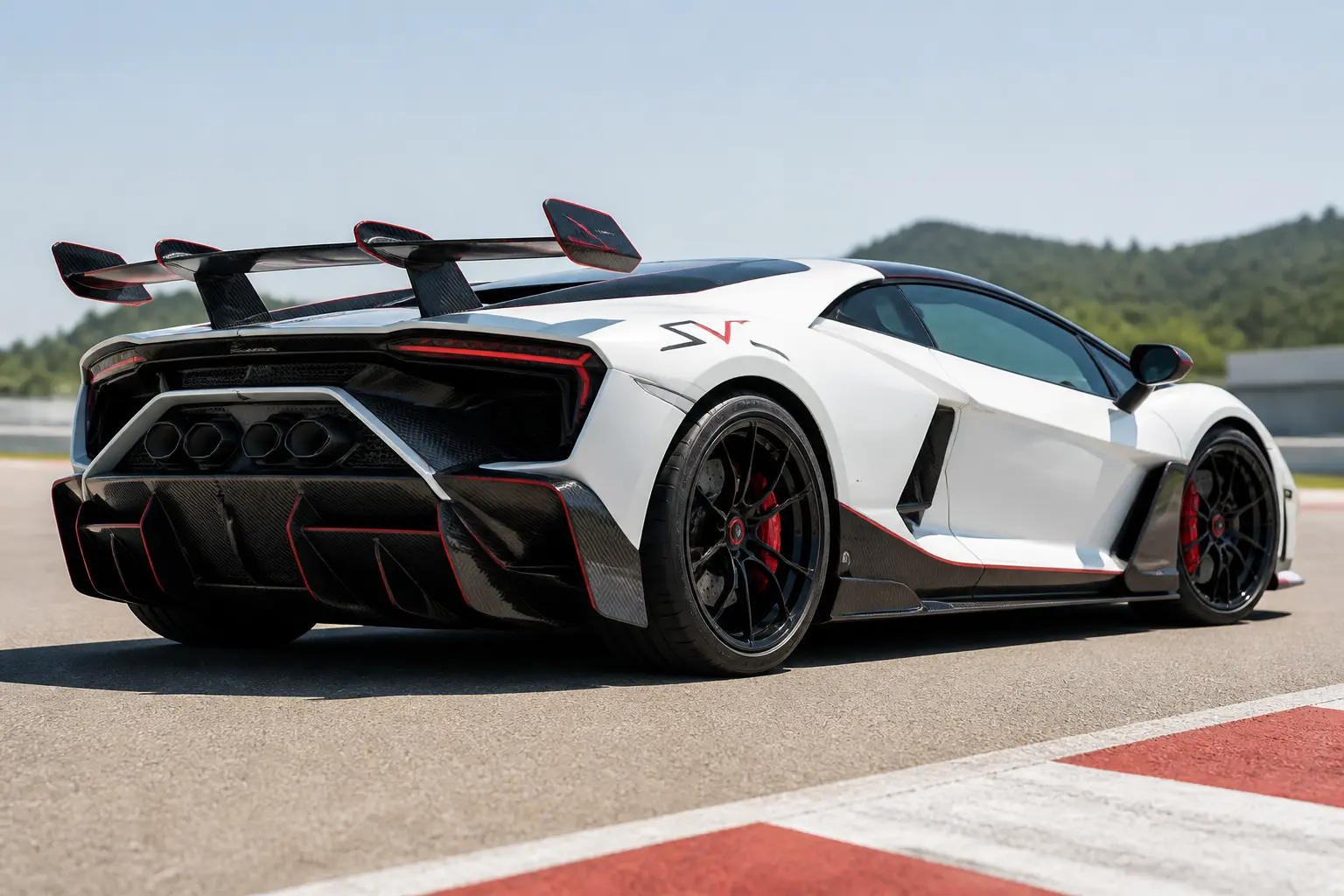
Lamborghini unveiled the Revuelto SV on August 14, 2026, as its most powerful production car ever, a hybrid V12 special limited to 1,963 units that starts at $741,172 in the United States. The car adds 50 CV over the standard model, cuts the 0-100 km/h time to 2.4 seconds and carries the Super Veloce badge that has marked peak versions of Lamborghini flagships for 55 years.
Factory driver Marco Mapelli had already posted a 1:41.6 production-car lap at Hockenheimring eight days earlier, giving the Monterey Car Week debut an immediate performance credential.
That sequence mattered. The lap arrived first. The reveal followed with numbers that matched the claim: more power, more downforce, shorter sprints and a fixed production cap tied to the company’s founding year. Collectors who already follow Super Veloce releases saw a familiar pattern delivered with hybrid hardware the earlier cars never carried.
1,065 CV and the Founding-Year Cap
The Revuelto SV pairs a 6.5-liter naturally aspirated V12 making 825 CV at 9,250 rpm with three electric motors and an upgraded 7.3 kWh battery. System output reaches 1,065 CV and 80 percent more downforce than the standard car, plus 1,425 Nm of torque. Top speed exceeds 345 km/h. Power-to-weight sits at 1.66 kg/CV.
Production is fixed at 1,963 examples, a direct nod to Automobili Lamborghini’s founding year. The company says the run is reserved for its most loyal customers and collectors. Most limited Lamborghinis sell out before public announcement, and earlier Super Veloce models have followed the same path.
| Metric | Revuelto SV | Base Revuelto |
|---|---|---|
| System power | 1,065 CV | 1,015 CV |
| 0-100 km/h | 2.4 s | 2.5 s |
| 0-200 km/h | 6.7 s | N/A |
| System torque | 1,425 Nm | Lower |
| Downforce vs base | +80% | Baseline |
| US starting price | $741,172 | About $608,000 |
The base car’s combined output and acceleration come from Lamborghini’s own figures for the base Revuelto’s 1,015 CV hybrid V12. The SV’s gains look modest on paper yet arrive with entirely new aero, dampers and brakes.
The 50 CV step and the tenth of a second cut to 100 km/h are only the headline deltas. The larger shift is the package around them: a battery that holds output longer, dampers drawn from GT3 work, and aero that raises both peak load and efficiency. Those pieces turn a small power bump into a different track car.
Pricing underscores the gap. The SV opens at $741,172 in the United States against about $608,000 for the base Revuelto. Options and Ad Personam work will push transaction prices higher still once allocations move.
Super Veloce Line Since the Miura
SV has meant Super Veloce since the 1971 Miura SV. Each generation has taken the flagship, cut weight or added aero, raised power and limited supply. The pattern is consistent.
- Miura SV (1971): the first Super Veloce, focused on power and handling over the standard Miura.
- Aventador LP 750-4 SV (2015-2017): 600 coupes, 50 kg lighter, 740 hp, downforce up 180 percent over base.
- Aventador SVJ (2018): 900 coupes plus 800 roadsters, Nürburgring claims and further aero refinement.
- Revuelto SV (2026): 1,963 units, hybrid peak, 80 percent more downforce and new racing dampers.
Earlier SVs have held or gained value in the collector market. Product line director Alessandro Farmeschi told CNBC that buyers choose Lamborghini for the driving experience and because the cars keep their value over time. The same expectation now attaches to the hybrid special.
Volume has grown across the line, yet scarcity has not vanished. Six hundred Aventador SV coupes gave way to a larger SVJ run and now to 1,963 Revuelto SV cars. Relative to total flagship output, each still reads as a closed list rather than an open order book. The Revuelto SV simply applies that logic to a hybrid V12 platform.
Aero That Changes the Balance
Engineers reworked the front splitter, underbody, side fins and rear wing. The double-element wing and Gurney flap raise rear downforce while the front gains sealing and cooling. Total downforce rises 80 percent over the Revuelto and 10 percent over the Aventador SVJ. Downforce-to-drag efficiency improves 60 percent.
Brake cooling gains 12 percent. New CCM-R Plus carbon-ceramic discs and bespoke Bridgestone Potenza Race R semi-slick tires (street-legal) complete the package. Suspension uses manually adjustable passive dampers derived from GT3 racing. Lamborghini claims 17 percent more agility and 10 percent more lateral grip than the base car.
- +80% total downforce versus standard Revuelto
- +17% agility from the new damper kinematics
- 1.66 kg/CV power-to-weight ratio
- Four times greater battery performance consistency under track load
The aero work is not only about peak force. A 60 percent gain in downforce-to-drag efficiency means the car can carry the extra load without a matching drag penalty. That balance shows up in high-speed stability and in the way the tires stay in their window across a lap.
Cooling and friction surfaces move with the same logic. Twelve percent more brake cooling and CCM-R Plus discs give the stoppers room to work when the wing is loaded. The Potenza Race R semi-slicks, still street-legal, are the contact patch chosen for that aero and damper set.
V12 Sound Meets Electric Torque Vectoring
The V12 still revs to 9,500 rpm and exits through a tuned dual exhaust available in matte grey, black or bronze. Two front axial-flux motors and one rear radial-flux unit deliver instant torque vectoring and all-wheel drive. The battery now sustains higher output longer, which matters for repeated track laps.
A new Pilota driving mode appears for the first time on a Revuelto. It sits beside the red ANIMA selector on the steering wheel and unlocks deeper customization of traction and chassis settings for circuit use. Chairman and CEO Stephan Winkelmann called the car “Lamborghini DNA in its purest form.”
The combustion side keeps the character buyers expect: a high-revving 6.5-liter V12, 825 CV on its own, and a tuned exhaust in three finishes. The electric side fills the gaps. Axial-flux motors at the front and a radial-flux unit at the rear feed torque vectoring without waiting on engine load. Together they produce the 1,065 CV system figure and the 1,425 Nm torque peak.
Cockpit Built Like a Race Seat
The interior follows the “Feel Like a Pilot” idea with a more focused dashboard, motorsport-inspired wheel controls and extensive visible carbon. Standard seats use a carbon shell. Optional monocoque carbon race seats cut weight further and raise lateral support at the cost of some comfort. Door panels are ultra-light carbon. Twelve contrasting leather colors are available on top of Nero Ade.
Design director Mitja Borkert said every surface was developed with a performance-driven approach while keeping the original Revuelto proportions. Center-lock hexagonal wheels and the SV logo mark the car externally. Some early reactions on X called the styling too close to the Aventador or insufficiently dramatic. The performance numbers and scarcity still dominate the conversation among collectors.
The cabin choices mirror the chassis brief. Carbon shells and optional monocoque race seats trade padding for hold. Ultra-light door panels shed mass where the driver sees and touches it. Wheel controls borrowed from motorsport layout put traction and chassis adjustments within thumb reach, which pairs with the new Pilota mode on the ANIMA selector.
Pilota Mode Puts Circuit Settings Forward
Pilota is new on the Revuelto line and aimed squarely at track work. It lives beside the red ANIMA selector and opens a deeper set of traction and chassis adjustments than the standard drive modes. Drivers can shape how the car deploys its hybrid torque and how the passive racing dampers respond once the wing is loaded.
That matters because the hardware underneath is already track-leaning. Manually adjustable dampers derived from GT3 racing, CCM-R Plus discs, and semi-slick Potenza Race R tires all assume repeated high-load corners. Pilota is the software layer that lets a driver lock those pieces into a circuit map rather than a road compromise.
The battery upgrade supports the same use case. Four times greater performance consistency under track load means the electric motors keep contributing torque vectoring and fill-in power across a stint instead of fading after a few hot laps. Combined with 17 percent more agility and 10 percent more lateral grip versus the base car, the mode turns the paper gains into something a driver can hold for a full session.
- Pilota mode: first appearance on a Revuelto, circuit-focused
- ANIMA selector: red wheel control with deeper traction and chassis maps
- Battery behavior: sustained output for repeated laps, not a single sprint
- Damper set: passive, manually adjustable, GT3-derived kinematics
The Hockenheimring Lap Set the Tone
Marco Mapelli’s 1:41.6 run at Hockenheimring came on August 6, 2026, eight days before the Monterey reveal. Lamborghini calls it the fastest production-car lap at that circuit. The timing was deliberate: a public credential before the price, the cap and the styling debate arrived.
The lap ties directly to the hardware list. Eighty percent more downforce than the base Revuelto, a 60 percent efficiency gain in downforce versus drag, and sticky street-legal semi-slicks give the car the load it needs through quick direction changes. The hybrid system’s longer battery consistency keeps electric torque available when the driver asks for it mid-corner and on exit.
- August 6, 2026: Mapelli records the 1:41.6 production-car lap at Hockenheimring.
- August 14, 2026: Lamborghini unveils the Revuelto SV at Monterey Car Week.
- Production run: 1,963 units fixed, allocated toward loyal customers and collectors.
For buyers, the sequence reduces uncertainty. Super Veloce cars have long sold on reputation and limited supply. This one arrived with a timed lap already on the board, then confirmed system output of 1,065 CV, a 2.4-second sprint to 100 km/h, and a top speed above 345 km/h. The story moved from claim to evidence in a single week.
Why the Pattern Matters for Residuals
Limited SV runs have historically commanded premiums once production ends. The Aventador SV and SVJ both trade well above their original transaction prices in strong examples. The Revuelto SV’s larger 1,963-unit total is still tight relative to overall Revuelto volume and is explicitly aimed at loyal owners. Farmeschi framed the purchase as both an emotional and a value-holding decision.
When you buy a Lamborghini, you buy a Lamborghini because you want it, because you like, you want to experience driving it, but also because it’s a car that keeps the value to the time.
Alessandro Farmeschi, Revuelto product line director, speaking to CNBC.
High-profile owners already treat special Lamborghinis as statements. Recent high-profile Lamborghini ownership moments show how specific plates and limited variants travel beyond the garage. The Revuelto SV arrives in that same culture, only with hybrid hardware that previous Super Veloce cars never carried.
Allocations favor existing clients. Public pricing beyond the $741,172 U.S. start will climb quickly once options and Ad Personam customization enter the picture. The car is already the fastest and most powerful production model ever to leave Sant’Agata Bolognese. In Super Veloce history that combination has rarely stayed ordinary for long.
The residual case rests on three existing facts working together: a closed 1,963-unit run, a Super Veloce badge with decades of collector follow-through, and performance credentials that include both the Hockenheimring lap and the 1,065 CV system peak. Hybrid hardware is the new variable. Earlier SVs proved the badge could hold value without it. This car tests whether the same market logic extends when three electric motors and a larger battery join the V12.
Frequently Asked Questions
How many Lamborghini Revuelto SV cars will be built?
Exactly 1,963 units worldwide. The number commemorates the year Automobili Lamborghini was founded in 1963 and is reserved for the brand’s most loyal customers and collectors.
What does SV stand for on a Lamborghini?
Super Veloce, Italian for Super Fast. The badge has marked the lightest, most aerodynamic and most powerful versions of Lamborghini flagships since the 1971 Miura SV.
How much more powerful is the Revuelto SV than the standard Revuelto?
The SV reaches 1,065 CV system output, a 50 CV increase over the base car’s 1,015 CV, paired with 1,425 Nm of torque and a battery that sustains higher output longer under load.
What is the 0-100 km/h time of the Revuelto SV?
2.4 seconds. It also reaches 200 km/h in 6.7 seconds and a top speed above 345 km/h according to Lamborghini’s official figures.
Did the Revuelto SV set any lap records before its reveal?
Yes. Factory driver Marco Mapelli recorded a 1:41.6 lap at the Hockenheimring on August 6, 2026, which Lamborghini states is the fastest time by a production car at that circuit.