A team at the University of California, Riverside has fixed a persistent flaw inside LIGO’s mirrors using an off-the-shelf thermal camera, no new hardware required. LIGO is the Laser Interferometer Gravitational-Wave Observatory, the twin-detector system that listens for ripples in spacetime. Jonathan Richardson, an associate professor of physics and astronomy at UC Riverside, led the group behind the fix.
Once folded into LIGO’s next upgrade, the technique could stretch the detector’s reach by roughly 33 million light-years. That number sounds modest against the scale of the universe, but the geometry of three-dimensional space turns it into a meaningfully bigger hunting ground, one weighted toward merging neutron stars, the rare collisions that arrive with visible light attached.
An Off-the-Shelf Camera Solves a Problem LIGO Couldn’t Engineer Away
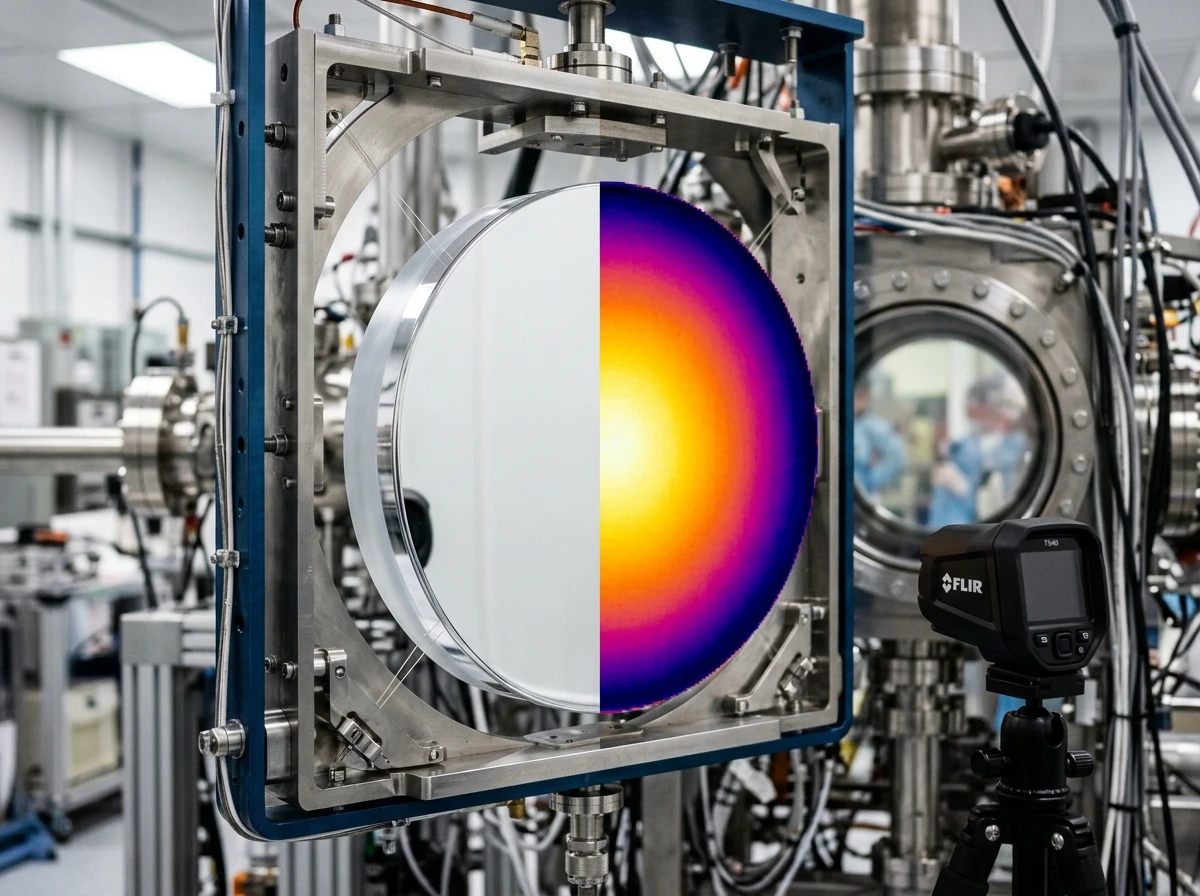
The fix targets a flaw engineers already knew how to fight but could never precisely aim at. Richardson’s group found that a commercial thermal imaging camera, pointed at a mirror’s surface and paired with computer models already used across the observatory, supplies exactly the map that targeted heating needs to cancel out distortion.
Richardson said in the university’s announcement, “It doesn’t require any new technology development, which is almost unheard of for solving a LIGO instrumentation problem.” The camera itself is a standard commercial unit. The advance sits entirely in how its images get processed.
Once integrated into LIGO’s next upgrade, the team estimates the technique could extend the observatory’s reach by about 33 million light-years, improving strain sensitivity by as much as 31 percent for the faintest signals.
Inside the 4-Kilometer Arms Where Gravity Leaves a Flicker
LIGO runs two L-shaped detectors, one in Washington and one in Louisiana, built to catch a distortion in spacetime smaller than a proton. Both sites have to agree before scientists trust a signal is real.
- A laser beam splits and races down two 4-kilometer tunnels arranged in an L shape.
- Each beam reflects off a mirror suspended at the far end of its tunnel.
- The reflected beams travel back and recombine at the point where they started.
- A passing gravitational wave stretches one tunnel by a sliver of a proton’s width while squeezing the other.
- That mismatch shifts the recombined light just enough to produce a measurable flicker.
- Scientists cross-check the flicker against the same instant at LIGO’s sister detector before calling it a real cosmic event.
Merging black holes and neutron stars are the main sources behind that flicker, events violent enough to ripple spacetime across billions of light-years. The fainter and more distant the collision, the harder it is to separate its signal from noise, which is exactly where mirror heating does its damage.
Nanometers of Heat, Miles of Lost Reach
LIGO’s mirrors rank among the purest optical components ever manufactured, polished to a smoothness measured in atoms. Even so, they absorb a sliver of the laser light constantly bouncing through them.
That absorption becomes heat. Circulating power inside the interferometer’s arms climbs toward a megawatt, and the resulting warmth bends each mirror’s face by only a few nanometers, roughly the width of a virus. It is enough to throw off the laser beam’s shape and quietly erode sensitivity across the whole detector.
Engineers have long known how to fight back: apply carefully targeted heat to the back of a mirror to cancel the warp. What they lacked was a full picture of that warp, mapped across the optic’s entire face rather than sampled at a handful of points. LIGO’s core mirrors, fused-silica optics roughly 34 centimeters across, left too much surface uncharted for older sensors to correct with confidence.
Richardson’s Team Already Tried the Hardware Fix
This is not Richardson’s first run at the problem. He joined UC Riverside in 2021 after a postdoctoral stint at Caltech’s LIGO Laboratory, where he helped commission the Advanced LIGO detectors, and has spent the years since building instrumentation aimed at squeezing more range out of the same tunnels.
- 2021: Richardson joins UC Riverside and wins a National Science Foundation grant to develop new gravitational-wave detector instrumentation.
- February 2025: His group publishes a paper in Physical Review Letters describing a ring-shaped adaptive-optics actuator built to reshape LIGO’s mirrors with far greater precision than earlier heating systems.
- July 2026: A follow-up paper in Classical and Quantum Gravity shows the actuator was never the missing piece. A commercial thermal camera, paired with computer models, supplies the precise distortion map it needed all along.
That 2025 device, covered in UC Riverside’s announcement of a ring-shaped actuator for LIGO’s mirrors, solved how to apply a correction. Knowing exactly which correction to apply remained unsolved until this year’s camera closed the loop.
Why 33 Million Light-Years Is Worth More Than It Sounds
The Volume Math
LIGO’s sensitivity has climbed in careful steps since it first switched on. Each generation of upgrades pushed the detection horizon a little farther into the dark.
| Milestone | Approx. Neutron-Star Merger Range | Roughly in Light-Years |
|---|---|---|
| Initial LIGO | 15 megaparsecs | 49 million |
| Second observing run | Just under 100 megaparsecs | ~320 million |
| Third observing run | 135 megaparsecs | ~440 million |
| A+ network design target | ~200 megaparsecs | ~650 million |
| A+ with the thermal-camera fix | ~210 megaparsecs | ~685 million |
The rightmost gain in that table, from roughly 200 to 210 megaparsecs, looks like the smallest jump on the page. It is not, once geometry gets involved. Volume scales with the cube of the radius rather than the radius itself, so that last 10-megaparsec step swells the enclosed search volume by close to one-sixth, not one-twentieth.
Why Neutron Stars Benefit Most
LIGO reports range using neutron-star mergers as the standard yardstick, and that happens to be the collision type multi-messenger astronomy wants most. Unlike two black holes swallowing each other in total darkness, colliding neutron stars fling out visible matter.
The only confirmed neutron-star collision LIGO has caught together with light, back in 2017, produced a kilonova that helped confirm where the universe’s gold and platinum come from. Every additional cubic megaparsec inside this expanded search volume is another shot at repeating that: an event telescopes can actually chase, unlike the black hole mergers that fill most of LIGO’s catalog.
What Changes Once LIGO’s Next Upgrade Arrives
The fix is not live yet. It still has to be folded into LIGO’s next upgrade cycle before it changes what the observatory can actually see, and no public rollout date has been attached to that step.
Richardson is already working on what comes after that upgrade. He serves as the optical Mode Sensing and Control lead for Cosmic Explorer, a proposed next-generation successor built to push well beyond what LIGO’s current tunnels can reach.
UC Riverside also named him a recipient of one of its top seed grants for gravitational-wave astronomy this month, backing further computational work aimed at future detector design.
For now, the fix exists as a published method and a number on paper: 33 million more light-years of reach, waiting on an upgrade schedule to make it real.
Frequently Asked Questions
What Is a Megaparsec, and How Far Is 33 Million Light-Years?
A megaparsec equals about 3.26 million light-years. LIGO’s range estimates are typically quoted in megaparsecs, so the 10-megaparsec gain from the thermal-camera fix converts to the roughly 33 million light-years UC Riverside cited when describing the upgrade.
What Is LIGO’s A+ Upgrade, and Where Does This Fix Fit In?
A+ is the upgrade path currently planned for LIGO’s two United States detectors, intended to push sensitivity well beyond the current observing run. Researchers estimate the camera-based fix alone could improve strain sensitivity by up to 31 percent once folded into that upgrade.
Could Virgo or KAGRA Use the Same Thermal-Camera Trick?
Nothing about the method is built specifically for LIGO’s hardware. It combines a commercial thermal camera with computer models of heat flow, both of which any interferometer could adopt in principle. Neither Virgo in Italy nor KAGRA in Japan has announced plans to do so.
Does This Fix Solve All of LIGO’s Sensitivity Limits?
No. Thermal lensing is one of several noise sources capping LIGO’s sensitivity alongside quantum noise and ground vibration, and this method addresses only the mirror-heating distortion. Richardson’s group has separately developed a hardware actuator for the same problem and continues building tools aimed at future detectors like Cosmic Explorer.