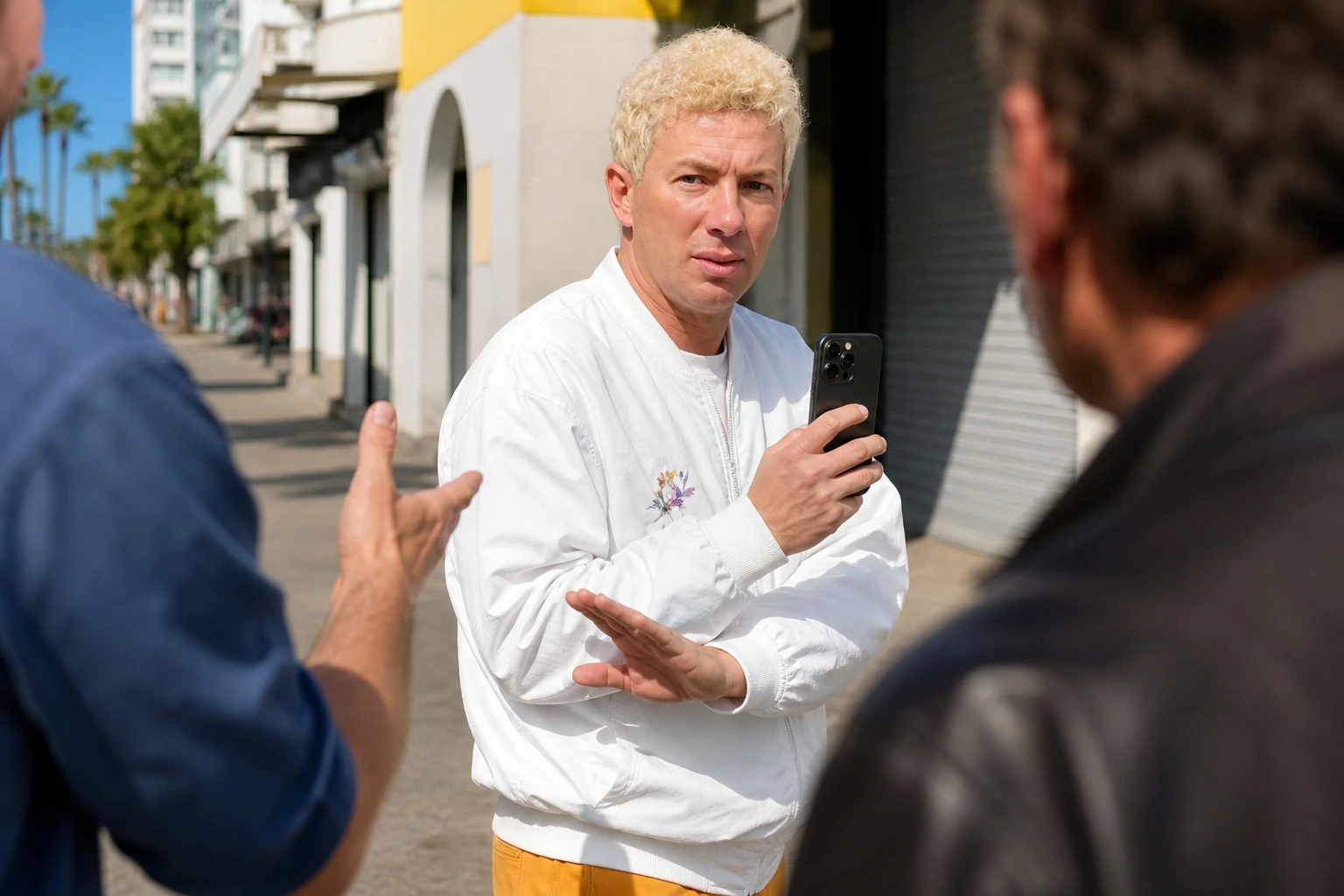
Adjara TV host Koba Partenadze posted a Facebook video on the morning of August 10 showing unidentified men confronting him on a Batumi street and telling him to follow them aside. He refused, saying he was headed to the television station, while one man used homophobic slurs tied to his bleached hair. Partenadze said the insults, threats and unwanted physical contact now happen almost every evening.
The Interior Ministry confirmed to Civil.ge that police launched an investigation. The Georgian Charter of Journalistic Ethics demanded urgent action to protect him before another tragedy occurs.
The clip is brief. The pattern it captures is not. What begins as a sidewalk demand becomes a public record of how routine harassment can look when a journalist simply tries to reach a newsroom.
Unidentified Men on the Way to Work
In the video reel, several people approach Partenadze and insist he step aside with them. He asks where he should follow a stranger and keeps walking toward the station. The confrontation continues. Civil.ge reported that one of the men directed abusive, homophobic language at him and mocked his hair color.
Partenadze later wrote that similar scenes have become routine. Some incidents were caught on camera. Others were not, because he never expected to need his phone as a daily shield for his safety and dignity.
The refusal itself is part of the record. He does not leave the public sidewalk. He names his destination. The men do not identify a lawful basis for the demand. The exchange ends without a formal arrest, yet the threat and the slur remain on the tape.
That combination matters for any later probe. Witnesses may differ. Memory fades. A timestamped reel fixes the words, the approach and the journalist’s stated purpose in a single continuous take.
How Many Times Before It Counts as Systematic
His accompanying post laid out the pattern in plain terms. He listed the daily reality and then asked the questions that turn an “incident” into something larger.
- Every evening he meets people who insult him, threaten him and make unwanted physical contact.
- Several attacks have occurred in recent days alone.
- He has footage of some episodes and none of others.
- He wants the same safety, legal protection and justice every citizen deserves, nothing more.
“How many times do I have to be attacked for this to stop being just an ‘incident’? How many times do I have to go to the police before someone considers this a systematic problem?” he wrote.
I am not asking for special treatment. I am not asking to be above the law. I am asking only for what every citizen deserves, safety, protection under the law and justice.
Partenadze made that statement on Facebook the same morning the video appeared.
The wording is deliberate. He rejects any claim of privilege. He frames the demand as ordinary citizenship. That framing presses investigators to treat repetition, not novelty, as the core fact.
When evening after evening produces the same conduct, each new file risks being logged as isolated. His questions push the opposite reading: frequency itself is evidence.
Three Years Earlier at Radio Adjara
This is not the first time Partenadze has reported a physical assault in Batumi. On June 14, 2023, Adjara TV and Radio Public Broadcaster said an unidentified man attacked him at Radio Adjara right after the morning show. Partenadze told interviewers the man grabbed him by the hair and threw him down three stairs. He was not seriously injured. He believed the motive was his unconventional appearance or clothing.
Police opened a case under Article 126 of the Criminal Code, which covers violence. The Charter of Journalistic Ethics called then for a quick, effective investigation and asked whether the attack linked to his professional work. The same organization is now repeating the call for the same journalist in the same city.
The through-line is hard to miss once the dates are set side by side.
- June 14, 2023 – An unidentified man attacks Partenadze at Radio Adjara after the morning show; police open an Article 126 case.
- 2023 – Parliament folds Adjara TV and Radio’s remaining independent structures into the national Public Broadcaster.
- August 10 – Partenadze posts street video of a new confrontation; the Charter again demands urgent protection.
Hair was a focus in 2023. Hair is a focus again in the latest insults. The workplace then was the radio building. The path now is the street walk to the television station. The city is unchanged.
Article 126 gave the earlier file a clear criminal label. The current probe’s article has not been named in the ministry’s public replies. Continuity of attention, not only continuity of harm, is what the repeated Charter appeals seek.
Hundreds of Attacks, Thin Accountability
Partenadze’s experience sits inside a documented national pattern. Justice for Journalists recorded 250 cases of attacks and threats in 2025 against media workers and newsrooms. That figure held roughly steady with 298 the year before. Physical attacks and threats to life fell to 35 incidents, nearly three times lower than 2024, yet 22 of those 35 still came from representatives of the authorities. Judicial and economic pressure dominated, accounting for 171 cases or 68 percent of the total.
Reporters Without Borders, working with the Center for Media, Information and Social Research, counted 600 attacks against the press in one year from October 2024 through 2025. The period covered the contested parliamentary election and the wave of protests that followed the suspension of EU accession talks. Tbilisi produced more than two-thirds of the cases. Assaults, arbitrary fines, arrests, threats and accreditation suspensions filled the tally. Georgia fell to 114th in the RSF World Press Freedom Index.
| Period / Source | Total Attacks or Violations | Physical Component | Key Note |
|---|---|---|---|
| 2025 (JFJ) | 250 | 35 | 85% by authorities; 171 judicial/economic |
| Oct 2024-2025 (RSF/CMIS) | 600 | 127 violent in early protest wave | Tbilisi majority; fines for “blocking roadway” common |
| May 2024-May 2025 (CMIS) | 342 | Not broken out | Broader rights violations against media |
| 2024 baseline (JFJ) | 298 | Higher physical count | Pre-2025 comparison year |
European Federation of Journalists material on the escalating media freedom crisis report noted that Mapping Media Freedom logged 63 physical assault cases involving 148 journalists since 2024, with police or state security named as perpetrators in 60 percent. Impunity remains the constant. Probes open. Convictions and protection orders rarely follow at the same pace.
Stats snapshot from the 2025 JFJ review:
- 250 total attacks and threats documented
- 35 physical attacks or threats to life, liberty and health
- 171 cases via judicial or economic means
- 9 foreign journalists denied entry
One high-profile thread running through the same period is the two-year prison sentence given to Mzia Amaglobeli, co-founder of Batumelebi and Netgazeti, after she slapped a Batumi police chief. Her case became a rallying point for independent newsrooms. Street-level harassment of the kind Partenadze describes coexists with that formal pressure.
Read together, the tallies show a shift in shape more than a simple decline. Physical counts can fall while judicial and economic tools carry most of the weight. Batumi street confrontations still fit the smaller physical slice. They also arrive in a climate already thick with other forms of pressure on the press.
Tbilisi dominates the national maps. That concentration does not empty the coastal cases of meaning. It shows how a regional journalist’s evening walk can mirror, at smaller scale, the same unresolved mix of threat and thin follow-through tracked in the capital.
Adjara TV After the Independence Cuts
Partenadze works for Adjara’s public broadcaster. In 2023 parliament passed amendments that folded the last independent structures of Adjara TV and Radio into the national Public Broadcaster. The national board, already seen as aligned with Georgian Dream, gained power over the regional outlet’s director, budget and priorities. Later reorganizations included staff dismissals. Critics described the move as the final step in taming a once more autonomous regional voice.
Whether Partenadze’s recent attackers are motivated by his on-air work, his appearance, or both remains unproven in the open investigation. The 2023 assault was widely linked by the journalist himself to how he looks. The latest video again features insults about his hair. Professional risk and personal targeting blur together in the same streets.
Ownership and governance changes do not, by themselves, prove a motive for any single sidewalk attack. They do define the institution the journalist still serves. A regional outlet now steered from the national board is a different workplace from the more autonomous structure that preceded the amendments.
Viewers who meet him only as a face on air may know little of that history. Attackers who fixate on bleached hair may know even less. The blur he describes still leaves investigators with both threads to test: the look, the job, and the possibility they reinforce each other.
Charter Call Meets Ministry Confirmation
The Georgian Charter of Journalistic Ethics issued a direct appeal after the August 10 video. It urged the Ministry of Internal Affairs to recognize the gravity of the repeated attacks, give the case proper weight, identify the perpetrators and hold them accountable “before another tragedy occurs.” The organization has made similar statements after earlier assaults on the same journalist and many others.
The ministry’s press center told Radio Free Europe/Radio Liberty that an investigation is underway and investigative measures are being carried out. Civil.ge reported the same confirmation on August 10 but noted the ministry did not specify the Criminal Code article under which the probe is running.
Similar sequences have played out before. A journalist reports violence. An investigation is announced. Public statements follow. Concrete protection and prosecutions lag. The same pattern appears in coverage of other press cases, from the exiled journalist tried over Georgia war post to the Salvadoran journalist arrest sparking press freedom outcry inside Georgia’s borders.
Announcement and outcome are different stages. The Charter’s language treats delay itself as risk. The ministry’s reply establishes process without yet answering the weight and the identification demands in full public view.
Street Harassment Meets Formal Pressure
Batumi now holds more than one emblem of pressure on independent journalism. Amaglobeli’s two-year sentence after the slap of a local police chief became a rallying point for newsrooms far beyond the city. Partenadze’s evenings describe a lower-intensity, higher-frequency form of harm on the same map.
One track runs through courts and prison terms. The other runs through sidewalks, slurs and hands that should not touch. Both tracks leave reporters calculating risk before ordinary workdays.
- Formal pressure: judicial files, economic levers, high-profile sentencing.
- Street pressure: repeated insults, threats, unwanted contact on the route to the station.
- Shared result: safety depends on whether institutions treat repetition as urgency.
National monitors already separate physical cases from judicial and economic ones in their tables. Life on the ground does not always keep those columns apart. A journalist can face a camera-phone confrontation at dusk and still work inside a broadcaster reshaped by parliamentary amendments years earlier.
That overlap is why local appeals keep citing gravity rather than novelty. The conduct is familiar. The request is for the response to catch up to the pattern.
Open Files Rarely Match The Pace Of Harm
Across the monitors cited above, the recurring gap is not the absence of paperwork. Files open. Statements issue. What lags is the chain that turns an opened case into identified suspects, charged acts and durable protection.
Partenadze’s own questions point at that lag directly. He asks how many police visits are required before the label shifts from isolated incident to systematic problem. The Charter’s renewed appeal uses the same logic when it warns against waiting for a worse outcome.
| Stage | What The Record Shows | What Still Lags |
|---|---|---|
| Report | Video, posts, workplace notice of assault | Consistent early protection measures |
| Confirmation | Ministry says a probe and measures are underway | Public naming of the Criminal Code article |
| Pattern | Repeated evenings, prior 2023 case, national tallies | Convictions and orders at matching speed |
Impunity, in the European Federation material, is described as the constant. That word does not require every file to close empty. It fits when openings outnumber visible endings year after year.
For a presenter still walking the same routes, the practical test is simple. Does the next evening look different because institutions moved. Or does the camera remain the only reliable witness within arm’s reach.
Partenadze continues walking the same Batumi routes to work. The cameras stay on. The investigation remains open. The larger count of unresolved attacks on Georgian media workers keeps rising in the background.