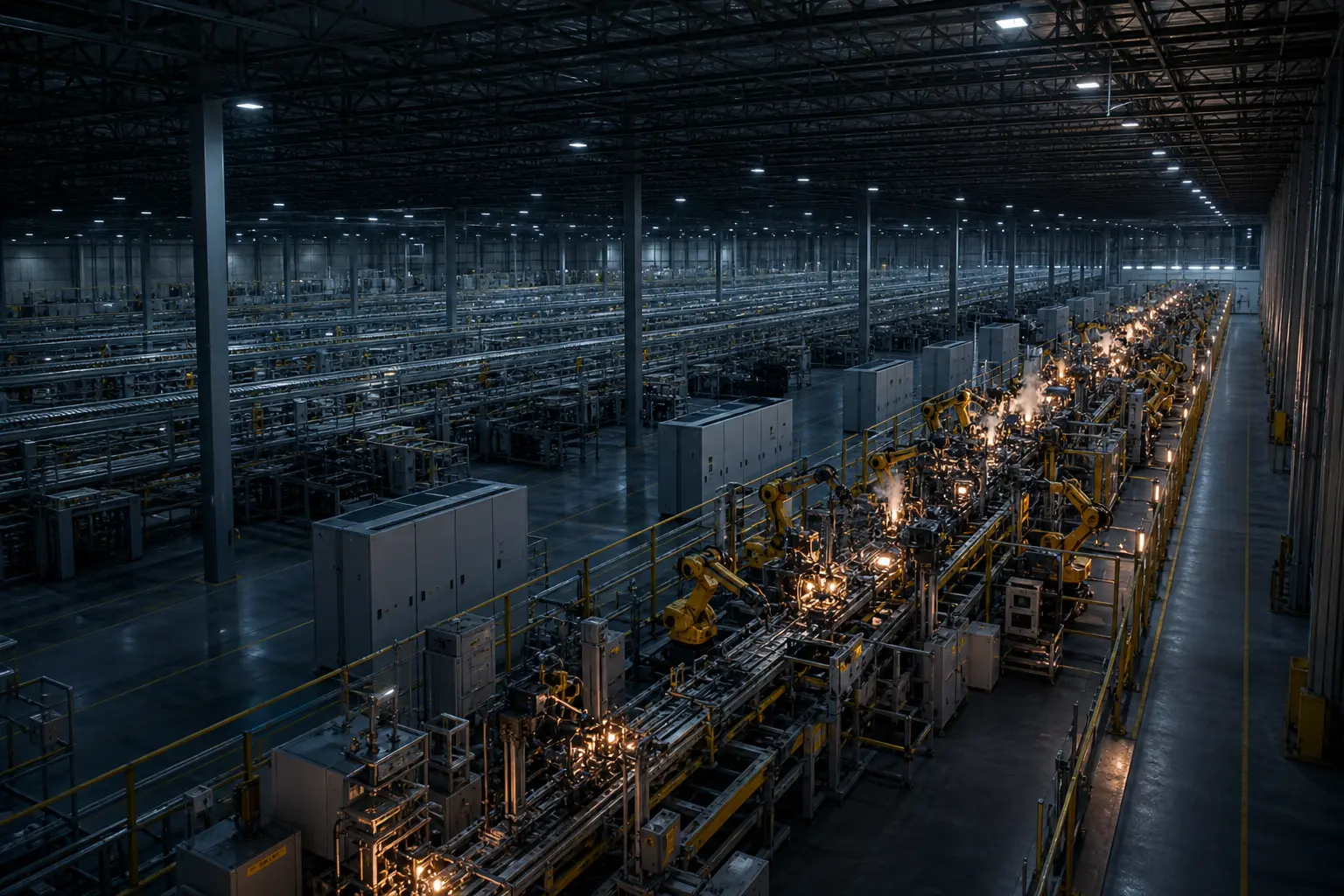
Hyundai and SK On have started making battery cells at their $5 billion joint venture in Bartow County, Georgia, more than a year behind the original schedule. The plant, called Hyundai SK Battery Manufacturing America, is running at a fraction of what it was built for. At full scale, it is designed to turn out 35 gigawatt hours of batteries a year, enough to supply roughly 300,000 electric vehicles.
The timing cuts both ways. An hour northeast in Commerce, Georgia, SK Battery America laid off 958 workers in March, more than a third of its staff, citing the same soft EV demand this new plant is betting will eventually show up.
Georgia’s Newest Battery Line Finally Turns On
A company spokesperson confirmed to the Atlanta Journal-Constitution that the joint venture “is in the early stages of production and plans to gradually scale up operations.” The factory sits on 752 acres off Highway 411 in Bartow County, inside a 3.3 million square foot building that already employs more than 3,500 people.
Georgia backed the project with $641 million in tax incentives and other subsidies. Once cells come off the line, Hyundai Mobis assembles them into battery packs for Hyundai, Kia and Genesis electric vehicles built in the United States. Three models depend directly on this new supply chain.
- Hyundai Ioniq 5, the compact crossover assembled at Metaplant America near Savannah
- Hyundai Ioniq 9, a three-row SUV built on the same Savannah campus
- Kia EV6 and EV9, mechanically related siblings built at Kia’s plant in West Point
That Savannah campus, formally Hyundai Motor Group Metaplant America, has also begun building hybrid Kia Sportage models as EV sales growth slows, a hedge that runs parallel to the battery bet a county away.
Three Years From Groundbreaking to First Cells
Georgia Gov. Brian Kemp announced the Bartow County site in December 2022, calling Hyundai and SK On “valued partners” in the state’s automotive push, according to the original site announcement. That release pegged the investment at $4 billion to $5 billion and estimated 3,500 new jobs, numbers that held up almost exactly as construction proceeded.
- December 2022: Kemp announces the Bartow Centre site pick for the Hyundai and SK On venture.
- April 2023: Hyundai, Kia and Hyundai Mobis boards finalize the 50-50 joint venture and confirm the $5 billion price tag.
- Second half of 2025: the original target for battery cell production, later pushed back.
- June 2026: the plant begins producing cells, according to the joint venture.
- July 2026: a spokesperson confirms early-stage production to the Atlanta Journal-Constitution, with output still scaling up.
Neither company has said publicly why the timeline slipped by roughly a year.
Three Korean-Backed Battery Bets, One State
Bartow County is not the only place a South Korean battery giant has bet big on Hyundai’s US expansion. Georgia now hosts three distinct Hyundai-linked battery projects, each with its own timeline and, lately, its own fortunes.
| Plant | Partners and County | Investment | Capacity | Status as of July 2026 |
|---|---|---|---|---|
| Hyundai SK Battery Manufacturing America (HSBMA) | Hyundai Motor Group and SK On, 50-50, Bartow County | $5 billion | 35 GWh a year, about 300,000 EVs | Early production, scaling up gradually |
| SK Battery America | SK On, wholly owned, Commerce | $2.6 billion | About 22 GWh a year, 200,000-plus EVs | Cut 958 jobs in March; about 1,600 employees remain |
| HL-GA Battery Company | Hyundai Motor Group and LG Energy Solution, 50-50, Bryan County | $4.3 billion | 30 GWh a year, about 300,000 EVs | Construction resumed after a raid; targeted first-half 2026 restart |
SK On’s Commerce facility opened back in 2022 as the state’s original showpiece for Korean battery investment, years before Bartow County or Bryan County broke ground.
SK’s Other Georgia Plant Just Lost a Third of Its Workforce
SK Battery America notified Georgia officials on March 6 that it was cutting 958 of its 2,566 employees at the Commerce plant, about 37% of the workforce, in a Worker Adjustment and Retraining Notification (WARN) filing. The company said it was adjusting operations to align with market conditions while staying committed to its Georgia investments.
The cuts trace back to Ford’s decision to cancel the fully electric F-150 Lightning in December, ending an $11.4 billion battery joint venture between SK and Ford. SK Battery America had supplied cells for that truck. The company now says it is pivoting toward battery energy storage systems (ESS) for the power grid, chasing demand that batteries for unsold EVs cannot provide.
The layoffs landed months before federal support for EV buyers disappeared entirely. The $7,500 credit for new EVs and $4,000 credit for used ones ended for vehicles bought after September 30, 2025, a policy shift Kemp has described as correcting an inflationary market distortion that had artificially propped up EV demand.
Let’s be clear: these were battery manufacturing jobs and now they’re gone.
Sen. Jon Ossoff, a Georgia Democrat, said it in a statement cited by the Associated Press, adding that the cuts were proof the administration’s policies were hurting the state’s economy.
The Raid That Still Shadows Bryan County
Nearly 500 workers were swept up at the HL-GA Battery Company construction site near Savannah on September 4, 2025, in what Homeland Security Investigations called the largest single-site enforcement operation in its history. Of the 475 people detained, more than 300 were South Korean nationals brought in to install specialized battery equipment.
Most were repatriated within about a week after South Korea’s government intervened. Construction stopped for roughly two months. It resumed in mid-November 2025 with a mix of new hires and returning workers. By then, more than 100 of the 317 detained South Korean nationals had their B-1 business visas reinstated without needing to reapply, a detail their attorneys read as proof the workers had been in the country lawfully.
Charles Kuck, an immigration attorney who represented several of the detained workers, told Forbes that “the ICE raid in Georgia is going to have a massive economic impact.” He said other attorneys were hearing from Asian and European companies weighing whether to pause big US investments for years.
LG Energy Solution said construction and business travel had resumed, with a spokesperson adding the company plans to locate “half of our total global battery cell-making capacity” in the US over the medium term. HL-GA said in November it remained on track to start production in the first half of 2026. Neither company has issued a public update confirming whether that goal was met.
Hyundai Is Quietly Gaining on Chevrolet
- 26,936 Hyundai EVs sold in the US through the first half of 2026, according to Kelley Blue Book data, trailing only Chevrolet among non-Tesla brands.
- 380% growth in Ioniq 9 sales this year as buyers look for efficient three-row options amid higher gas prices.
- 40% decline in Chevrolet’s EV sales from nearly 47,000 a year earlier, narrowing Hyundai’s gap to just 1,331 vehicles.
- $35,000 starting price for the 2026 Ioniq 5 after Hyundai cut prices by up to $9,800 to offset the lost tax credit.
Hyundai’s price cuts across the Ioniq 5 lineup came directly out of savings from localizing its battery supply chain in Georgia, the automaker says. Hyundai also ran a promotion with 0% financing and up to $10,000 off electric vehicles earlier this month, an aggressive push while overall US EV sales sit at roughly 8% of the new vehicle market, about flat with a year earlier.
Does Georgia’s Battery Bet Survive a Slow EV Market?
Hyundai and SK On have already spent billions assuming EV demand recovers well before the decade ends. The Bartow County plant can already produce far more battery capacity than current sales need, and how fast it climbs toward full output now depends on whether Hyundai and Kia’s US EV sales keep gaining while rivals retreat.
Georgia’s EV-adjacent investment already topped $17 billion and 22,800 jobs before this plant was even announced, and the tally has only grown since with Rivian’s own multibillion-dollar factory taking shape elsewhere in the state. That scale of industrial buildout, layered on top of a wave of new data centers, is also reshaping the state’s electricity planning. The fight over who pays for roughly $16 billion in new power generation heads to Georgia voters in November.
Hyundai and SK On say output will keep rising from here. The only question the market has not answered is how many buyers are waiting for it.
Frequently Asked Questions
How Many Jobs Does the Bartow County Battery Plant Support?
The plant already employs more than 3,500 people, matching the jobs estimate Georgia officials gave when the project was announced in December 2022. That estimate has held steady through construction, unlike the production timeline, which slipped by roughly a year.
Why Did Production Start a Year Later Than Planned?
Neither Hyundai nor SK On has given a public reason. The delay lines up with a broader industry pullback, as automakers have collectively written off more than $55 billion after overestimating near-term EV demand, according to industry reporting.
Was the Bryan County Site Troubled Before the Immigration Raid?
Yes. Two construction workers died at the HL-GA site earlier in 2025, and several subcontractors named in the raid’s search warrant were already under investigation by the Occupational Safety and Health Administration over those deaths.
Is the Federal EV Tax Credit Coming Back?
There is no indication of that. The $7,500 new-EV credit and $4,000 used-EV credit ended for purchases after September 30, 2025, and current law shows no sign of reinstating them in 2026.
How Does the Ioniq 5 Compare to Tesla’s Best Sellers?
Through the first half of 2026, the Ioniq 5 was America’s third-top-selling EV, trailing only the Tesla Model 3 and Model Y, according to sales data cited by Electrek.
Could There Be More Battery Plant Layoffs in Georgia?
It is possible. Industry trackers note that without an expected increase in EV demand over the next couple of years, additional job cuts at Georgia’s battery plants remain on the table.