Hyundai Motor Group’s Metaplant America in Ellabell, Georgia, began building the 2027 Kia Sportage Hybrid on June 2, the first gas-electric vehicle and first Kia produced at a plant that was designed to make only electric cars. It is the third model off the line, joining the battery-powered Hyundai IONIQ 5 and IONIQ 9.
Governor Brian Kemp called it a historic moment. The reveal also doubled as an admission. The $7.6 billion factory was built as Hyundai’s flagship all-electric plant, and a hybrid SUV coming down the same line shows how far US appetite for EVs has slipped, and how quickly the company moved to hedge.
A Robot Delivered the Sportage Hybrid to the Stage
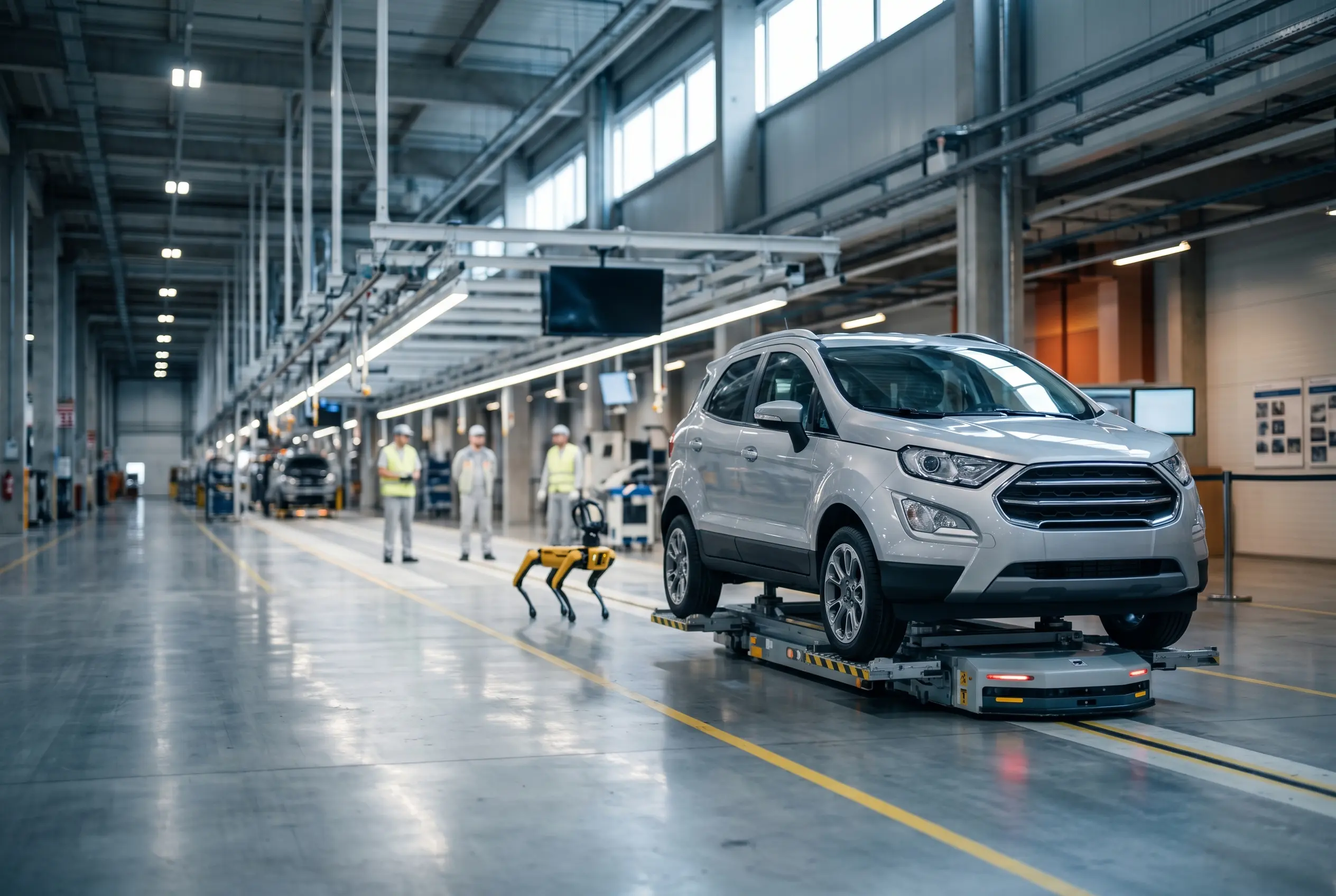
The new SUV reached the stage riding an autonomous mobile robot (AMR, a self-driving cart used across the plant’s floor). Two yellow robot dogs wiggled in front of a row of posed Kias as roughly 200 employees, the workers Hyundai Motor Group Metaplant America (HMGMA) calls Meta Pros, watched the unveiling.
The choreography was pure factory-of-the-future theater, and the automation underneath it is real. The same Ellabell campus has been used as a live testing ground for advanced robotics, including Boston Dynamics’ Atlas humanoid on a working line. That flexibility is the whole point of the place, and it is why a hybrid could slot in beside two EVs without tearing up the plant.
The Sportage Hybrid has been built in South Korea for years. This is the first time it has been assembled in the United States. Kia North America and America President and CEO Seungkyu (Sean) Yoon and Kia Georgia President and CEO Stuart Countess joined Kemp and the Meta Pros for the reveal, which Kia and HMGMA announced in a joint statement on the Sportage Hybrid launch. The model is a compact SUV, one of Kia’s volume sellers, and Yoon said demand for hybrid SUVs like the Sportage, Carnival, and Telluride is climbing.
A Factory Built for Electrons, Reworked Before It Opened
The Metaplant broke ground in 2022 and rolled out its first IONIQ 5 in 2024 as Hyundai’s dedicated electrified-vehicle plant. Pure electric was the plan. Then the plan changed while the concrete was still curing.
Chris Susock, chief manufacturing officer for Hyundai Motor North America, said the site was originally meant to build all-electric vehicles. Partway through construction, officials decided to make the plant capable of hybrid electric vehicle (HEV) production too, so the company could ride out whatever the market did.
It’s about the flexibility in the automation and technology of these plants moving forward. It gives us the ability … to be able to switch on a dime, to change the mix pattern based on power trains in order to adapt to the market very quickly.
That was Susock, speaking at the Ellabell reveal. The decision looks shrewd now, but it started as damage control. A plant designed for one powertrain became a plant that can run several, which is why the same workforce that builds EVs could be retrained rather than laid off. Many Meta Pros traveled to Kia’s plant in West Point, Georgia, and to South Korea to learn Sportage Hybrid assembly, building on the kind of preparation Georgia invested in when it opened the Hyundai mobility training center near the plant.
Why the Electric Bet Cooled
The market shift Susock is reacting to has a clear trigger. The $7,500 federal credit for new electric vehicles, a discount that did much of the work pulling buyers into showrooms, ended for purchases after September 30, 2025, under the One Big Beautiful Bill Act (OBBB, the tax-and-spending law President Donald Trump signed on July 4, 2025).
Once that $7,500 incentive lapsed, EVs got more expensive to buy overnight, and demand softened. The full menu of clean-vehicle rules now sits on the IRS clean vehicle tax credit page, where the new and used EV credits are listed as expired. A loan-interest deduction worth up to $10,000 a year survives through 2028, but that is a thinner lure than a five-figure price cut at signing.
For a plant built to pump out electric cars by the hundreds of thousands, the timing was brutal. Hyundai had bet that US EV adoption would keep climbing through the decade. It stalled instead, and the hybrid version of the Sportage is the company’s answer to a question its original blueprint never asked: what do you build when the electric demand isn’t there yet?
Detroit Is Backing Away From the Same Bet
Hyundai is not alone, and it is moving faster and cheaper than most. Across the industry, automakers spent 2025 and early 2026 writing down battery-electric vehicle (BEV) plans and shoveling money toward hybrids that actually sell. The charges have been enormous.
| Automaker | EV-related hit or cut | Move toward hybrids |
|---|---|---|
| General Motors | About $7.6 billion in EV-related charges, reported in early 2026 | Reintroduced plug-in hybrids it had dropped in North America |
| Ford | A $19.5 billion charge to write down BEV investments | Redirected development toward trucks and an expanded hybrid lineup |
| Honda | Cut electrification and software spend by about 30% through 2030 | Accelerated new in-demand hybrid models |
| Hyundai / Kia (HMGMA) | No write-down; added hybrid capability mid-build | Sportage Hybrid now in Georgia, with more models possible |
That last row is the difference. GM and Ford committed factories and product lines to pure electric and are now paying to unwind those commitments. By baking hybrid flexibility into the Metaplant during construction, Hyundai turned a market reversal into a line-changeover instead of a multibillion-dollar charge. The bet still cooled. It just didn’t blow a hole in the balance sheet.
Production Is Running at Half the Plant’s Capacity
The Metaplant is still climbing toward its ceiling. Last month the facility shipped about 6,000 units, which Susock pegged at roughly 50% of current capacity. The plan is to hit full output by 2028. Here is where the numbers sit today.
- About 6,000 units shipped in the most recent month, around half of current capacity.
- 580,000 vehicles a year is the full-capacity target Hyundai expects to reach by 2028.
- Nearly 2,000 Meta Pros work at the plant now, with 8,500 jobs at HMGMA planned by 2031.
- Up to 550,000 Kia vehicles a year across the West Point and Ellabell plants combined, per the company.
- The Metaplant is engineered to build up to 10 different models on the same flexible line.
The $7.6 billion is the plant alone. Counting Hyundai’s battery joint ventures with LG Energy Solution and SK On, the group’s total Georgia commitment runs to about $12.6 billion, the largest single investment in the state’s history, detailed on the state’s economic development page for the Metaplant project. Susock framed the next phase as a simple handoff to product planners: give the factory a forecast, and it will build whatever the mix calls for, whether that is more Kias, different hybrids, or new models entirely.
What Georgia Bet On
For the state, the math has always been about jobs more than powertrains. Kemp built much of his economic pitch around the Metaplant, and a hybrid coming off the line keeps those paychecks coming whether or not Americans rush back to EVs.
Yoon leaned into that, calling the Savannah-area plant “a clear testament to our confidence in this state’s future as an automotive powerhouse,” and predicting the Sportage Hybrid would “quickly become one of our highest volume models.” Tony Heo, HMGMA’s president and CEO, credited the retrained Meta Pros for getting the hybrid line ready. The company’s official narrative, laid out on the HMGMA corporate site, still leads with electric ambition, but the floor tells a more flexible story.
The Metaplant opened as proof that the electric future had a Georgia address. Three years on, its third vehicle burns gasoline, and that is the clearest sign yet of how much the road to that future has lengthened.