A pesticide already pulled from the market once by a federal court over thin bee safety data is now showing signs of the exact harm regulators once said they could not rule out. Georgia Tech researchers found that low doses of sulfoxaflor altered gene expression in bumblebee ovaries and suppressed egg laying. The work was funded by the U.S. Department of Agriculture.
Roughly one third of the food Americans grow depends on pollinators like bees, according to the researchers behind the study. Sulfoxaflor was sold as the safer, next generation answer to older bee killing chemicals. The new data complicates that pitch considerably.
Ovarian Tissue Shows the Sharpest Genetic Shifts
The team, led by scientists in Georgia Tech’s School of Biological Sciences, exposed worker bumblebees of the species Bombus impatiens, the common eastern bumblebee, to low concentrations of sulfoxaflor. They then tracked how gene activity shifted across different tissues.
Ovarian tissue moved the most. Egg laying dropped. Nest building slowed in lab colonies. Neural tissue and foraging behavior barely budged by comparison, meaning the bees looked and acted normal while their reproductive machinery quietly broke down.
The suppressed egg laying and stalled nest building were documented in a peer reviewed paper in the journal Ecotoxicology and Environmental Safety. Researchers flash froze bee tissue to track RNA shifts and ran computational models to pinpoint which biological systems absorbed the damage.
What makes this study exciting is that it connects molecular changes in gene expression to real-world consequences for individual bees and their colonies.
Michael Goodisman, a professor in Georgia Tech’s School of Biological Sciences and a co-author of the study, made that connection between the molecular data and colony survival. It is the kind of link that pesticide reviews rarely make.
The Safety Tests Were Built for a Different Kind of Harm
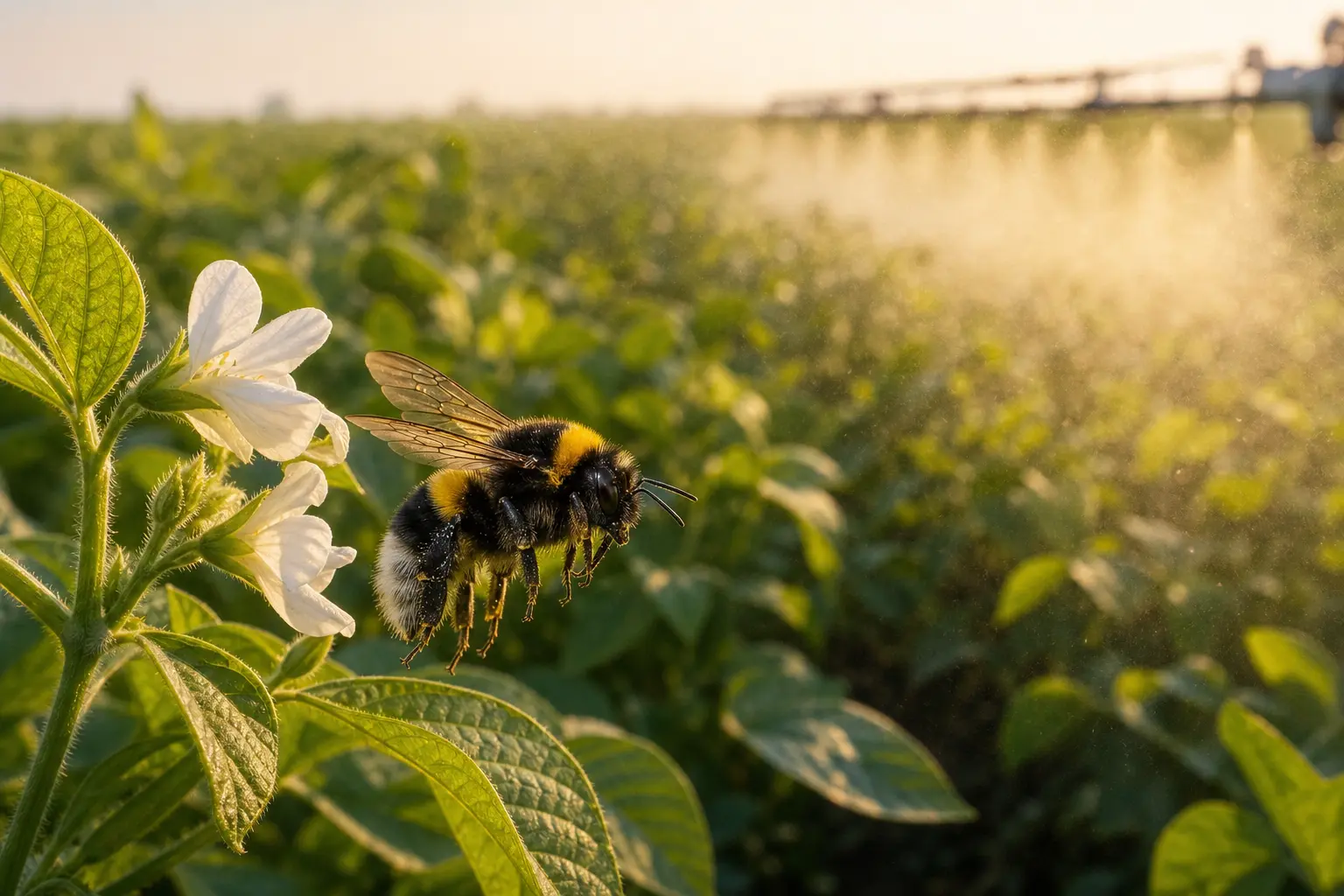
Federal pesticide registration in the United States runs through the Federal Insecticide, Fungicide, and Rodenticide Act (FIFRA, the law governing how pesticides get approved and labeled). Those reviews lean heavily on acute toxicity, essentially how much of a chemical it takes to kill a bee outright in a short window.
Sulfoxaflor was designed to score well on exactly that measure. It breaks down faster in the environment than older chemicals and generally needs fewer applications per season.
Chronic, low dose reproductive harm sits outside that testing frame entirely. A bee can survive a full exposure, forage normally, and still carry ovaries that have stopped functioning the way they should. That is the gap the Georgia Tech data lands in.
A Pesticide That Already Lost Once in Court
This is not sulfoxaflor’s first brush with scientific doubt. The chemical has a legal history that reads like a warning the industry kept working around.
- 2010: Dow AgroSciences submits its application for sulfoxaflor to the EPA.
- January 2013: EPA proposes a conditional registration at reduced application rates while more bee data is collected.
- Mid-2013: EPA reverses course and grants an unconditional registration instead, less than seven months after the conditional proposal.
- September 2015: The Ninth Circuit Court of Appeals vacates that registration in Pollinator Stewardship Council v. EPA, ruling the agency relied on flawed and limited data.
- November 2015: EPA issues a cancellation order pulling sulfoxaflor off the market.
- 2016: EPA re-registers the chemical, but only for crops not attractive to pollinators.
- July 2019: EPA expands the registration to more than 200 million acres, including pollinator-attractive crops like soybeans, cotton, and citrus.
- December 2022: The Ninth Circuit rules again, in Center for Food Safety v. Regan, that the 2019 expansion violated the Endangered Species Act.
Two separate appellate rulings, seven years apart, found the same basic problem. The agency kept approving sulfoxaflor faster than it could prove the approval was safe for pollinators.
Where the Regulatory Fight Stands Now
Following the 2022 loss, EPA had to go back and formally weigh sulfoxaflor’s effect on federally protected species, something it had skipped in 2019. The agency evaluated more than 1,700 listed species nationwide along with hundreds of critical habitats.
| Metric | Figure | Source |
|---|---|---|
| Listed species evaluated | More than 1,700 | EPA final biological evaluation |
| Critical habitats evaluated | More than 800 | EPA final biological evaluation |
| Species EPA predicts face no effect | 47% | EPA final biological evaluation |
| Species facing jeopardy of extinction | 63 | Center for Food Safety’s reading of the findings |
| Additional species predicted to be harmed | 462, including 314 plants | Center for Food Safety’s reading of the findings |
Sylvia Wu, senior attorney at the Center for Food Safety, one of the groups that sued over the 2019 expansion, said “today EPA finally admitted to what the agency has known for more than a decade: sulfoxaflor kills bees, pollinators and our nation’s most imperiled species.”
Lori Ann Burd, environmental health director at the Center for Biological Diversity, went further, saying the chemical “is likely to drive the Miami tiger beetle, Dakota skipper, rusty-patched bumblebee and 60 other endangered species to extinction.”
EPA has not pulled the registration. Its own poses no significant risk to human health language for sulfoxaflor remains posted, alongside the agency’s argument that growers could see crop losses up to 50 percent for certain pests without it. Both positions, the jeopardy findings and the safety claim, currently sit on the same federal website.
Who Grows the Crops, Who Keeps the Bees
Sulfoxaflor targets sap feeding pests like aphids and tarnished plant bugs, insects that can gut a soybean or cotton field fast. Its approved uses now stretch across a wide range of American agriculture, including:
- Soybeans and corn, the row crops named specifically in the Georgia Tech research
- Cotton and citrus groves
- Strawberries and cucurbit crops like cucumbers and squash
- Alfalfa and select tree plantations
Farmers growing those crops rely on sulfoxaflor precisely because it works fast against pests without the older, longer lasting chemistry of neonicotinoids. That trade-off is now under fresh scrutiny.
Lauren McCoy gardens on a smaller scale, teaching her kids where food actually comes from. “It starts from a seed and grows into something that we can eat. And then, in turn, compost,” she said.
McCoy avoids chemical sprays in her own yard when she can. “There’s a lot of natural remedies you can use, or you can even plant things that deter pests,” she said.
The Other Pressures Bees Cannot Escape
Researchers were careful to note that sulfoxaflor is one stressor among several. Rising temperatures, more frequent heatwaves, disease, and habitat loss are all squeezing bumblebee populations at the same time.
The species Georgia Tech tested, Bombus impatiens, is common and commercially reared, which is partly why it was chosen for lab work. Other bumblebees are in far worse shape. The American bumblebee, a separate species, has vanished from eight states and dropped by close to 90 percent over two decades, according to a 2021 petition to the U.S. Fish and Wildlife Service. The rusty patched bumblebee is already federally listed as endangered.
Georgia bee populations are already dealing with more than one kind of pressure. Researchers have also documented colonies that sense a failing queen and revolt from within, and beekeepers along the state line are watching Africanized honeybees pushing toward the Georgia border. None of those threats cancel out sulfoxaflor’s role. They stack on top of it.
Goodisman and his co-authors framed their work as a tool for balance rather than a call to ban the chemical outright, saying a clearer picture of how sulfoxaflor affects bee biology could help farmers protect crops while also protecting the pollinators those crops ultimately need.
Frequently Asked Questions
Is Sulfoxaflor Classified as a Neonicotinoid?
Courts and some advocacy groups refer to sulfoxaflor as a neonicotinoid because it acts on the same nicotinic receptor pathway in insects. EPA and its manufacturer classify it as a distinct sulfoximine compound and market it as a next generation alternative to older neonicotinoids, so the label depends on which regulator or petitioner is doing the describing.
Why Did Researchers Test Bombus Impatiens?
Bombus impatiens, the common eastern bumblebee, is widely reared commercially and easy to raise in controlled lab colonies, which makes it a standard research stand-in. It is not currently endangered, unlike the rusty patched bumblebee, so a reproductive effect in this hardier species raises questions about what a more vulnerable bumblebee might experience.
Is Sulfoxaflor Currently Banned in the United States?
No. It remains registered for use on more than 200 million acres of American cropland following EPA’s 2019 expansion, even after the Ninth Circuit ruled that expansion violated the Endangered Species Act in 2022. EPA’s court-ordered biological evaluation is what produced the jeopardy findings for dozens of species.
What Other Pesticides Did EPA Compare Sulfoxaflor Against?
EPA’s own draft assessment measured sulfoxaflor against neonicotinoids including imidacloprid, clothianidin and thiamethoxam, plus organophosphates such as malathion, chlorpyrifos and diazinon, concluding sulfoxaflor was less persistent than several of them.
How Long Were the Bees Exposed in the Georgia Tech Study?
Worker bumblebees were tracked through 21 days of low-dose exposure, with researchers checking gene activity, egg laying, nest building and foraging behavior at points along the way.
What Pests Does Sulfoxaflor Actually Target?
It is built to control sap feeding insects, chiefly aphids and tarnished plant bugs, pests capable of cutting yields by as much as half in some crops if left unchecked.