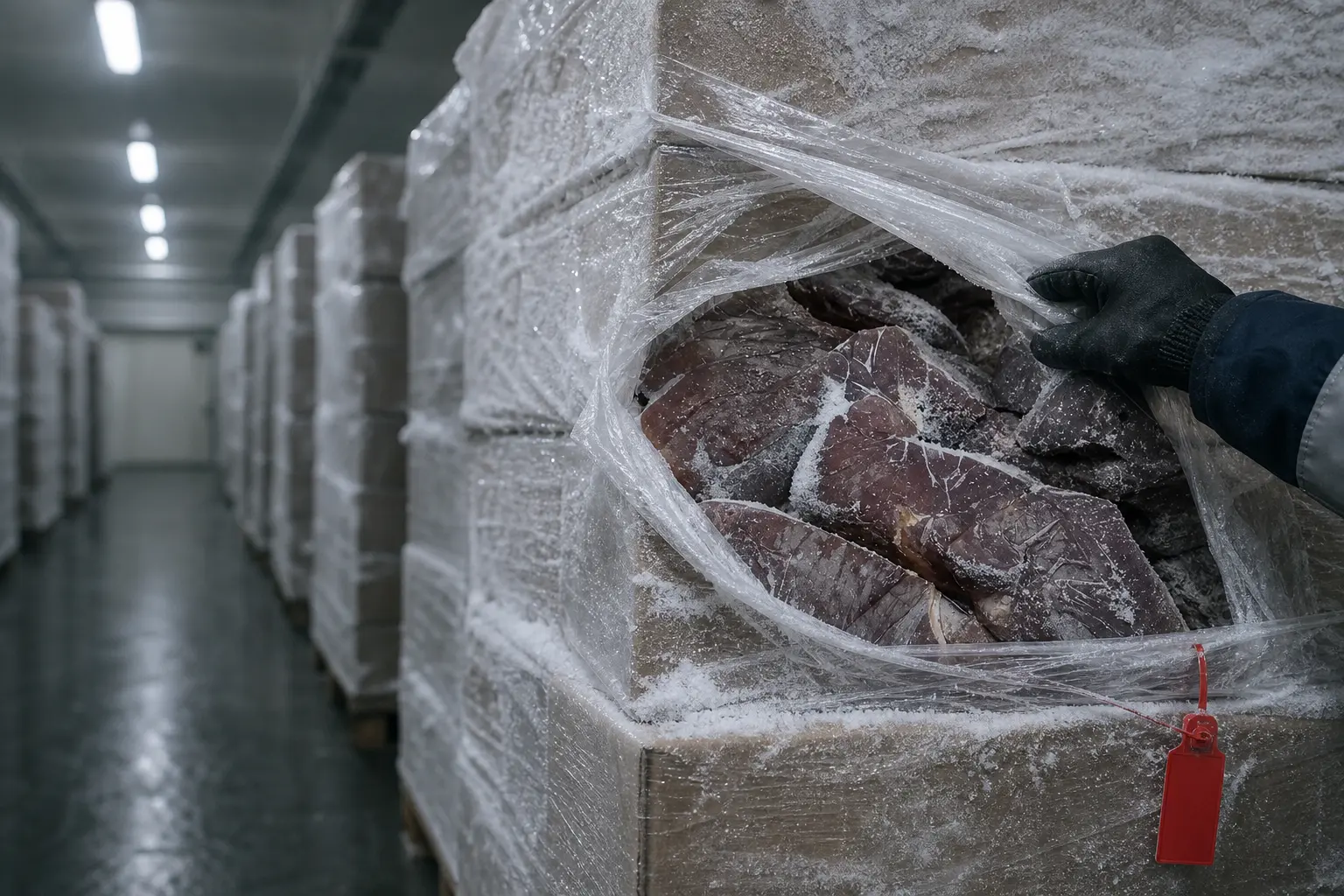
Georgia’s Ministry of Finance Investigation Service has charged one person with selling 19 tons of expired, potentially hazardous frozen meat, tracing the product from a foreign supplier through a Tbilisi cold storage warehouse to a neighborhood meat shop. Investigators seized a large quantity of the meat as evidence from both sites.
It is not the first time in less than a year that Georgian food inspectors have found expired or improperly slaughtered meat moving through the same kind of blind spots, and the pattern says as much about the country’s food safety system as this single case does.
Investigators Trace a Trail From a Foreign Seller to a Tbilisi Shop
According to the Investigation Service, the case followed a simple supply chain. A buyer purchased frozen meat products from a foreign citizen, moved them into cold storage, then sold them retail.
- Sourced from a foreign citizen whose nationality has not been disclosed
- Stored at a cold storage facility in Tbilisi belonging to the defendant
- Distributed to a meat shop, where it was offered for sale to the public
- Seized as evidence from both the shop and the storage facility once investigators moved in
The Investigation Service, the law enforcement arm of Georgia’s Ministry of Finance, did not release the defendant’s name or say how long the meat had been in circulation before the case broke. It described the product only as expired and potentially hazardous, without detailing lab results or specific pathogens.
A Rulebook Georgia Wrote for Brussels a Decade Ago
The inspection system that eventually caught this case did not spring up overnight. Georgia signed the Deep and Comprehensive Free Trade Area (DCFTA, the trade section of its 2014 Association Agreement with the European Union) in June 2014, and a government decree tied to that deal put Georgia’s National Food Agency in charge of checking meat, eggs, fish, and dairy for foodborne disease.
Under that decree, several official bodies share Georgia’s food safety oversight, spanning the agriculture ministry’s food agency, the health ministry, disease control authorities, and the Revenue Service for imports. On paper, it is a layered system built to match EU expectations well before Brussels ever talked about candidacy.
In practice, the agency runs on two tracks: scheduled inspections of registered producers, and unplanned checks triggered by consumer complaints or a business failing an earlier review. That second track is where cases like this one tend to surface, usually after the product has already reached a shelf.
September’s Violations Look Like a Rehearsal
Ten months before this Tbilisi case, Georgia’s National Food Agency ran into a strikingly similar set of problems. The table below lines up what inspectors found then against what investigators say happened this month.
| Case | Location | What Was Found | Outcome |
|---|---|---|---|
| July 2026, Tbilisi | Cold storage facility and meat shop | 19 tons of expired, potentially hazardous frozen meat bought from a foreign citizen | Defendant criminally charged; product seized as evidence |
| September 2025, Gori | New Gemo 2019 LLC, Rustaveli 10 | Frozen kebab batch dated August 25, 2025, with an October 25 sell by mark | Ordered off the market; withdrawal supervised by agency officers |
| September 2025, Samtredia | Slaughterhouse operated by Roin Burkadze | Cattle slaughtered without veterinary oversight or mandatory health marking | Flagged as a critical violation by the National Food Agency |
| September 2025, Talaveri, Bolnisi | Meat outlet operated by Rovshan Gyulmametov | Meat sold without required veterinary health marking | Flagged as a critical violation by the National Food Agency |
Different towns, different products, the same underlying failure: meat entering commerce without the paperwork or oversight the system is designed to require.
Why Can’t Regulators See the Informal Meat Market?
Georgia’s food safety rules only reach as far as the businesses that register with the state, and a large slice of meat sales in the country still happen outside that net through small, undocumented butchers and resellers that inspectors rarely visit unless someone complains.
That gap is not new. A 2019 report by the Institute for War and Peace Reporting (IWPR) found that Georgian regulators had little practical way to track unregistered sellers, even as the National Food Agency carried out its DCFTA mandated checks on registered producers. The report described everyday consumers choosing convenience and price over paperwork.
I regularly buy beef from one and the same butcher.
Manana Parkosadze, a 65 year old retired biologist in Tbilisi, told IWPR she trusted her butcher because he sold in the same market regularly, even without documents proving where his meat came from. She said the price gap with supermarkets, several lari per cut, made the tradeoff worth it. That informal trust economy is exactly the layer where expired or unregistered meat can move for weeks before anyone official notices.
Georgia’s Food Rules Outlast a Frozen EU Bid
Georgia’s food safety architecture is still running even though its broader relationship with Brussels has stalled for reasons that have nothing to do with meat. The European Council granted Georgia EU candidate status in December 2023. Then, citing a law on foreign influence that democracy watchdogs compared to Russian legislation, the accession process came to a de facto halt in 2024, according to the Council of the European Union.
The freeze has since deepened. The European Commission’s November 2025 Enlargement report described Georgia as, in effect, a candidate country in name only, and Brussels has partially suspended pre-accession funds over democratic backsliding, the International Crisis Group reported. Georgian Prime Minister Irakli Kobakhidze has dismissed the assessment as unfair and politically motivated.
None of that political rupture touches the 2014 trade deal that built Georgia’s food inspection system in the first place. The National Food Agency keeps running its DCFTA mandated checks, still finding illegal slaughterhouses and expired kebab and now 19 tons of frozen meat, on a technical track that has kept moving while the political track froze solid.
What Happens Next to the Seized Meat and the Case
The Ministry of Finance’s enforcement reach extends well past meat. The same agency’s Revenue Service has intercepted other contraband moving through the country, including 433,840 cigarette packs hidden inside metal doors at the Red Bridge border crossing, a reminder that customs and criminal investigators in Georgia handle a wide range of smuggled and mislabeled goods, not meat alone.
In this case, the defendant faces prosecution over the sale itself. The foreign citizen who first sold the meat has not been named or charged. The Investigation Service has not said whether anyone else in the chain is under scrutiny, and the seized meat remains in official hands as evidence while the case proceeds.
Frequently Asked Questions
Is expired frozen meat actually dangerous to eat?
Freezing slows bacterial growth but does not reverse spoilage that already happened before the product was frozen, and it does not destroy toxins some bacteria leave behind. Authorities describing seized meat as potentially hazardous, as Georgia’s Investigation Service did in this case, are typically flagging that risk rather than a confirmed illness.
What does the DCFTA have to do with meat inspections?
The Deep and Comprehensive Free Trade Area is the trade section of Georgia’s 2014 Association Agreement with the EU. A government decree tied to that deal is what put the National Food Agency in charge of checking meat, eggs, fish, and dairy for foodborne disease, years before Georgia ever applied for EU candidacy.
How many food safety violations does Georgia find in a typical sweep?
In one multi month stretch reported last September, the National Food Agency carried out more than 5,100 state inspections nationwide and logged 449 violations, ranging from unmarked meat to an unlicensed slaughterhouse, giving a sense of scale well beyond any single case.
How is this case different from a routine food recall in Georgia?
Most violations the National Food Agency finds result in a withdrawal order, where a company pulls product from shelves under supervision, as happened with the Gori kebab producer. This Tbilisi case escalated further, into a criminal charge handled by the Ministry of Finance’s Investigation Service rather than a regulatory withdrawal alone.