Georgia’s Department of Natural Resources has approved spending more than $8 million on the first phase of a planned 4,000-acre state wildlife management area next to the Okefenokee Swamp. The Conservation Fund, a nonprofit that bought roughly 8,000 acres from Twin Pines Minerals last year for just under $60 million, is now selling half of that land to Georgia in two closings that begin in August and close out with a second 1,000-acre tract in March 2027 to form the new Alachua Trail Wildlife Management Area along the swamp’s eastern, southeastern edge.
Board Approves First Phase of Alachua Trail WMA
The Georgia Board of Natural Resources approved the two-phase purchase at a recent meeting, with money drawn from the Georgia Outdoor Stewardship Program, a state fund that collects tax revenue from sales of outdoor gear. Stacy Funderburke, vice president of the central Southeast region at The Conservation Fund, called the state’s purchase “the first step to making sure all 8,000 acres are protected.” The two closings will build the new Alachua Trail WMA to 4,000 acres when the second tract is added in March 2027, per WABE’s coverage of the board’s approval.
The state’s new wildlife management area will sit along the eastern, southeastern edge of the Okefenokee, Funderburke said, opening land for hunting, fishing, and other recreation the state already manages on similar properties. The 4,000-acre footprint will cover Trail Ridge, a line of mineral-rich sand dunes that forms the swamp’s eastern boundary. State wildlife staff plan longleaf pine restoration work on the 2,900-acre tract and protections for species like gopher tortoises and indigo snakes. Funding for the first phase flows through the same Georgia Outdoor Stewardship Program that awarded a $7 million grant for the same Trail Ridge property in its March 2026 grant cycle. When the deal is done, the WMA will hold half of The Conservation Fund’s Okefenokee land; the remaining 4,000 acres will eventually become part of the federal Okefenokee National Wildlife Refuge.
| Phase | Acres | Closing target | Funding |
|---|---|---|---|
| First | 2,900 | August | Over $8 million from Georgia Outdoor Stewardship Program |
| Second | 1,000 | March 2027 | Finalizes Alachua Trail WMA |
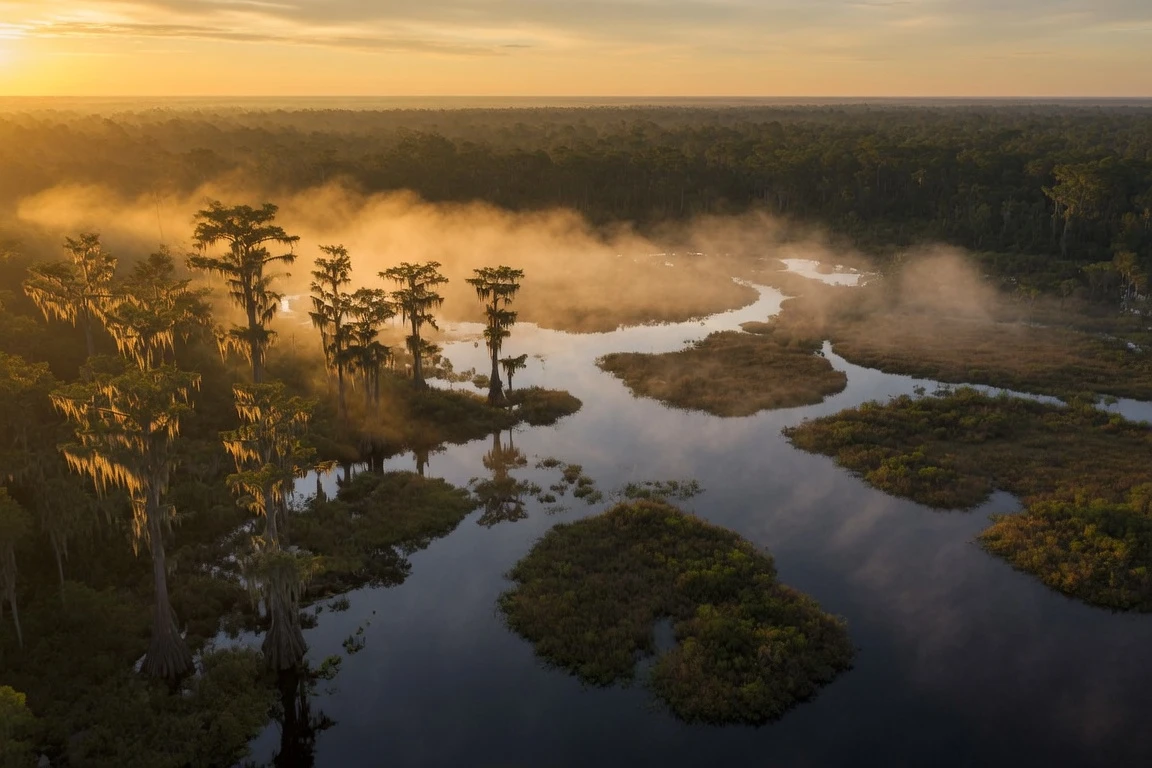
How a Titanium Mine Became Conservation Land
The Conservation Fund paid Twin Pines Minerals just under $60 million in June 2025 for roughly 8,000 acres along Trail Ridge, the mineral-rich sand ridge that runs along the swamp’s eastern edge. The purchase ended a six-year fight over Twin Pines’ plan to develop a nearly 600-acre “demonstration mine” on the ridge, a project scientists warned could harm the swamp’s water table and raise the frequency of drought and wildfire. Twin Pines had signaled its intent to expand beyond the initial tract if its first mine cleared permitting. The Conservation Fund bought not just the demonstration mine site but every Twin Pines holding in the area, along with the underlying mineral rights, a step meant to remove the mining threat permanently, per The Conservation Fund’s June 2025 announcement.
The Georgia Environmental Protection Division had been poised to issue final permits for Twin Pines’ mine before the Conservation Fund deal closed. Funderburke called the acquisition the most important deal he has worked on and said the organization’s goal is to move the land into permanent public ownership. The nonprofit is now moving 4,000 acres to the state as a wildlife management area and will eventually fold the remaining 4,000 acres into the federal Okefenokee National Wildlife Refuge, in earlier coverage of the conservation purchase.
Georgia’s Okefenokee National Wildlife Refuge is a special place and one of the most important natural treasures in Georgia. It’s the kind of place that sticks with us and sustains us, a destination for nature lovers and home to unique plants and wildlife like alligators, wood storks and bald eagles.
Stacy Funderburke is vice president of the central Southeast region at The Conservation Fund. The quote is from the nonprofit’s June 2025 announcement of the land purchase.
The Conservation Fund drew on a broad coalition of funders and conservation groups to close the 2025 deal:
- Holdfast Collective, a nonprofit funded by outdoor apparel maker Patagonia
- The James M. Cox Foundation
- One Hundred Miles, the Brunswick-based coastal protection nonprofit
- The Southern Environmental Law Center
- Georgia Rivers Network
Trail Ridge Has Seen This Before
The Conservation Fund’s June 2025 buy was not the first time the nonprofit stepped between a mining company and the Okefenokee. Decades before Twin Pines surfaced, the mineral and materials giant DuPont tried to mine thousands of acres on Trail Ridge in the late 1990s. DuPont pulled out under pressure from environmentalists and then-Secretary of the Interior Bruce Babbitt. DuPont donated the land it had planned to mine to The Conservation Fund. A portion of that donated land is now part of the Okefenokee National Wildlife Refuge.
Funderburke acknowledged after the 2025 deal that there remains a “huge need” for more land to be protected on Trail Ridge. Large chunks of the ridge remain privately held, including by property owners who have expressed interest in exploring mining on their own land. Josh Marks, president of Georgians for the Okefenokee and a veteran of both fights, has called on the General Assembly to pass the Okefenokee Protection Act to block new mine permitting on Trail Ridge, while The Conservation Fund says it is “very open to finding other conservation outcomes to ensure that the Okefenokee is protected forever.”
The pattern this time differs in one key respect: The Conservation Fund bought the land rather than receiving it as a donation. The nonprofit is now using state money to move half of the land into public hands. The other half will move into the federal refuge system. The mineral rights, in either case, are being retired so the properties cannot be mined in the future.
What Now Lives in State Hands
The state’s new Alachua Trail WMA covers habitat that includes longleaf pine forest and the dry, sandy ground that gopher tortoises and eastern indigo snakes depend on. The state-run tract will be open to public hunting and other recreation, similar to other Georgia wildlife management areas, with management aimed at the same upland species. Funderburke called it “a great opportunity for new recreation opportunities.”
The refuge the new WMA adjoins is one of the most ecologically rich places in North America. The Okefenokee National Wildlife Refuge covers 407,000 acres and includes more than 350,000 acres of designated wilderness, the largest preserve of its kind east of the Mississippi River, according to The Atlanta Journal-Constitution. The Conservation Fund reports that more than 800,000 people visit the swamp each year, spending $91.5 million in Ware, Charlton, and Clinch counties. The swamp supports an estimated 15,000 American alligators and threatened and endangered species including the red-cockaded woodpecker, indigo snake, and wood stork.
The swamp also forms the headwaters of two rivers, the Suwannee, which empties into the Gulf of Mexico, and the St. Marys, which drains into the Atlantic. Beneath the surface, the swamp holds carbon-rich peat as deep as 15 feet in spots, locking millions of tons of greenhouse gases in the ground. Those peat deposits were part of what scientists at the University of Georgia warned Twin Pines’ groundwater withdrawals could damage, raising the odds of wildfire in the swamp’s southeast quadrant.
The Cost Conservation Didn’t Buy
The 2025 deal did not land quietly in Charlton County, the rural Georgia county that sits on the mine site and a slice of the Okefenokee. Twin Pines had promised the mine would protect the swamp and bring hundreds of good-paying jobs to a place where the median household income runs roughly $26,000 below the state average, according to U.S. Census Bureau figures cited by The Atlanta Journal-Constitution. The company’s plan survived bipartisan opposition in the Georgia General Assembly for several sessions before the sale closed. Twin Pines declined to comment on the sale.
I strongly believe in private property rights and in the need for future projects to be assessed with greater objectivity, rather than driven by emotion or public pressure.
Drew Jones is a Charlton County commissioner. The quote is from a written statement to The Atlanta Journal-Constitution.
House Speaker Jon Burns, whose chamber passed 2024 legislation that could have temporarily slowed Twin Pines’ expansion, said in a written statement he was “grateful” a deal had been reached “all while respecting private property rights and upholding our state’s longstanding commitment to our business community.” Georgia’s Democratic U.S. Senators Jon Ossoff and Raphael Warnock, who had both pushed back on the mine, praised the Conservation Fund deal as a win for Georgians. Sen. Raphael Warnock added that the deal gives further support to the swamp’s bid for UNESCO World Heritage status.
The Tax That Funds the Deal
The first phase of the state’s purchase is being paid for out of the Georgia Outdoor Stewardship Program, a fund at the center of Georgia’s effort to grow state conservation funding. The fund collects tax revenue from sales of outdoor gear and doles it out through a competitive grant process. The Conservation Fund won a $7 million GOSP grant for the same Trail Ridge tract in the program’s March 2026 grant cycle, per the state’s March 2026 GOSP grant cycle announcement. Walter Rabon, the state’s DNR commissioner and chairman of the Outdoor Stewardship Trust Fund board, said GOSP “continues to deliver meaningful conservation results across our state.”
The state’s purchase covers the land and the mineral rights underneath it, an arrangement The Conservation Fund designed to make the conservation outcome durable. Twin Pines sold the nonprofit the mineral rights along with the surface holdings in 2025, and the nonprofit is now passing both into state and federal hands. The refuge has been nominated for UNESCO World Heritage status, and the World Heritage Committee is expected to consider the bid in 2026.
Frequently Asked Questions
What is the Alachua Trail Wildlife Management Area?
The Alachua Trail Wildlife Management Area is a new state-run public recreation area planned for 4,000 acres along the eastern, southeastern edge of the Okefenokee Swamp in Charlton County, Georgia. The Georgia Board of Natural Resources approved buying the first 2,900 acres at a recent meeting, with a second 1,000-acre closing scheduled for March 2027.
How much is Georgia paying for the land?
The Georgia Board of Natural Resources approved spending over $8 million on the first 2,900-acre phase of the Alachua Trail WMA. The money comes from the Georgia Outdoor Stewardship Program, a state fund that collects tax revenue from outdoor gear sales. The Conservation Fund also received a $7 million GOSP grant for the same Trail Ridge tract in the program’s March 2026 cycle.
Who owned the land before The Conservation Fund?
Twin Pines Minerals, an Alabama-based company, owned the land before The Conservation Fund purchased roughly 8,000 acres from Twin Pines for just under $60 million in June 2025. Twin Pines had planned a titanium mine on a 600-acre demonstration tract along Trail Ridge before the Conservation Fund stepped in.
What will happen to the other 4,000 acres?
The remaining 4,000 acres held by The Conservation Fund will eventually become part of the federal Okefenokee National Wildlife Refuge, according to Stacy Funderburke, the nonprofit’s regional vice president. The nonprofit is working to transfer the land into permanent conservation and retire the mineral rights so the properties cannot be mined in the future.
When did the original Conservation Fund purchase happen?
The Conservation Fund announced its purchase of the Twin Pines land on June 20, 2025. The deal ended a six-year fight over the proposed titanium mine and included the underlying mineral rights. The state of Georgia is now buying half of those acres through a two-phase closing that begins in August.