A research group at Delft University of Technology has taught quadcopters to recognize the early warning signs of their own crashes, well before a damaged rotor sends the aircraft spiralling. The method borrows a tool from ecology, a phenomenon called critical slowing down, and applies it to autonomous flight for what the team believes is the first time. The work was published this week in the Proceedings of the National Academy of Sciences.
Engineers have long been able to monitor a drone’s health with model-based fault detection, but those systems assume the aircraft still behaves like the engineers’ original blueprint. Once wear, manufacturing variation, or unexpected damage pushes the machine away from that model, the safety net collapses with it. The Delft approach sidesteps the model entirely by reading the drone’s own sensor stream and watching for the statistical signatures of impending instability. In the published tests, the system flagged deteriorating flight stability before loss of control, every time it was asked.
From a Forest’s Tipping Point to a Drone’s Warning Light
Critical slowing down is a well-studied concept in ecology and climate science, used for decades to flag when a system is sliding toward a tipping point. A forest that bounces back from a dry year in a few months, then a few months more after the next dry year, is sending a warning that its resilience is fading; eventually, a routine disturbance is enough to trigger collapse. The same mathematics has been used to study lake ecosystems, ice sheets, and financial markets approaching systemic stress. Researchers at Delft and Wageningen University asked a different question: would the same signature appear inside an actively controlled machine, one that is already working to keep itself stable?
Active control complicates the picture. A drone, an aircraft, or a self-driving car is constantly adjusting its inputs in response to changing conditions, which can mask the very signal that ecology looks for. The Delft team, led by Jasper van Beers, found that the signature still appears, just buried in the noise of the control loop. Their paper, “Early warning signals for loss of control in complex systems,” available on the arxiv preprint of the paper, demonstrates the result on quadcopters with deliberately damaged rotors.
The collaboration between an aerospace engineering group and ecologists was not a marketing decision. Marten Scheffer, Ingrid van de Leemput, and the Wageningen side brought the critical-slowing-down toolkit; Prashant Solanki and the Delft control-systems side brought the drones. The team’s abstract frames the result as a holistic system safety monitor that does not require a model, and the wider implications are spelled out in plain language in a release captured by EurekAlert.
You can compare our approach to the way humans experience pain. After an injury, pain provides immediate feedback about our condition and helps us judge what actions remain safe. Machines generally lack this form of self-awareness. The new indicators, derived from real-time measurement data, offer a first step towards giving engineered systems a similar ability to recognise when they are approaching their limits.
The quote, attributed to Van Beers in the EurekAlert release on the work, is doing more rhetorical work than it might appear. Pain is not just an alert that something is broken; it is a behavioural nudge that changes how you move for the rest of the run. The Delft monitor is meant to do the same job for a machine: not just raise a flag, but change the inputs. The team frames the indicator as a first step towards giving engineered systems a similar ability to recognise when they are approaching their limits.
Putting Rotor Damage on a Test Stand
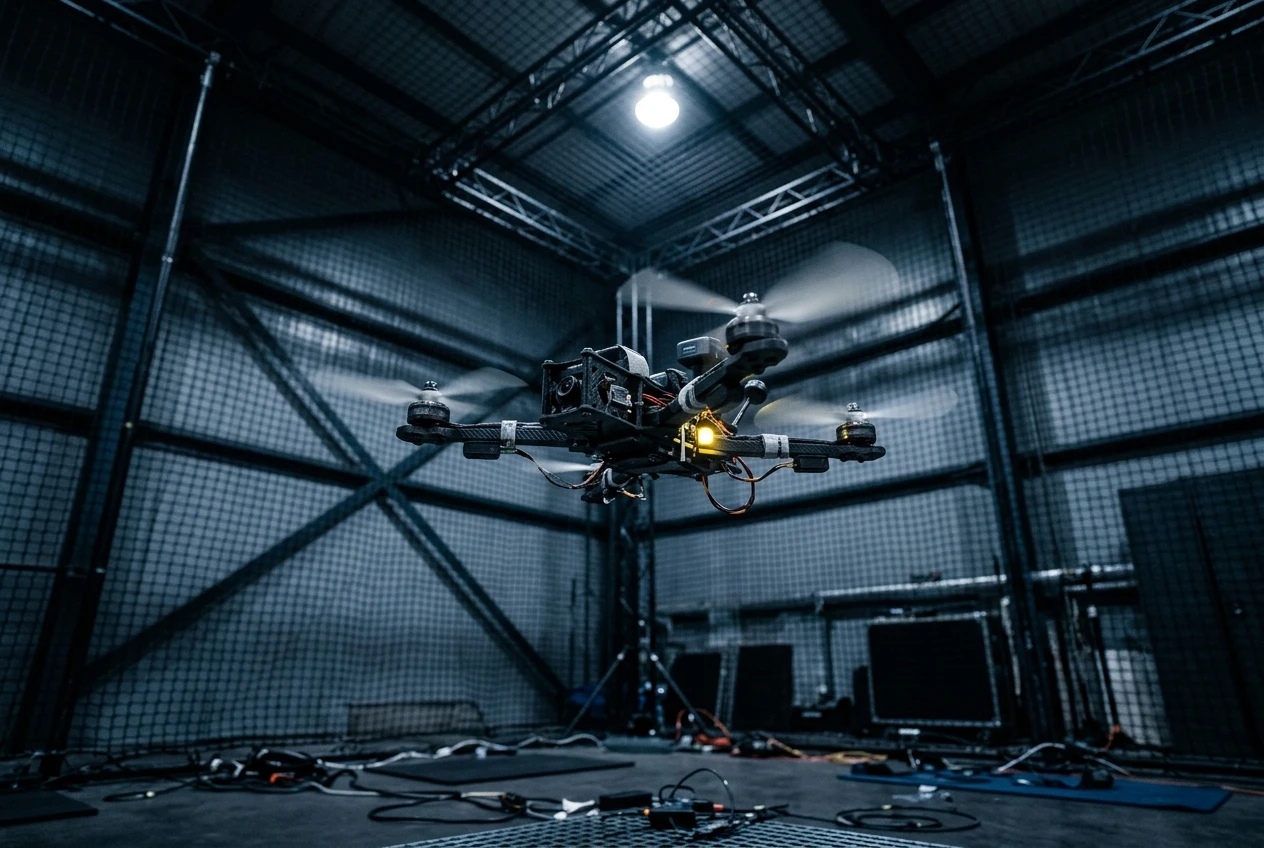
The validation work ran inside the CyberZoo, a netted test cage in TU Delft’s aircraft hall where researchers can safely push autonomous aircraft to the edge of loss of control. The facility, listed by the university as a 10-metre by 10-metre by 7-metre indoor space equipped with an Optitrack indoor GPS system, is the standard proving ground for drone research inside the Faculty of Aerospace Engineering, per the CyberZoo facility page at TU Delft. The team deliberately damaged the propellers of autonomous quadcopters and let the aircraft fly.
The result was the kind of slow-motion degradation engineers dread. Flight controllers continuously compensated for the growing rotor imbalance, so each drone kept flying well past the point where a passenger would have noticed. Eventually, a small disturbance, a gust of air or a control input slightly outside the safe envelope, was enough to send the aircraft into instability. A Hackster writeup of the work reports that the new monitoring method consistently detected the drone’s declining stability before that critical moment occurred. That word, consistently, matters.
The arxiv preprint, submitted on December 24, 2025, walks through the same result with the formal vocabulary of resilience indicators. The team’s claim is that the technique works across the kinds of damage and disturbance combinations they tested, not just the single worst case. As they put it in the abstract, the underlying principles suggest that these indicators could apply across a wider class of controlled systems.
A Monitor That Does Not Need a Working Blueprint
Most engineering safety systems are model-based: they take a precise mathematical description of the aircraft, then compute the envelope of inputs that is known to keep the system stable. The weakness is in the word precise. A machine that has worn differently from how its designers expected no longer matches the model, and the safety envelope is wrong by an amount no one can predict. The Delft team’s monitor does not need that envelope, because it does not need the model.
The system reads the drone’s onboard sensors directly and looks for statistical changes in how the aircraft responds to disturbances. As damage accumulates, the response slows, becomes more sluggish, takes longer to settle. That is the same generic signature that an ecologist sees in a stressed ecosystem: slower recovery from small shocks, in plain language. A Hackster writeup on the method describes how the system reads the drone’s sensor data to identify subtle changes that suggest it is becoming less stable.
The advantage, in the team’s framing, is that the method works on machines engineers have not fully characterised, including ones with manufacturing variation, accidental damage, or wear that no test plan anticipated. That is the property that makes it attractive outside the drone lab, where every additional aircraft type is a fresh modelling project. Van Beers said the indicators offer a first step towards giving engineered systems a similar ability to recognise when they are approaching their limits. The phrase first step is doing some honest hedging here, because the work has only been demonstrated on quadcopters, not on aircraft or power grids yet.
From Detecting Pain to Choosing How to Fly
The next move, in the team’s view, is to close the loop. A drone that detects impending instability should not just raise a warning that nobody acts on; it should change its own flight. The Wageningen-Delft writeup describes the same approach used to determine strategies that maintain flight despite damage to an aircraft’s wing, much in the same way humans accommodate ankle injuries by limping in order to keep walking. A drone with a chipped prop might throttle back aggressive manoeuvres, fly smoother, or change heading to reduce the load on the damaged side.
Real-world implementation would look more like an autopilot reroute than a pilot decision. The aircraft would accept a less efficient flight path in exchange for a higher probability of completing the mission and landing intact. That kind of graceful degradation is something human pilots do naturally, and something machines are still bad at. The Delft result is a first technical hook for doing it no model required.
Why the Same Math Could Reshape Other Industries
The team is explicit that the drones are the demo, not the destination. The arxiv abstract ends with the line that the indicators could apply across a wider class of controlled systems including reactors, aircraft, and self-driving cars. The Hackster writeup lists industrial robots, aircraft, power grids, manufacturing equipment, and autonomous vehicles as candidates. The first commercial pressure point, in their view, is the drone sector itself, where the numbers are climbing and regulators are starting to ask pointed questions.
The table below lays out where the Delft team thinks the method most naturally fits, based on the systems they name in the EurekAlert release and the abstract. It is not a roadmap or a forecast; it is the list of applications the researchers themselves named, sorted by how close each one is to the demonstrated quadrotor result. The headline difference from conventional safety methods is the same in every row: no detailed model is required, just sensors that are already on the machine.
| System | Why it fits | Earliest realistic use |
|---|---|---|
| Quadcopters and other drones | Already demonstrated on rotors in the CyberZoo | First real-world impact expected in the drone sector |
| Autonomous aircraft and self-driving cars | Closed-loop controllers that match the drone’s architecture | Predictive maintenance and instability warning before a model-based safety envelope is even built |
| Industrial robots | Sensor-rich, controller-driven, often working near human operators | Quality control on manufacturing lines, flagged in the EurekAlert writeup |
| Power grids and reactors | Large engineered systems with strong resilience signatures already studied in ecology | Concept-stage; no flight-equivalent demonstration yet |
Frequently Asked Questions
What is critical slowing down?
Critical slowing down is the ecological observation that a system takes longer to recover from small disturbances as it approaches a tipping point. Forests, lakes, and climate systems all show the signature: a slow recovery means a fragile system. The Delft team transferred the same statistical test to actively controlled machines, where the recovery time of the control loop is the indicator.
Which researchers did this work?
The team is led by Jasper van Beers of Delft University of Technology, with collaborators Marten Scheffer, Prashant Solanki, and Ingrid A. van de Leemput from Wageningen University & Research, alongside Egbert H. and others on the arxiv listing. Wageningen brought the ecological toolkit; Delft brought the drones.
Where was the drone testing done?
Testing took place in the CyberZoo, an indoor facility in TU Delft’s Faculty of Aerospace Engineering. The cage is a 10-metre by 10-metre by 7-metre cube equipped with an Optitrack indoor GPS system, used by every drone-related research group at the faculty.
Does this need new sensors on the drone?
No. The EurekAlert release says the technique uses data from inexpensive onboard sensors, meaning the sensors already on the aircraft. The work is model-independent by design, so it does not need a fresh physical model of the drone to work either.
What comes next?
The team is pointing at the drone sector as the first commercial landing, with self-driving cars and aircraft as the longer-term targets. The next stage of work, in their framing, is closing the loop so a drone that senses impending instability automatically picks safer manoeuvres rather than waiting for a human decision.