The Courtauld Gallery will hang nearly twenty Georgia O’Keeffe paintings that have never been shown in Britain when Georgia O’Keeffe: Ghost Ranch opens in October 2027, built around the remote New Mexico property the artist called, simply, her country. Of the show’s almost two dozen works, only six have hung in a UK gallery before.
British audiences have had two prior chances to look closely at O’Keeffe. Both times, a large part of the response missed what her own curators now say the work is actually about: not a stylised idea of the American Southwest, but a specific 21,000 acre ranch she refused to leave for fifty years.
Nearly Two Dozen Works, Most Straight From New Mexico
Dr Karen Serres, senior curator of paintings at the Courtauld Gallery, told the Guardian that few people in Britain grasp how central Ghost Ranch was to O’Keeffe’s development as an artist. She drew a direct line between the ranch’s cliffs and O’Keeffe’s famous close-up flower paintings.
“For example, in her flower paintings, where she goes really, really, really close up and says, ‘I want to do that because I want to make people look at things that are overlooked,'” Serres said. “She does the exact same thing for these landscapes.”
The show will include Red and Yellow Cliffs, from 1940, and Gerald’s Tree I, from 1937, both painted directly from the rock formations surrounding her home. Most of the roughly two dozen works travelling to London have never left the United States for a UK audience before.
| Exhibition | Year | Venue | Scale | UK Reception |
|---|---|---|---|---|
| First UK museum survey | 1993 | Hayward Gallery, London | O’Keeffe’s first dedicated British retrospective | Dismissed by critics as amateur and commercial |
| Georgia O’Keeffe | 2016 | Tate Modern, London | 221 objects, including 115 major O’Keeffe paintings | Framed around disputing a sexualised reading of her flowers |
| Georgia O’Keeffe: Ghost Ranch | 2027 | Courtauld Gallery, London | Almost two dozen works, most UK premieres | Built around her New Mexico home rather than her biography |
The gap between those shows explains why so much of this material is arriving in Britain for the first time. Serres said the Courtauld’s exhibition is meant to let the landscape itself do the explaining, rather than relying on secondhand accounts of who O’Keeffe supposedly was.
The Land That “Fitted Her Exactly”
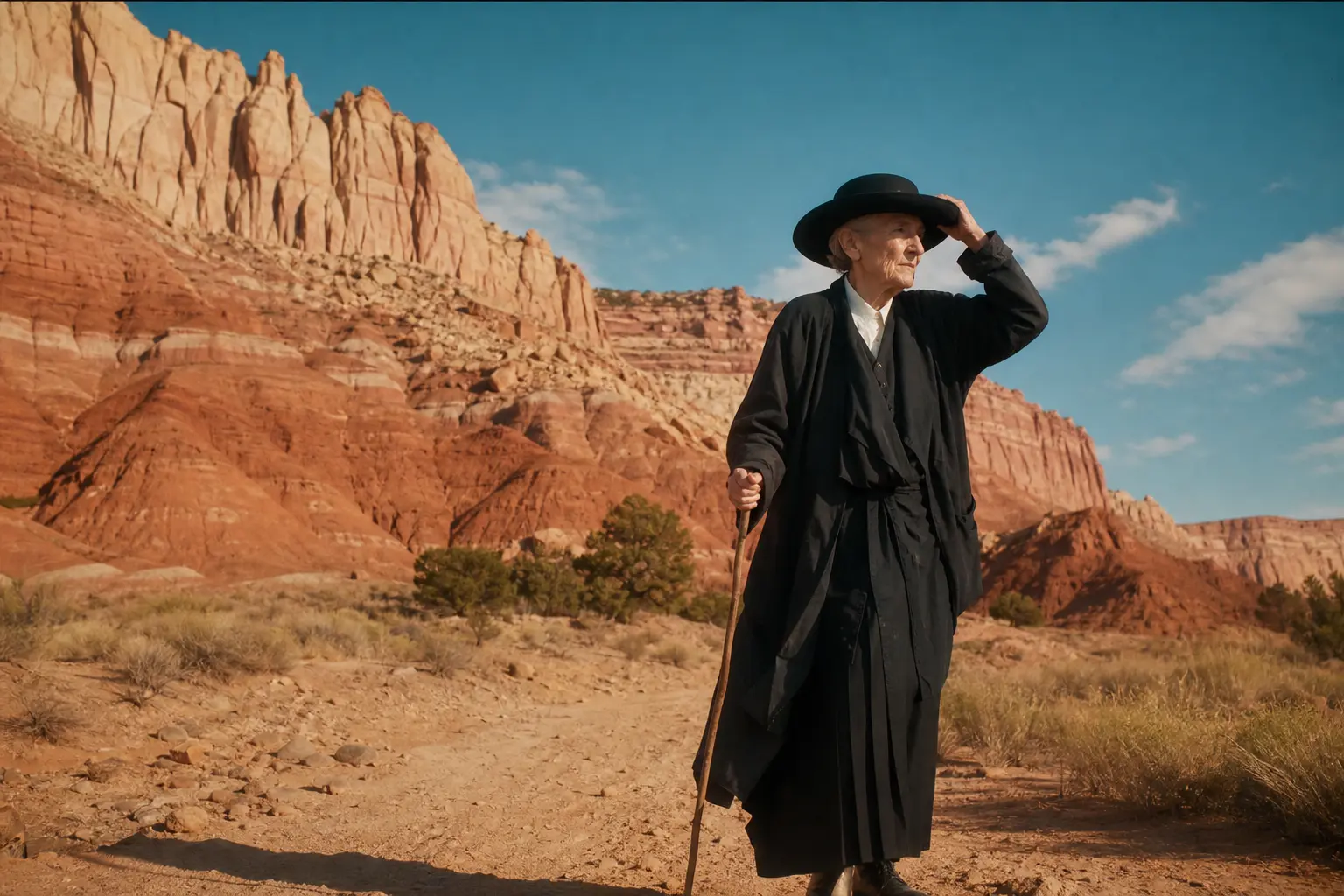
O’Keeffe first stayed at Ghost Ranch for the summer of 1934, renting a room on a property then owned by the conservationist Arthur Pack and his wife, Phoebe. “As soon as I saw it, that was my country,” she once said. “I’d never seen anything like it before, but it fitted to me exactly.”
She kept returning every summer, wintering in New York, and in 1940 bought her own small foothold there: a house and seven acres carved out of the Packs’ much larger holding, according to the Georgia O’Keeffe Museum’s own account of her Ghost Ranch home. The Packs eventually gave the rest of the 21,000 acre ranch to the Presbyterian Church’s Board of Christian Education in 1955.
Ghost Ranch was one of two homes O’Keeffe kept in New Mexico. The other, in the village of Abiquiú sixteen miles south, is preserved today and open to visitors. Ghost Ranch itself is not.
The solitude, the stillness and the harsh, dry, splendid landscape are more her world.
Calvin Tomkins wrote that in a 1974 New Yorker profile of O’Keeffe, describing animal skulls and bleached antlers hanging on the walls of her patio, and rocks gathered on her walks piled across low tables and shelves. O’Keeffe added her own mythology to the place, telling interviewers a murder had once taken place there before she bought it. Cecil Beaton photographed her at the ranch for Vogue, images that helped cement the desert hermit persona that still surrounds her.
- 21,000 acres – the size of the ranch Arthur and Phoebe Pack owned before donating it to the Presbyterian Church in 1955
- 7 acres – the house and land O’Keeffe actually purchased there in 1940
- $44.4 million – the 2014 sale price of Jimson Weed/White Flower No. 1, once the highest ever paid for a work by a woman artist at auction
- 6 of 24 – works in the Courtauld’s Ghost Ranch show that have previously been exhibited in Britain
Why Did British Critics Get O’Keeffe So Wrong?
British critics savaged O’Keeffe’s first major UK show at the Hayward Gallery in 1993, and the reviews still read as strikingly personal. Writers called her a “commercial illustrator,” “irredeemably amateur,” an artist who “made good monthly images on calendars,” and simply “grossly overrated.”
The tone was less about her technique than about where she fit, or didn’t, in a male-dominated modernist canon that British critics of the period were still policing closely. O’Keeffe, by then dead nearly a decade, had no way to answer back.
That hostility set the template for how O’Keeffe would be discussed in Britain for a generation. Her American reputation, already secure by the 1970s as one of the defining modernists of the twentieth century, took decades longer to translate across the Atlantic.
Tate Modern Tried to Correct the Record in 2016
Tate Modern staged the next major corrective, a survey opening in July 2016 that brought together 221 objects, including 115 major O’Keeffe paintings, the largest collection of her work ever assembled outside the United States and her first UK museum survey in more than two decades.
Much of the coverage still framed the show around a single question: whether O’Keeffe’s flower paintings were, as generations of critics had insisted, coded depictions of female genitalia, a reading O’Keeffe herself rejected throughout her life. The exhibition’s stated goal was to push back against what curators called “conservative male” assumptions about her work.
Serres said that fight is not finished. “She’s known as just this formidable female artist,” Serres told the Guardian. “But actually seeing her work, understanding what she’s about, I don’t think we are there yet.”
The Market Settled Its Verdict Years Ago
Whatever British critics thought, collectors reached a different conclusion years before Tate Modern’s show. Jimson Weed/White Flower No. 1 sold at Sotheby’s in November 2014 for $44.4 million, more than tripling the previous auction record for a woman artist, Joan Mitchell’s $11.9 million, set just six months earlier.
The painting had last changed hands in 1987 for $900,000. Its 2014 sale held as the record for almost eleven years, until a Sotheby’s sale in November 2025, when Frida Kahlo’s El sueño (La cama) sold for $54.7 million and pushed O’Keeffe into second place among women artists at auction.
The timing means the Courtauld’s exhibition arrives just months after O’Keeffe lost a record she had held for over a decade. Her market standing has never been in question. Her standing with the critics who shape how the British public sees her is a separate, slower argument.
Stewardship Now Covers the Land She Painted
Ghost Ranch’s current custodians have been formalising their protection of the landscape O’Keeffe made famous. The retreat center that now occupies the property put in place a new conservation partnership covering 6,000 acres of the vistas she painted last December, permanently restricting development across the cliffs and mesas that appear in works across the Courtauld’s show.
Her hometown has its own, lighter-hearted way of holding onto her. In Sun Prairie, Wisconsin, where O’Keeffe was born, the town recently gave a painted cow sculpture nicknamed after the artist a fresh repaint after eighteen years on display.
Between the conservation deal, the market record, and now a major London exhibition, O’Keeffe’s estate and the institutions that hold her work are all moving in the same direction. Whether British criticism catches up is the part Serres says is still unresolved.
Frequently Asked Questions
Is Ghost Ranch open to the public?
No. Unlike O’Keeffe’s Abiquiú home, which is preserved and open for tours, Ghost Ranch operates today as an education and retreat center under the Presbyterian Church, which received the 21,000 acre property from the Pack family in 1955. Public access runs through scheduled programs rather than daily visits.
What did Georgia O’Keeffe’s most valuable painting sell for?
Jimson Weed/White Flower No. 1 sold for $44.4 million at Sotheby’s in November 2014, a record for a woman artist at auction. The same painting had sold for just $900,000 in 1987. Frida Kahlo’s El sueño (La cama) surpassed the record in November 2025, selling for $54.7 million.
Did O’Keeffe live at Ghost Ranch all year?
No. For years her pattern was summers at Ghost Ranch and winters in New York, a rhythm that began with her first extended stay in 1934. She later made New Mexico her permanent, year-round home.
How many works are in the Courtauld’s Ghost Ranch exhibition?
Almost two dozen paintings make up Georgia O’Keeffe: Ghost Ranch, opening at the Courtauld Gallery in October 2027. Only six have previously been shown in a UK gallery, meaning roughly eighteen count as British debuts, including Red and Yellow Cliffs from 1940 and Gerald’s Tree I from 1937.
Has Georgia O’Keeffe had a major UK exhibition before?
Yes, twice. The Hayward Gallery staged her first British retrospective in 1993, where critics were notably dismissive. Tate Modern followed in 2016 with a 221 object survey, her first UK museum show in more than two decades.