Roughly $15 billion in congressional earmarks rode into law on the roughly $1 trillion spending package President Trump signed in February, and a thin slice of it is now landing at Georgia hospitals and health agencies. Most of the individual grants are modest, running from $200,000 for an Athens diaper bank to $964,000 for a Ringgold hospital’s telehealth upgrade.
Those local wins are the easy story to tell. The harder one sits a few steps up the funding chain, where Georgia is standing up a $1.4 billion rural health overhaul on a clock that runs out for many applicants in mid June, all while the state’s rural hospitals brace for billions in Medicaid losses over the next decade.
The Half-Million in Local Health Earmarks
The earmarks, formally called congressionally directed spending, were secured by U.S. Sens. Jon Ossoff and Raphael Warnock, both Georgia Democrats. They function as line items lawmakers attach to a spending bill to send money to named projects back home. In this round, the named projects skew toward equipment, buildings, and software rather than ongoing operations.
Emory Decatur Hospital drew about half a million dollars to improve its neonatal intensive care unit, part of Emory’s broader specialized care footprint in Georgia. CommonSpirit Memorial Hospital North Georgia, a newly opened facility in Ringgold, landed $964,000 for technology. The full slate of metro Atlanta and North Georgia health care upgrades the senators announced ranged from hospital wards to a public health campus.
| Recipient | Amount | Purpose |
|---|---|---|
| Emory Decatur Hospital, Decatur | ~$500,000 | Neonatal intensive care unit improvements |
| CommonSpirit Memorial Hospital, Ringgold | $964,000 | Virtual Integrated Care technology |
| University of North Georgia | $700,000 | Clinical training simulators and supplies |
| Cobb and Douglas County public health | ~$3 million | New department campus |
| Albany Area Primary Health Care | $1.8 million | Community health center expansion |
| Athens Area Diaper Bank | $200,000 | Warehouse space and supplies |
The diaper bank grant shows how far the term “health” stretches in an earmark list. Erin Campbell, director and founder of the Athens Area Diaper Bank, said the money will pay for storage and stock that families cannot find through food aid programs. “Just in our community alone, it’s over 10,000 children that are at risk of diaper need,” Campbell said. “When families have to decide between diapers or food, that’s a choice we don’t think any family should have to make.”
Why $964,000 Buys Telehealth Carts, Not Hospital Beds
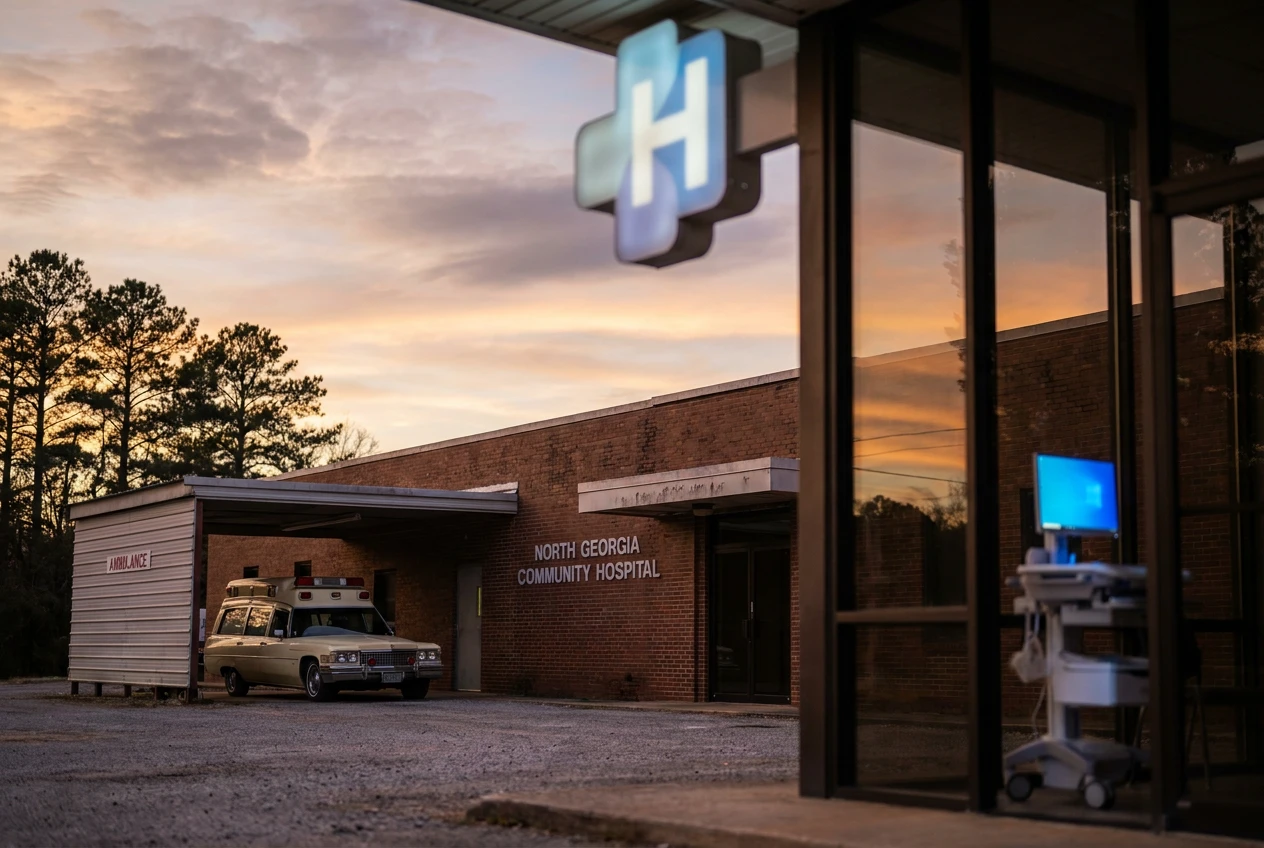
The pattern running through the hospital grants is staffing by screen rather than by hire. CommonSpirit’s Ringgold money funds Virtual Integrated Care, the industry shorthand for remote nurses who watch patients and handle paperwork from a central hub while bedside staff stay on the floor. It is a workaround for a labor shortage that money alone cannot fix in a rural county.
Angie Stiggins, hospital administrator at CommonSpirit Memorial Hospital North Georgia in Ringgold, said upgrading the technology to support staffing is the facility’s top priority.
It will reduce and take away the burden of documentation from our bedside care team so they can really focus on hands-on care.
That framing matters. The grants are not adding maternity wards or surgical suites, the high-cost services that rural hospitals keep cutting. They are buying the tools that let thinner teams cover the same patient load. For context on how stretched those teams already are, look at newborn deliveries across Middle Georgia hospitals, where staffing pressure has pushed some labor and delivery units to the brink.
The $1.4 Billion Stream Behind the Headlines
The earmarks are loud and local. The bigger money is quieter and statewide. Georgia is rolling out a program built on the federal Rural Health Transformation Program, a $50 billion national fund spread across the states over five years, and the share headed to Georgia dwarfs every earmark in the metro Atlanta package combined.
The Centers for Medicare and Medicaid Services awarded Georgia its first-year allotment in late December. The state-run version, branded GREAT Health for Georgia Rural Enhancement and Transformation of Health, is now moving money to providers through staged application rounds.
- $218.8 million awarded to Georgia for the first of five program years.
- $1,427,778,682, or roughly $1.4 billion, is Georgia’s total budget across all five years.
- 7th highest among all 50 state awards, one of the largest first-year allotments in the country.
The size signals intent. Georgia health officials have mapped the spend around telehealth, hospital infrastructure, and workforce, the same priorities the earmarks nibble at on a far smaller scale. The full Rural Health Transformation Program framework for Georgia sits with the state Department of Community Health, and the December award announcement laid out the multiyear ramp. A reader watching only the senators’ press releases would miss the program that will move three times as much in a single year as the entire earmark list.
Racing the June 15 Deadline for Rural Funds
For providers, the calendar is the urgent part. The state opened Phase 3 of GREAT Health funding to projects focused on hospital-based telehealth, and the window is short. Applications close on June 15, and a separate competitive round opens that same day.
Here is how the near-term schedule lines up for rural applicants:
- Phase 3 opened May 15 for entities named in the state’s GREAT Health application, including a grant track called Care to Consumer: Telepods.
- Phase 3 applications close June 15, with submissions running through the state’s grants management portal.
- Phase 4, a competitive process open to a broader pool of applicants, is expected to open June 15 as Phase 3 closes.
The structure favors the prepared. Phase 3 is effectively a fast lane for organizations already on the state’s list, while Phase 4 throws the doors open to wider competition. Providers can track the rural health funding opportunities and grant portal for the guidelines and submission links. Miss the mid-month cutoff and the next realistic shot is the competitive round, where the odds get longer.
The Medicaid Math That Frames Every Dollar
None of this money arrives in a vacuum. The same law that created the $50 billion rural fund also reshaped Medicaid, and the two numbers point in opposite directions for Georgia. The Congressional Budget Office estimates the One Big Beautiful Bill Act will cut $911 billion in federal Medicaid and Children’s Health Insurance Program spending nationally over 10 years.
For Georgia specifically, the projected hit is $5.4 billion in lost Medicaid funding over the next decade, with an estimated 460,000 residents expected to lose coverage. Set that against Georgia’s $1.4 billion rural award and the gap is roughly four to one before a single dollar reaches a patient.
The strain is already visible. St. Mary’s Sacred Heart Hospital in rural Lavonia closed its labor and delivery unit and its obstetrics and gynecology center last fall, citing recent congressional Medicaid cuts in its decision. Analysts at Georgetown’s Center for Children and Families have argued the rural fund cannot fill the hole the coverage losses will open, and several Georgia hospitals sit on watch lists.
Four rural facilities have been flagged as at risk of cutting services or closing under the new law:
- Fannin Regional Hospital in Blue Ridge
- Flint River Community Hospital in Montezuma
- Irwin County Hospital in Ocilla
- Washington County Regional Medical Center in Sandersville
The math is the story. A Georgetown analysis of the rural fund and Medicaid losses frames the transformation money as a partial cushion, not a replacement. If the June application rounds steer the $1.4 billion toward the hospitals on the watch list, the new telehealth tools could keep some doors open through the coverage squeeze. If the money chases newer, healthier facilities instead, the same dollars will read as a press release while the rural map keeps thinning.
Frequently Asked Questions
What is Georgia’s Rural Health Transformation Program?
It is the state’s version of a $50 billion federal fund created to shore up rural health systems. Georgia branded its program GREAT Health and is distributing money through staged application rounds run by the Department of Community Health, targeting telehealth, hospital infrastructure, and workforce.
When is the June 15 deadline and who can apply?
June 15 is the close of Phase 3, which opened May 15 for organizations already named in Georgia’s GREAT Health application. A broader competitive round, Phase 4, is expected to open the same day for a wider pool of applicants.
How much federal rural health money is Georgia getting?
Georgia received $218.8 million for the first program year and a total budget of roughly $1.4 billion across five years. That award ranks seventh highest among all state allotments under the national program.
What did the congressional earmarks fund for Georgia hospitals?
The earmarks paid for equipment and technology rather than operations: about $500,000 for Emory Decatur Hospital’s neonatal unit, $964,000 for telehealth tools at CommonSpirit’s Ringgold hospital, $700,000 for training simulators at the University of North Georgia, and $200,000 for the Athens Area Diaper Bank.
Will the new funding offset Georgia’s Medicaid cuts?
Not fully. Georgia faces an estimated $5.4 billion in Medicaid losses over 10 years against a $1.4 billion rural award, and policy analysts say the transformation fund is a partial cushion rather than a replacement for the lost coverage dollars.