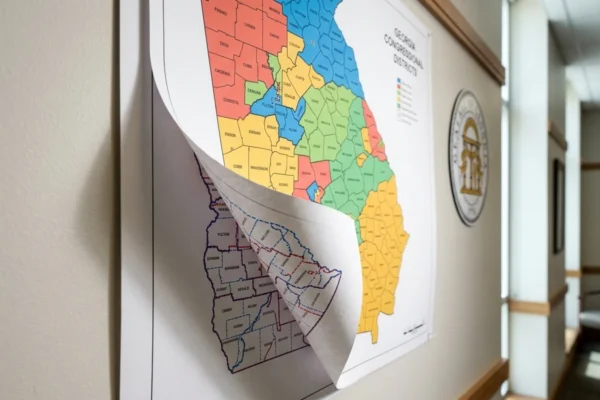
Georgia’s Interior Ministry switched on a new speech-monitoring unit on June 1, a ten-person division ordered to scan social media and public spaces for what the government labels hate speech, offensive campaigns and aggressive communication. The Ministry of Internal Affairs (MIA, the agency that runs the country’s police) says the team will detect violations on its own initiative, assemble case files and send them to court.
The unit did not appear from nowhere. Sixteen months earlier, parliament rewrote the country’s administrative law to make insulting a public official a finable offence, and that provision has sat on the books since February 2025. Now it has a dedicated squad whose job is to go looking for people to charge under it.
A Ten-Person Unit Built to Police Public Speech
The new body is formally called the Division for Combating Hate Speech, and it sits inside the MIA’s Human Rights Protection Department. The ministry describes its work as “systematic monitoring” of public communication. In plain terms, the staff watch what people post and say, decide what crosses a legal line, and act on it.
According to the ministry’s own description, the division has four core tasks:
- Monitor and proactively detect public statements the ministry judges to insult human dignity or amount to hate speech
- Identify the people behind those statements
- Draw up administrative offence protocols and assemble case materials
- Forward the cases to court for a ruling under existing procedure
Leading the division is Tamta Kimbarishvili, a ministry lawyer. Her recent record is part of why critics are uneasy: she spent the past year representing the Interior Ministry in administrative cases tied to anti-government protests, and received a certificate of appreciation in June 2025 from the then-interior minister. The site has already reported how the government handed the new unit to a ministry insider rather than an independent rights body. The cases will move through the same administrative offence procedures the police already run.

The February 2025 Amendment the Unit Now Enforces
To understand why a monitoring desk matters, you have to read the law it feeds. On February 6, 2025, lawmakers added Article 173-16 to the country’s administrative code. The article makes it an offence to verbally insult, curse at or otherwise offend a state-political official, civil servant or public servant during, or in connection with, their official duties.
The penalties are not symbolic. They scale up sharply if a person is caught twice.
| Offence under Article 173-16 | Fine | Detention |
|---|---|---|
| First insult of an official | 1,500 to 4,000 lari (roughly $555 to $1,475) | Up to 45 days |
| Repeat offence | 2,500 to 6,000 lari | Up to 60 days |
The wording is the part legal observers keep circling back to. The Organization for Security and Co-operation in Europe (OSCE, the regional democracy and rights watchdog) warned that the amendment was too broad and subjective to refer to verbal insults, swearing and humiliating comments without defining the elements that actually constitute a violation. You can read the relevant clauses in the consolidated Administrative Offences Code of Georgia on the state legislative portal.
Why Proactive Monitoring Changes the Calculus
Plenty of countries have insult statutes that rarely get used, because someone has to file a complaint first. Georgia’s new arrangement removes that brake. The division is designed to act without a single citizen complaint, with staff scanning feeds, flagging posts and starting cases on their own.
That shift turns a paper offence into a daily enforcement risk. The law has already produced its first headline case. Writer Beka Lokhishvili received the first administrative detention under the new framework, a 15-day sentence over a Facebook post that criticized police conduct and called the ruling party a terrorist organisation rather than a political party. The post was later deleted, but the charge stuck.
Rights groups place the monitoring unit inside a wider pattern. Human Rights Watch has documented how a cluster of recent measures, taken together, work to criminalize peaceful protest and dissent in Georgia. A standing team that searches for offences, rather than waiting for them to be reported, is the piece that makes the rest enforceable at scale.
The Vagueness Lawyers Keep Flagging
The sharpest objection is not about hate speech as a category. It is about the elastic term sitting next to it. “Aggressive communication” has no fixed legal meaning, and lawyers argue that vagueness is the point.
The concept of aggressive communication is so vague that it could apply to almost any critical, provocative, ironic or emotional political statement.
That assessment comes from Tamta Mikeladze of the Social Justice Centre, a Tbilisi rights organisation. The same worry runs through the legal profession’s response. Tamar Oniani, head of the Georgian Young Lawyers’ Association (GYLA, the country’s main legal advocacy group), has said the provision is too broad and subjective to list verbal insults, swearing and humiliating comments as offences without defining additional elements that mark a real violation.
Oniani’s group frames the unit as an institutional mechanism to control criticism of the government, not a genuine effort against bigotry. GYLA’s own 2025 human rights situation report catalogues a year of fines and detentions over statements officials deemed insulting, often comments made on social media. The new division gives that enforcement a permanent home and a payroll.
How Georgian Dream Defends the Department
The ruling party rejects the censorship reading. Mamuka Mdinaradze, executive secretary of the governing Georgian Dream party, tried to answer the criticism before the unit even opened. He argued that free expression is the foundation of a democratic state, but said it cannot become a basis for justifying offensive and hateful statements.
Mdinaradze added that diversity of opinion and critical discussion are essential for a democratic state, while insisting there are minimum standards society should agree on, including respect for one another. The government’s message, in short, is that the line falls between robust debate and abuse, and that the state has a duty to protect public space from what it calls destructive polarization.
On staffing, Deputy Minister of Internal Affairs Aleksandre Darakhvelidze said in late May that experience would drive recruitment. “The emphasis will be on current employees who have experience, and we will accumulate these personnel from various units,” Darakhvelidze said. That detail matters: the team is being drawn from inside the police, not from independent human rights specialists.
The test now is behaviour, not rhetoric. If the division spends its first months building cases against ordinary social-media posts, the law’s critics will read that as proof of intent. If it stays quiet, the government can point to restraint as vindication. Either way, the machinery is built, staffed and switched on, and the next protocol it files will tell Georgians which version they are living in.
Frequently Asked Questions
What is Georgia’s new hate speech monitoring unit?
It is a division inside the Ministry of Internal Affairs called the Division for Combating Hate Speech, operating under the ministry’s Human Rights Protection Department. Its job is to monitor public communication, including social media, and to start administrative cases against statements it judges to be hateful, offensive or aggressive.
When did the department begin operating?
It launched on June 1, 2026, starting with 10 staff members. The ministry has signalled the team could grow as it recruits experienced personnel from other police units.
Who heads the new MIA division?
Tamta Kimbarishvili, a ministry lawyer who previously represented the Interior Ministry in administrative cases connected to anti-government protests. She was named head of the division around its June launch.
What law does the unit enforce?
Mainly Article 173-16 of the Administrative Offences Code, added in February 2025, which makes verbally insulting a public official an offence. A first violation carries a fine of 1,500 to 4,000 lari or up to 45 days of detention, with steeper penalties for repeat offences.
Why do critics oppose the department?
Lawyers and rights groups argue the term “aggressive communication” is undefined and could cover almost any sharp political criticism. Because the unit acts on its own initiative without complaints, they fear it becomes a tool to monitor and punish dissent rather than to address genuine hate speech.