Georgia has approved cutting down 9,688 Red List trees to make way for a 224 megawatt wind farm in Imereti. Government Decree No. 1466 hands Gogni Wind Company LLC the right to clear state forest in the Mukhuri and Terjola areas, opening ground for turbines, a substation and miles of transmission cable.
It is the second time in recent memory Georgia’s government has authorized a wind developer to fell thousands of protected trees at once. A smaller project up the road did it first, and the numbers this time are much bigger.
What Georgia Just Approved
The decree permits removal of 7,533 common chestnut (Castanea sativa), 2,115 Colchian box (Buxus colchica) and 40 yew (Taxus baccata), all listed on Georgia’s Red List of protected species. The felling clears space for the project’s 220 kV overhead and 35 kV underground transmission lines and a new 220 kV substation.
| Species | Latin Name | Trees Authorized | Notes |
|---|---|---|---|
| Common chestnut | Castanea sativa | 7,533 | Dominant canopy species across Mukhuri and Terjola forests |
| Colchian box | Buxus colchica | 2,115 | Vulnerable since 2006, already under separate pest threat |
| Yew | Taxus baccata | 40 | Slow growing conifer, among the longest lived trees in the region |
| Total | – | 9,688 | Cleared from state forest in Imereti |
The government’s decree formally authorizing the felling lays out what counts as protected in Georgia and what a developer owes the state for removing it.
- Red List – Georgia’s official register of plant and animal species classified as threatened, near threatened or vulnerable to extinction inside the country; clearing a listed species from state forest requires its own government decree, as with Gogni’s 9,688 trees.
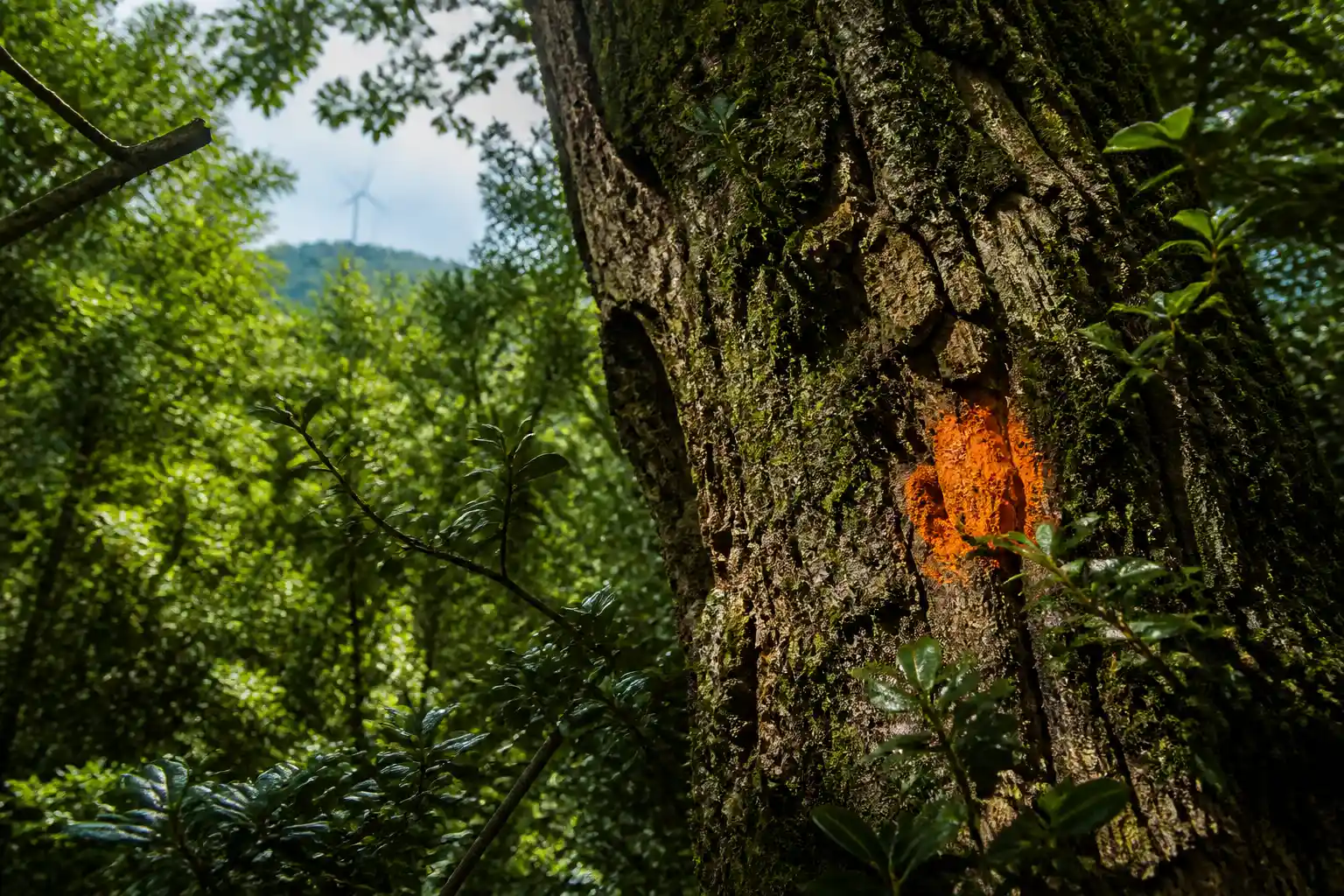
Why Imereti’s Ridges Became Georgia’s Wind Frontier
Georgia still leans heavily on hydropower, and that dependence carries risk. Dry years cut output, and the country imports natural gas from a small number of suppliers in a volatile region. The International Energy Agency has flagged Georgia’s continuing dependence on hydropower and gas imports as a structural weak point in its energy security.
Wind fills a gap hydropower cannot. Ridgelines in Imereti catch strong, steady air currents, which is exactly why developers have clustered projects there. Georgia’s climate strategy sets a target of 27.4% renewable energy in total consumption alongside a pledge to cut greenhouse gas emissions by up to 57% against 1990 levels. Wind is one of the few resources left that can move that number quickly, since most of the country’s large hydropower sites are already built out.
Business outlet BM.ge has reported that Gogni will carry up to 28 turbines, each capable of 8 megawatts, producing an estimated 602 to 668 million kilowatt hours a year, enough to matter on a national grid still shadowed by import risk.
The Bank CEO Behind the Turbines
Gogni Wind Company LLC is not a stranger to Georgian finance. Archil Gachechiladze, chief executive of Bank of Georgia, one of the country’s largest banking groups, holds a 90% stake in the project through a separate vehicle, AG Wind Power LLC. Businessman Emzar Gamezaradashvili owns the remaining 10% through EG LLC.
A bank CEO building a quarter-gigawatt wind farm on the side is unusual, but not unheard of among Georgia’s small circle of large private investors. Trade publication Windtech International reported that Ming Yang Smart Energy, a Chinese wind turbine manufacturer, agreed to supply equipment and development services for an earlier 187 MW phase of the project. The capacity has since grown to 224 MW under the current plan.
Gachechiladze runs one of the two dominant retail banks in a country of under four million people. His personal wind investment sits well outside his day job, but the same decree process that regulates state forests now also determines how much of it he gets to build.
Rikoti Wrote the Playbook First
Gogni is not the first Georgian wind project to trade Red List forest for turbines. The government previously authorized removal of 2,370 Red List chestnut trees in the Khashuri, Surami and Tsedani forests for the 65 MW Rikoti Wind Power Plant, developed by Taba LLC, a subsidiary of Turkish conglomerate Anadolu Holding, Georgia Today reported.
| Metric | Gogni Wind Farm | Rikoti Wind Farm |
|---|---|---|
| Capacity | 224 MW | 65 MW |
| Red List trees cleared | 9,688 | 2,370 |
| Lead developer | Gogni Wind Company LLC | Taba LLC (Anadolu Holding) |
| Location | Terjola / Tkibuli, Imereti | Khashuri, Imereti border |
| Grid trigger | 220 kV line and substation | 110 kV transmission line |
Measured against raw capacity, Gogni clears roughly 43 trees per megawatt against Rikoti’s 36. The comparison actually understates the gap in older growth, since 2,000 of Rikoti’s 2,370 counted trees were young chestnut saplings under 8 centimeters in diameter, while Gogni’s tally leans on mature chestnut alongside slow growing box and yew that take decades to replace.
The Species Already Losing Before the Chainsaws Arrive
Colchian box is not an ordinary hedge plant. It is a relict species that has grown in the Colchic forests of western Georgia since long before the last ice age, and it has been listed as Vulnerable on Georgia’s Red List since 2006.
It was already in trouble. An invasive insect, the box tree moth, reached the Caucasus around 2012 and devastated plantings in southern Russia within a year. By 2015, surveys found the moth’s larvae stripping native boxwood in four Georgian regions, Imereti among them, according to the 2015 survey mapping the moth’s spread published by the Journal of the Entomological Research Society. Georgia’s Agency of Protected Areas turned to the IUCN and an EU-backed program for help building a national response plan.
Separate research projecting a region wide collapse of Buxus forests across Europe and the Caucasus found that losing native boxwood carries ecological and economic costs well beyond one species, from soil stability on steep slopes to the loss of a plant with no natural substitute in that forest layer. Now 2,115 more Colchian box trees are authorized for removal, this time by decree rather than by moth.
The Compensation Georgia Is Betting On
The decree does not let Gogni Wind Company simply cut and go. It sets conditions.
- Store all harvested chestnut, Colchian box and yew timber at a site designated by the National Forestry Agency
- Pay compensation for the 9,688 Red List plants removed, due only after that storage step is confirmed
- Carry out restoration planting matched to the number of Red List trees removed, within a timeframe set by the decree
Whether that restoration keeps pace with what comes down is the open question. Georgia’s regulatory system has faced scrutiny before over whether compensation rules translate into results, a separate enforcement gap in Georgian regulatory follow through that surfaced when investigators uncovered nearly 19 tons of expired meat moving through supposedly monitored supply chains. A young box or chestnut sapling planted this year will not replace a Colchic canopy tree for decades, whatever the paperwork says.
How Many More Red List Trees Will Georgia’s Wind Push Cost?
Likely more, given the pattern now in place. Two projects, Rikoti and Gogni, have together cleared over 12,000 Red List trees in Imereti’s wind corridor, and Georgia’s renewable targets all but guarantee more turbines are coming to the same ridgelines.
Gogni’s turbines cannot rise yet. The company’s environmental impact assessment is still awaiting sign off from Georgia’s Environmental Supervision Department, the step that stands between this decree and the first tree actually coming down.