Georgia’s State Election Board voted 3-1 Thursday to allow counties to switch to hand-marked paper ballots, issuing guidance that directly conflicts with a June 2 directive from the secretary of state’s office and placing every county election official in the state between two competing authorities. The non-binding resolution, introduced by newly appointed Vice Chair Janelle King, gives counties formal permission to abandon the state’s touchscreen voting machines if the legislature fails to act before July 1.
That deadline arrives in 26 days. Under Senate Bill 189 (SB 189), which Georgia’s Republican-controlled General Assembly passed in 2024, QR codes can no longer serve as the official basis for counting votes after July 1. Lawmakers created that deadline, then adjourned in April without passing a funded replacement or providing a cent to transition away from the existing machines. A special session opens June 17, with no resolution guaranteed.
Georgia’s Self-Made Voting Deadline
Georgia’s current voting system uses touchscreen ballot-marking devices manufactured by Dominion Voting Systems, rebranded as Liberty Voting Systems after a recent acquisition, that print a paper ballot listing a voter’s choices alongside a QR code. Voters make selections on a screen and the device produces a printed record showing those choices in human-readable text and, encoded separately, a QR code. When the ballot goes through the tabulation scanner, the machine reads the QR code to record the vote; the printed text beside it plays no role in tabulation. Critics from both parties, with the loudest voices concentrated on the political right after 2020, argued for years that voters have no way to verify what the scanning equipment is actually counting.
SB 189’s language is direct. Beginning July 1, the official count “shall be based upon the text portion or the machine mark… and not any machine coding that may be printed on such ballots.” What the legislature did not include alongside that mandate: a funded replacement system, guidance on whether existing scanners could be reprogrammed to read printed text, or any state appropriation for the transition. A compromise bill from House Governmental Affairs Committee Chair Victor Anderson, a Republican, would have kept existing machines in use through 2026 while requiring a state-funded QR code phase-out by 2028. It passed the House in bipartisan fashion. Senate Republicans declined to take it up.
The General Assembly adjourned April 2, leaving 159 counties without a legal and workable election system for November. As Georgia’s 2026 regular session closed without addressing the voting system problem, county officials were left holding a law they must comply with and no state guidance on how to do it. Secretary of State Brad Raffensperger had repeatedly flagged the absence of any transition funding during the session; the legislature never addressed it. Rachel Glover, associate director of the ACLU of Georgia’s Voter Access Project, called the situation preventable, saying lawmakers created the problem by passing the QR code ban in 2024 without providing counties any guidance or resources to comply.
Thursday’s Vote and a Board Resignation
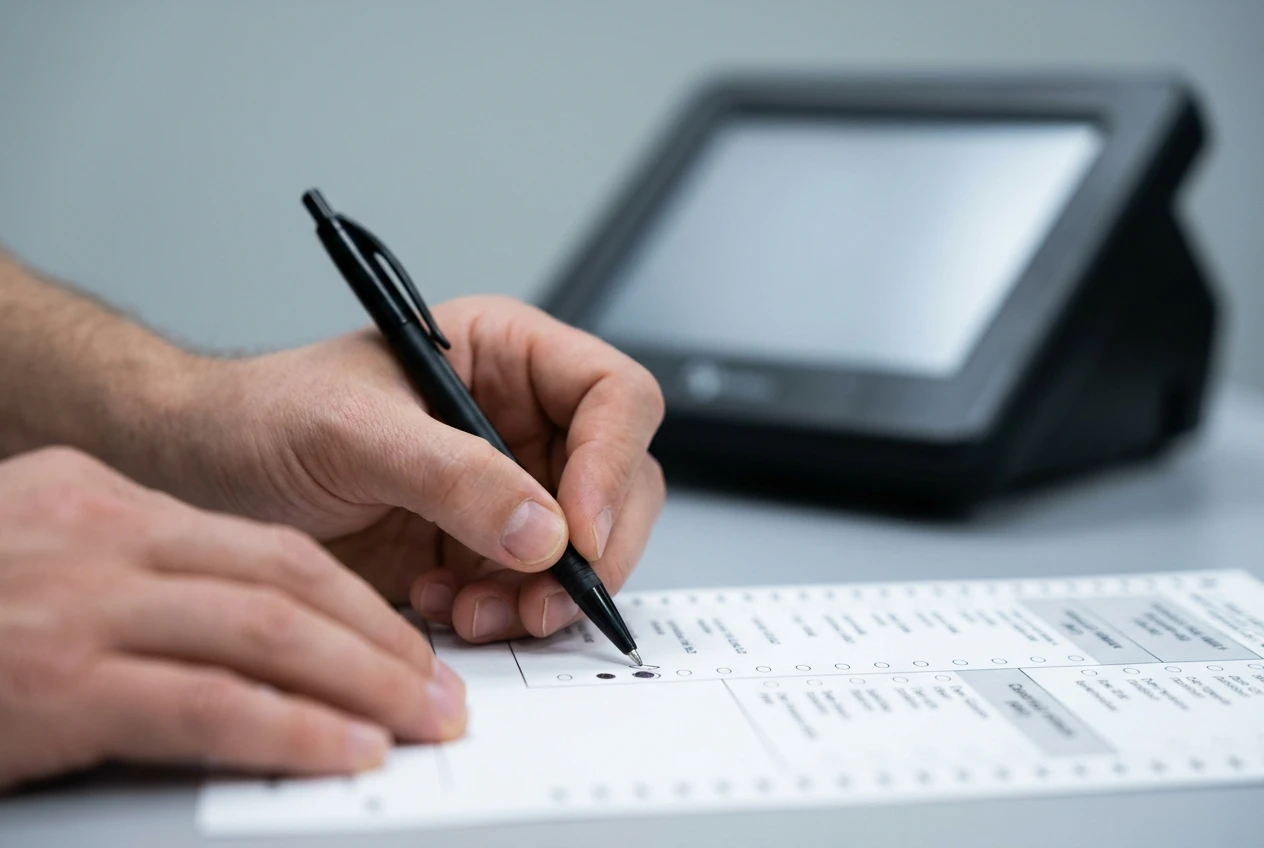
The State Election Board has pushed for hand-marked ballots since at least March, when it passed a unanimous resolution urging lawmakers to hasten the switch. In May it took up a more aggressive proposal that would have immediately mandated paper ballots statewide; that measure failed 4-1, with Chair John Fervier, a Kemp appointee, arguing the board lacked the authority to compel such a change. Thursday’s vote was narrower in scope: the board gave counties the option to switch, stopping short of a directive.
King framed the resolution as a contingency measure for county offices waiting on legislative action. “We don’t know what’s going to happen in the special session,” she said at the meeting. “We need to have something in the hands of these counties, so that they can have support from us.” The board also approved interim guidelines to distribute alongside the resolution.
The non-binding language reflects a hard-learned legal lesson. Ahead of the 2024 election, a bloc of conservative Republican board members pushed through a package of rule changes, including provisions to mandate hand-counts, expand poll-watching areas, and give officials broader latitude to delay certification. Fulton County Superior Court Judge Thomas A. Cox Jr. struck down those rules before they took effect, finding the board had illegally usurped legislative authority. The Georgia Supreme Court subsequently blocked four additional SEB rules on the same grounds, confirming that the panel cannot implement rules beyond the scope of existing Georgia election law. Thursday’s resolution was drafted to stay on the right side of that precedent, but it still puts county officials in a legal gray zone ahead of the November 2026 general election.
Board member Jan Johnston, a Republican Party appointee who served as vice chair until Wednesday, announced her resignation during Thursday’s meeting. Johnston had been a vocal advocate for hand-marked paper ballots but had also, earlier this year, declined to support board resolutions she felt directly challenged the legislature’s authority. “The decision was not an easy one,” she said. “Family and personal responsibilities require my attention at this time, and they must come first.” Her departure opens a seat Gov. Kemp will need to fill before the special session convenes.
Two Agencies Issue Conflicting Guidance
The Secretary of State’s Position
Two days before Thursday’s vote, State Elections Director Blake Evans sent a letter to counties preparing for the July 28 special election to fill the late Congressman David Scott’s seat, the first major Georgia election to take place after the QR code deadline. Evans left no ambiguity. “There is nothing in the text of S.B. 189 that permits counties to utilize a different method of voting or tabulation,” he wrote on June 2. “Counties must continue to use the state voting system, which consists of ballot marking devices for all in person voting and ballot scanners.” Evans is the state’s elections director, the official responsible for coordinating with counties on election procedures, and his June 2 letter was addressed specifically to superintendents preparing for the July 28 race, making it the most direct post-deadline guidance counties have received. The secretary of state’s office followed Thursday’s vote with a public statement from Communications Director Michon Lindstrom: “Once again, State Election Board members have overreached their authority and are interfering with the legislative process.”
The Attorney General’s Warning
Senior Assistant Attorney General Elizabeth Young attended Thursday’s meeting and declined to endorse either agency’s position. She put the practical problem plainly for the board.
Obviously it would cause confusion for elections superintendents if they are getting differing instructions from two agencies, both of which have some authority over what they’re doing.
Young’s comment, made at the State Election Board’s June 5 meeting, pointed to the core gap: both agencies have legal standing in election administration, and the current dispute has no mechanism to resolve which one governs when they conflict. Any county that follows the board’s resolution over Evans’s June 2 directive will do so without legal cover. There is no signal from the attorney general’s office that it would defend that choice. That ambiguity is not abstract; Georgia law gives election superintendents direction from the secretary of state’s office but also imposes duties set by the State Election Board, and when both disagree, county officials have no clear hierarchy to appeal to.
Georgia’s Counties Are on Their Own
Switching to hand-marked paper ballots without state procurement support is a logistical challenge most county election offices can’t absorb on a six-week timeline. Ordering ballot printers, printing ballots, retraining poll workers, and updating counting procedures takes six months to a year under normal circumstances, according to the ACLU’s Glover. With Georgia’s November general election early voting typically beginning in mid-October, any county starting a procurement process today would be working against a schedule that vendors and training calendars weren’t built to handle. A coalition of civil rights and voting organizations warned Kemp earlier this spring that without immediate state action, counties face “legal uncertainty, increased risk of litigation, and potential challenges in certifying election results.”
Scale makes the problem worse in larger jurisdictions. Fulton County Elections Director Nadine Williams told the board at a recent meeting that hand-counting a single contest in 2020 required roughly 275 two-person teams working four to five days. A full November ballot across a county with hundreds of thousands of registered voters would multiply that effort by an order of magnitude.
Here is where each approach stands as of June 5:
| Feature | Current QR Code System | Hand-Marked Paper Ballots |
|---|---|---|
| Vote-counting method | Scanner reads QR code | Scanner reads printed text, or hand-count |
| Compliance with QR code ban after deadline | Non-compliant | Compliant |
| State procurement funding | None provided | None provided |
| Secretary of State guidance (June 2) | Required; continue using | Prohibited for in-person voting |
| State Election Board resolution (June 5) | Superseded after deadline | Permitted if legislature fails to act |
| Count time in large counties | Hours | Potentially multiple days |
The July 28 Race and Georgia’s 13th District
The first major Georgia election after the QR code deadline is the congressional special election on July 28 to fill the seat of Rep. David Scott, who died April 22 at age 80 after nearly five decades in public service. Gov. Kemp scheduled the race on May 1. Six candidates qualified for the all-party ballot, including Scott’s daughter Marcye Scott and former Gwinnett County school board chair Everton Blair. The race was the specific event Evans cited in his June 2 letter when he instructed counties to continue using their existing machines. Scott’s death briefly widened Republicans’ already narrow House majority, and national Democrats pushed Kemp to act quickly on the special election date.
Georgia has already navigated one special congressional election this year: the April runoff for Georgia’s 14th Congressional District, where Republican Clay Fuller defeated Democrat Shawn Harris for the seat vacated by Marjorie Taylor Greene. That race closed before the QR code deadline created any compliance questions. The 13th District contest does not have that clearance.
Each of the six counties spanning Scott’s former district, including Rockdale, Clayton, DeKalb, and Gwinnett, received Evans’s June 2 letter instructing them to use existing machines. Those same county offices now also hold the board’s Thursday resolution giving them permission to switch. The timeline they are navigating:
- June 17: Special legislative session opens; any legislative fix for the QR code ban must emerge from this session
- June 29: Last day to register to vote in the special election
- July 1: QR code ban takes legal effect
- July 6: Early voting begins in the special election
- July 28: Special election day for Georgia’s 13th Congressional District
- August 25: Runoff, if no candidate secures a majority
Kemp’s special session proclamation covers both the redistricting questions arising from the U.S. Supreme Court’s ruling in Louisiana v. Callais and the state’s voting system compliance problem. The ACLU of Georgia called on lawmakers to extend the QR code deadline to 2028 and provide a clear, funded path for counties. Zachary Peskowitz, a political science professor at Emory University, has called a special session “the most likely way to get this resolved.” If the session ends without a fix, outside groups have signaled they will sue, arguing the state is out of compliance with its own election law and putting the outcome on a judge’s timeline. The session begins June 17.