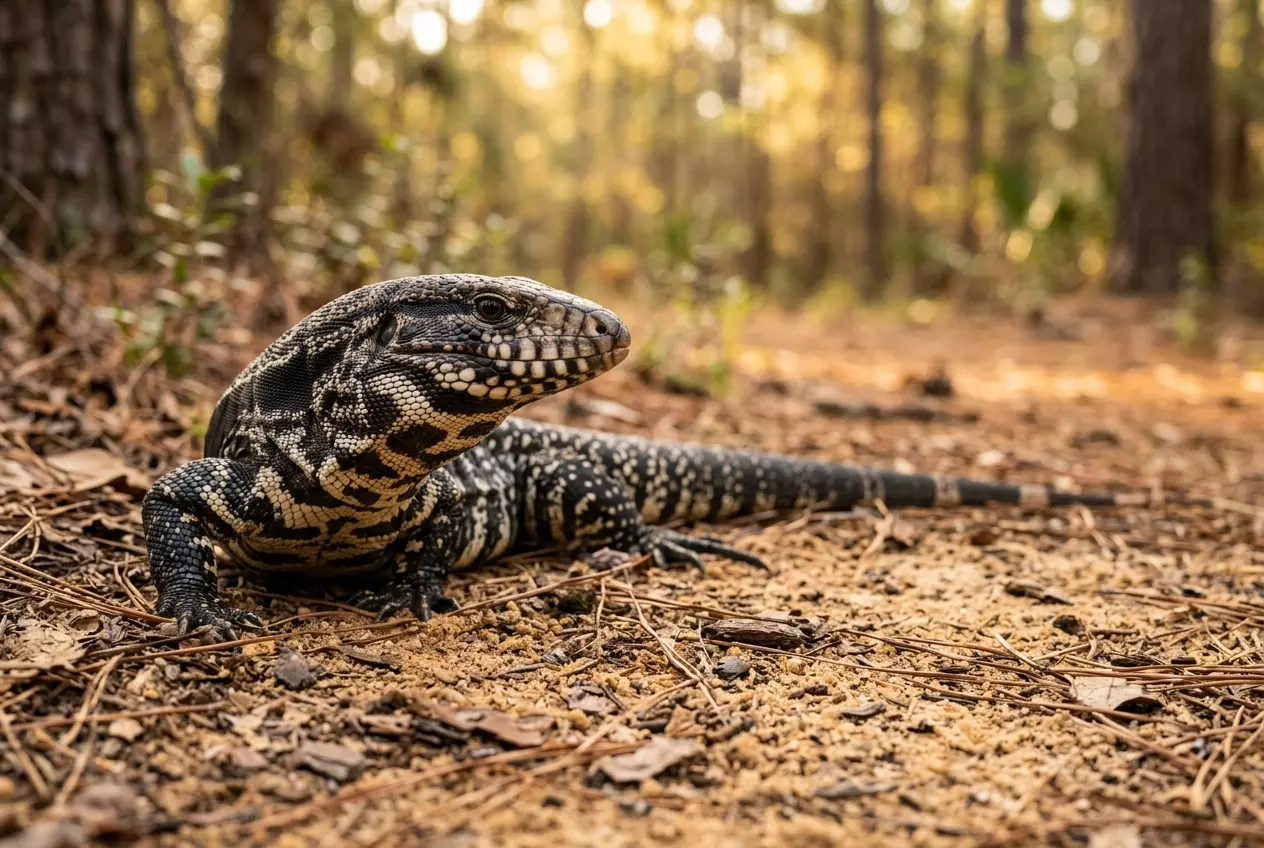
More than 20 Argentine black and white tegus, South American lizards that reach four feet in length and lay up to 35 eggs a season, are confirmed living wild in southeast Georgia’s Toombs and Tattnall counties. June is when the next generation starts hatching.
Georgia’s Department of Natural Resources (DNR), working with the U.S. Geological Survey and Georgia Southern University, has spent eight years trapping and removing animals from this colony. The species feeds on quail eggs, gopher tortoise nests, and alligator clutches, three organisms at the center of Georgia’s conservation spending and rural outdoor economy, and the current count suggests removal hasn’t closed the population.
Twenty Tegus and a June Hatchling Window
The DNR and its partners have documented more than 20 tegus living wild across Toombs and Tattnall, with confirmed sightings stretching from Lyons to Reidsville. The state’s only known established wild colony sits in these two counties; scattered reports from Valdosta to Atlanta represent escaped or released pets without evidence of a breeding population.
Female Argentine black and white tegus (Salvator merianae) reach reproductive maturity after two winters in dormancy and can lay up to 35 eggs per year. Hatchlings emerge in June and July, roughly six to eight inches long, with a bright green head coloration that fades within their first month. Adults are fast-moving and strong swimmers capable of extended submersion, and they brumate through cold months using existing burrow systems, which is part of why winters haven’t pushed them out of southeast Georgia.
Georgia Public Broadcasting reported that 30 tegus have been caught or killed in the two-county area since 2018. With the confirmed wild population still above 20, the colony has reproduced faster than removal has reduced it, or more animals remain undetected than earlier surveys captured.
- 4 feet: confirmed maximum length, adults typically weighing more than 10 pounds
- 35: eggs a female can lay per breeding season
- 20+: tegus confirmed wild in the two counties as of June 2026
- 30: total caught or killed by DNR and partners since 2018
Georgia’s Ground Nesters Bear the Cost
Ground-Nesting Birds Lose Eggs First
Bobwhite quail and wild turkeys nest directly on the ground, leaving clutches exposed to any predator that can locate them. National invasive species records confirm that ground-nesting bird eggs are documented tegu prey. The confirmed colony sits in the heart of southeast Georgia’s bobwhite country.
Hunting operations across Georgia’s coastal plain depend on sustainable ground-nesting bird populations built through consistent nesting success. Lease and guided hunt revenues reflect bird counts from multiple prior seasons, meaning predation by a new species doesn’t appear in the numbers until several years of decline have already compounded.
Protected Reptiles Take the Deeper Hit
The gopher tortoise (Gopherus polyphemus) is protected under Georgia law and listed as a federal species of concern. It is also the architect of burrow systems that shelter an estimated 350 commensal species. The DNR confirms that tegus eat both gopher tortoise eggs and young animals, meaning the threat covers the current juvenile cohort and the next breeding generation.
American alligators, also protected, nest in dense vegetation near water. Tegus are comfortable in that habitat. The DNR has confirmed that alligators are among the species whose egg clutches tegus will raid. Georgia runs both a nuisance alligator removal program and a limited permit hunt; consistent nest disruption across multiple seasons would put pressure on both.
Farm Fields and Backyard Flocks
The dietary range extends beyond wild species. Tegus eat chicken eggs, fruit, vegetables, pet food, carrion, and small live animals, covering most of what a working farm or suburban lot provides. Toombs County supports substantial vegetable and peanut production. The DNR has confirmed that tegus carry salmonella, raising a bacterial contamination concern for crops that extension agents haven’t had to account for from this source before.
Georgia’s agricultural sector has seen what an unchecked invasive can do to farm economics quickly. When the invasive cotton jassid spread across at least 13 Georgia counties in 2025, response infrastructure was stretched and economic exposure moved faster than containment planning had anticipated.
Florida Numbers Show Where This Goes
Florida’s tegu problem started with escaped pets around 2006 in the Miami-Dade area. By the time collaborative interagency trapping began, the animals were already breeding across multiple sites. 6,000+ tegus have been removed from Miami-Dade County since trapping started there, with growth described as exponential: fewer than 200 trapped statewide in 2012, more than 1,000 by 2017.
The state now has four established wild populations, documented in 35 of its 67 counties. Trapping at a single site near Everglades National Park can yield hundreds of animals per season. The state banned all tegu species from the pet trade in 2024, fifteen years after the animals were first confirmed wild in Miami-Dade.
Georgia sits at a comparable point to where that trajectory began. A 2025 peer-reviewed analysis of U.S. tegu range expansion found the species already documented across Alabama, South Carolina, and Georgia, with isolated sightings in Texas, and concluded that suitable habitat in the South extends well beyond Florida’s current footprint. The U.S. Geological Survey, which co-funds Georgia’s removal work, has published research supporting year-round survival potential for the species across much of the region.
South Carolina has documented the species in four counties, with biologists suspecting active reproduction in at least some of them. The northward spread follows the same origin: a captive animal escapes or is released, finds mates, and the population accumulates through several nesting cycles before it attracts systematic state attention.
Eight Years of Trapping in Two Counties
Removal Operations Since 2018
DNR’s Wildlife Resources Division began investigating reports of tegus in the two-county area in 2018. The work has since grown into a coordinated, multi-agency effort: DNR handles field operations and law enforcement, the U.S. Geological Survey co-funds the research, and Georgia Southern University runs field trapping and laboratory analysis of caught animals.
Since 2022, all trapped tegus are humanely euthanized and transported to Georgia Southern, where biologists document stomach contents and check females for eggs. Georgia Public Broadcasting reported that 30 animals have been caught or killed in the colony zone since the program began. With the confirmed wild population still above 20, removal has not yet closed the colony.
They can live almost anywhere and eat almost anything.
The description comes from Daniel Sollenberger, senior wildlife biologist with the Georgia DNR’s Wildlife Resources Division, speaking in a public DNR alert on the southeast Georgia tegu population.
| Metric | Georgia Colony | Established Comparison |
|---|---|---|
| First wild detection | 2018 | 2006 (Miami-Dade County) |
| Confirmed wild populations | 1 | 4 |
| Counties with sightings | 2 (established) | 35 (reported) |
| Total animals removed | ~30 since 2018 | 6,000+ from Miami-Dade alone |
| Key research partners | USGS, Georgia Southern University | University of Florida, National Park Service |
| Pet trade status | Banned December 2023 | All species banned 2024 |
The 2022 Regulatory Turn
Georgia moved on the legal front in 2022, adding the Argentine black and white tegu to its list of regulated “wild animals” alongside five other reptile species. The designation banned importing and breeding in the state. Pet owners had until December 4, 2023 to register and tag existing animals or transfer them to a licensed permit holder.
The Georgia DNR’s tegu response page notes that the wild colony most likely originated with escaped or intentionally released captive animals, predating the 2022 regulations. The four-year gap between the program’s 2018 start and the wild animal designation reflects how long field documentation takes to drive formal policy change.
What Landowners and Hunters Can Do
Tegus aren’t protected under Georgia wildlife law. On private property with landowner permission, they can be legally trapped or killed year-round, subject to local ordinances and basic safety precautions. On state Wildlife Management Areas (WMAs), the animals can be taken with firearms legal for whichever hunting season is currently open on that specific WMA; trapping on WMAs is not permitted.
The DNR asks anyone who spots a tegu, alive or dead, to report the sighting. Those reports help biologists map which animals are still active and direct removal resources. Residents in Toombs and Tattnall can also reduce their property’s appeal to the lizards by keeping pet food indoors, filling holes that could serve as burrow entrances, and clearing brush piles that young tegus use for cover.
- Online: gainvasives.org/argentine-black-and-white-tegu
- Phone: (478) 994-1438
- Email: gainvasives@dnr.ga.gov
- Note the location and photograph the animal if possible
Caution applies even where removal is legal. Tegus carry salmonella, and anyone handling a removed animal should follow standard hygiene precautions. Sightings outside the two-county zone, from Valdosta to Atlanta, still matter to the agency; they typically represent escaped pets, but a quick report allows a fast response before the animal has time to establish.
Georgia officials have noted that established invasive populations become nearly impossible to eradicate once breeding takes hold, pointing to Florida’s four wild populations spanning 35 counties as evidence of the trajectory. The DNR has been removing tegus from these two counties since 2018. Hatchlings arrive this month.