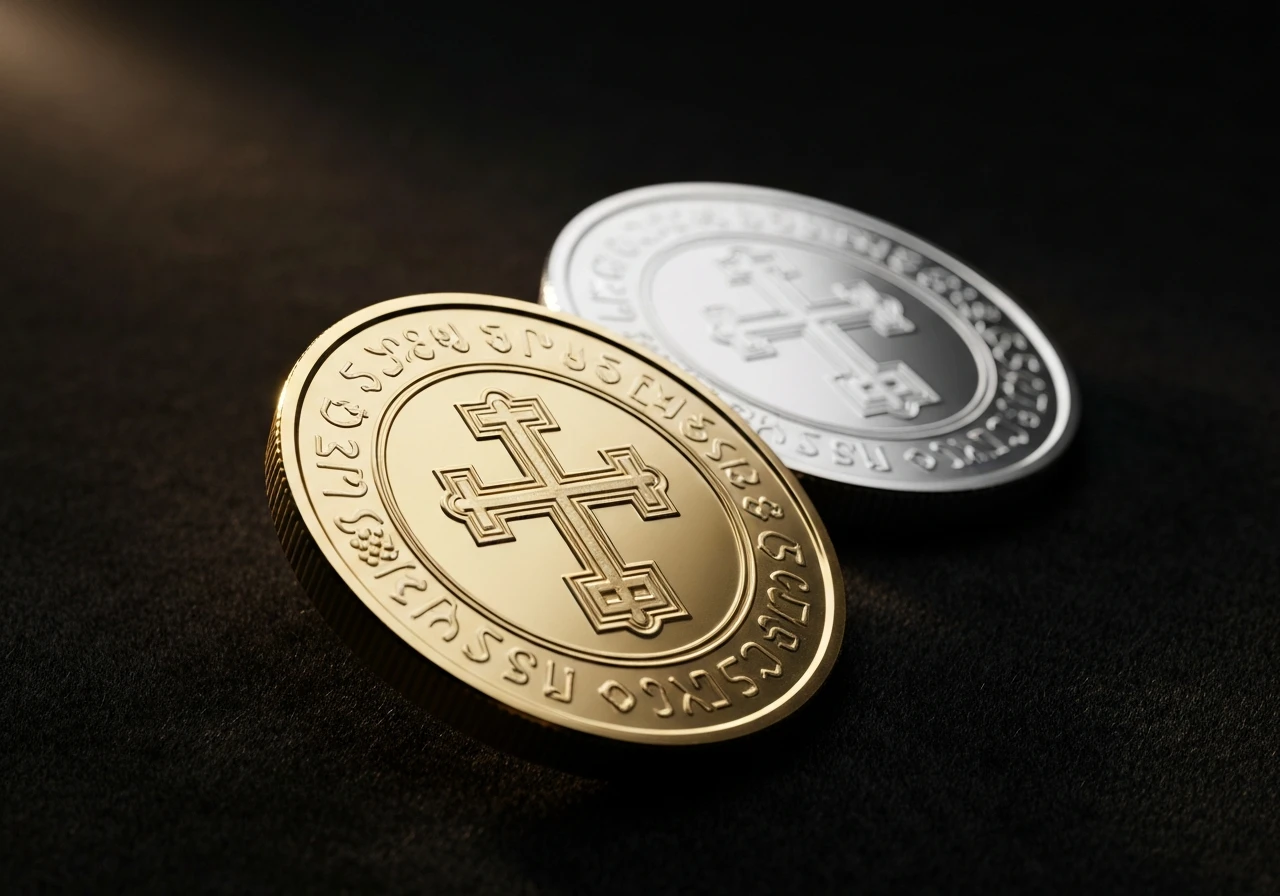
The National Bank of Georgia (NBG, the country’s central bank and monetary regulator) will strike gold and silver collector coins to mark 1,700 years since Christianity became the state religion of the ancient Kingdom of Iberia. The bank confirmed the plan on June 1, after Governor Natia Turnava met the head of the Georgian Orthodox Church to settle the concept and design.
The coins are the metal centerpiece of a state-and-church celebration that already has a budget, a calendar, and a commission running it. Georgia has minted moments like this before, which means the rough shape of what is coming sits on the public record long before a single coin is pressed.
The Decision, the Commission, and a Patriarch’s Sign-Off
The mintage followed a formal recommendation from a special commission set up for the anniversary, a body that mixes representatives of the Government of Georgia with clergy from the Patriarchate. Its co-chairs are Prime Minister Irakli Kobakhidze and Catholicos-Patriarch of All Georgia Shio III, the same two figures steering the wider commemorations.
Turnava, the NBG governor, met Shio III directly to talk through the look of the pieces, and the bank said it will develop the artwork in cooperation with the Patriarchate. RDS NEWS earlier covered the central bank’s plan to mint the commemorative coins. The NBG framed the move as routine for an institution that, in its own words, has long marked major historical milestones in struck metal.
What the bank has confirmed is narrow. Two metals, gold and silver. A theme. A design partner. The denomination, the weights, the mintage figures, and the release window all remain open, which is exactly where the bank’s own back catalogue becomes useful.
- 1,700 years since Christianity was declared the state religion of Iberia
- GEL 5.3 million (about $2 million) set aside for the anniversary program
- 326 AD, the year most scholars now favor for the conversion
Georgia Has Struck Its Milestones in Metal Before
This is not the bank’s first religious or national anniversary in precious metal. Earlier issues include 10-lari collector coins dedicated to the 2,000th anniversary of the Nativity and the 3,000th anniversary of Georgian statehood, both reaching for the big round numbers of national memory.
More recent issues show the modern playbook in sharper detail. In 2023 the bank put out matching 5-lari coins for two founding figures, the medieval unifier Bagrat III and the ancient Iberian king Parnavaz I, struck in Au 900 (gold of 90 percent purity) and Ag 925 (silver of 92.5 percent purity). The Bagrat III and Parnavaz I collector coin specifications listed gold mintages of just 700 units per design.
Then in 2025 came the splashier set. The 30th anniversary lari coin issue arrived in three metals, with gold, silver, and a cheaper copper-nickel tier so ordinary buyers could own one.
One supplier runs through both. Poland’s Mennica Polska, better known as the Polish Mint, pressed the recent Georgian collector series, and the bank sold them in small batches over a handful of days. The pattern is consistent enough to read forward.
| Issue | Year | Face value | Metals | Smallest mintage | Gold coin price |
|---|---|---|---|---|---|
| Bagrat III / Parnavaz I | 2023 | 5 lari | Gold, silver | 700 (each gold design) | GEL 1,470 |
| 30th anniversary of the lari | 2025 | 5 lari | Gold, silver, copper-nickel | 1,500 (gold) | GEL 2,500 |
What the Template Says the New Coin Will Be
Strip the two recent issues down to their shared features and a predictable specification emerges. The 1,700-year coin has not been detailed, but the bank rarely strays far from its own grammar.
- A low face value, most likely 5-lari, with religious anniversaries having historically reached 10 lari
- Gold in Au 900 and silver in Ag 925, the bank’s standard collector alloys
- A small mintage, somewhere in the 700 to 5,000 band seen on recent coins
- A strike by the Polish Mint, the bank’s recent contractor
- Sale within days through the NBG cash center, the Kvareli Money Museum, and an online platform
- Per-customer purchase caps to spread the limited stock
The one wildcard is denomination. Because the older Nativity and statehood coins carried a 10-lari face, the religious weight of this anniversary could push the new piece above the 5-lari norm. The artwork is the real unknown, and that is precisely the part Turnava handed to the Patriarchate.
A 326 AD Conversion the State Still Honors
The milestone reaches back to Saint Nino, a missionary who, by tradition, arrived in Iberia around 320 and converted Queen Nana and then the pagan king Mirian III. Churches rose at Svetitskhoveli and a clutch of other sites, and the cathedral remains the spiritual anchor of the story the coins will carry.
Mirian’s decision made Iberia, in the standard telling, the second country in the world to adopt Christianity as a state religion, after neighboring Armenia. That ranking is a point of national pride and a reason the anniversary draws both government and church into the same room.
The exact year is less settled than the celebration implies. Scholars have proposed dates from 312 to 337, with 326 the figure most now use as a chronological anchor, a debate aired in research such as a paper on new evidence for dating Christianity as Georgia’s state religion. The round number 1,700 counts forward from that anchor.
The Coins Are One Line in a GEL 5.3 Million Program
The mintage sits inside a far larger spend. The government has set aside GEL 5.3 million, drawn from its reserve fund, to stage the anniversary across the year.
The main program runs from June 1 through October 14, with a wider rollout having begun around the May 26 Independence Day. It closes with a symposium titled “God, Homeland, Human,” a framing that knits faith and nationhood into a single banner.
In between sit cultural and educational events, scientific conferences, student expeditions, and religious commemorations including the feast of Svetitskhoveli. The work is being coordinated jointly by the Government of Georgia and the Patriarchate, the same partnership steering the coin design.
For a small economy, fixing two precious-metal coins to a publicly funded religious commemoration is also a statement about where church and state meet. The commission structure, co-chaired by a prime minister and a patriarch, makes that partnership explicit rather than implied.
Who Buys a Saint in Precious Metal
Collector coins like these are not really pocket money. With gold mintages in the hundreds and silver in the low thousands, recent Georgian issues went on sale in small daily tranches with purchase limits of one gold, two silver, or five copper-nickel pieces per customer, and the scarcity is the point. Demand for bullion-backed collectibles tracks the wider metals market, where prices have climbed alongside policy moves such as India’s hike in gold and silver import duty.
For now the design sits with the Patriarchate, the denomination is unset, and the release date has not been published. The only fixed points are two metals, a commission, and a number: 1,700.
Frequently Asked Questions
When Will the NBG Coins for 1,700 Years of Christianity Be Released?
No release date has been announced. The National Bank is still developing the design with the Patriarchate, and based on past issues the launch is likely to be tied to the anniversary events running through October 14, 2026.
How Much Will the Collector Coins Cost?
Prices have not been set. For comparison, recent NBG gold collector coins sold for between GEL 1,470 and GEL 2,500, while silver versions ranged from about GEL 100 to GEL 130.
Where Can You Buy National Bank of Georgia Collector Coins?
Recent issues were sold through the National Bank’s cash center, the Kvareli Money Museum, and an online platform, with per-customer purchase limits applied during the first days of sale.
Are the Commemorative Coins Legal Tender?
Yes. The coins carry a nominal lari face value and are legal tender, but their collector and precious-metal value trades well above that face value.