Georgia shipped 4,200 tons of bay leaves abroad in the first half of 2026, worth $17.3 million. Nearly nine of every ten dollars came from just two buyers, China and Russia, according to the country’s Ministry of Environmental Protection and Agriculture. Export volume rose 27% and value climbed 23% from the same period a year earlier, with the average kilogram fetching $4.10.
But the ministry’s own quarterly releases, read side by side, show growth reversing hard in the second quarter, even as the six-month headline stayed positive. Almost the entire trade rides on two buyers with complicated politics attached to both.
Splitting the Half Into Quarters
The ministry has not published an April-through-June figure on its own. Its two most recent releases do that work for anyone willing to subtract one from the other.
A report covering the first quarter put bay leaf exports at 2,800 tons worth $12.1 million, up 86% in volume and 80% in value from the first quarter of 2025. Monthly filings show February alone brought in 803 tons worth $3.2 million, up 60% in tonnage from a year earlier. China took 68% of that month’s shipments and Russia took 22%.
Then came the half-year report: 4,200 tons worth $17.3 million for January through June, up a comparatively modest 27% in volume and 23% in value.
Subtract the first quarter from the half and the second quarter comes out to 1,400 tons worth $5.2 million. Applying the same subtraction to 2025 puts that year’s second quarter at roughly 1,804 tons worth $7.3 million. Bay leaf shipments fell 22% in tonnage and 29% in value in the second quarter of 2026 compared with the same three months of 2025.
| Period | Bay Leaf Exports (Tons) | Export Value | Year-on-Year Change |
|---|---|---|---|
| First quarter 2025 | 1,500 | $6.7 million | Base year |
| First quarter 2026 | 2,800 | $12.1 million | Volume up 86%, value up 80% |
| Second quarter 2025 | 1,804 | $7.3 million | Base year |
| Second quarter 2026 | 1,400 | $5.2 million | Volume down 22%, value down 29% |
| First half 2025 | 3,304 | $14.0 million | Base year |
| First half 2026 | 4,200 | $17.3 million | Volume up 27%, value up 23% |
RDS News calculated the second-quarter rows above by subtracting the ministry’s first-quarter releases from its half-year totals. The ministry has not published its own quarterly figure for the April-to-June period.
Bay leaf shows up in Georgian customs records under an older name, laurel, and the category was a much smaller business only a few years ago. Ministry data from mid-2023 put seven months of laurel exports at $9.0 million, roughly half of what six months bring in now.
Why Do China and Russia Buy Most of Georgia’s Bay Leaf?
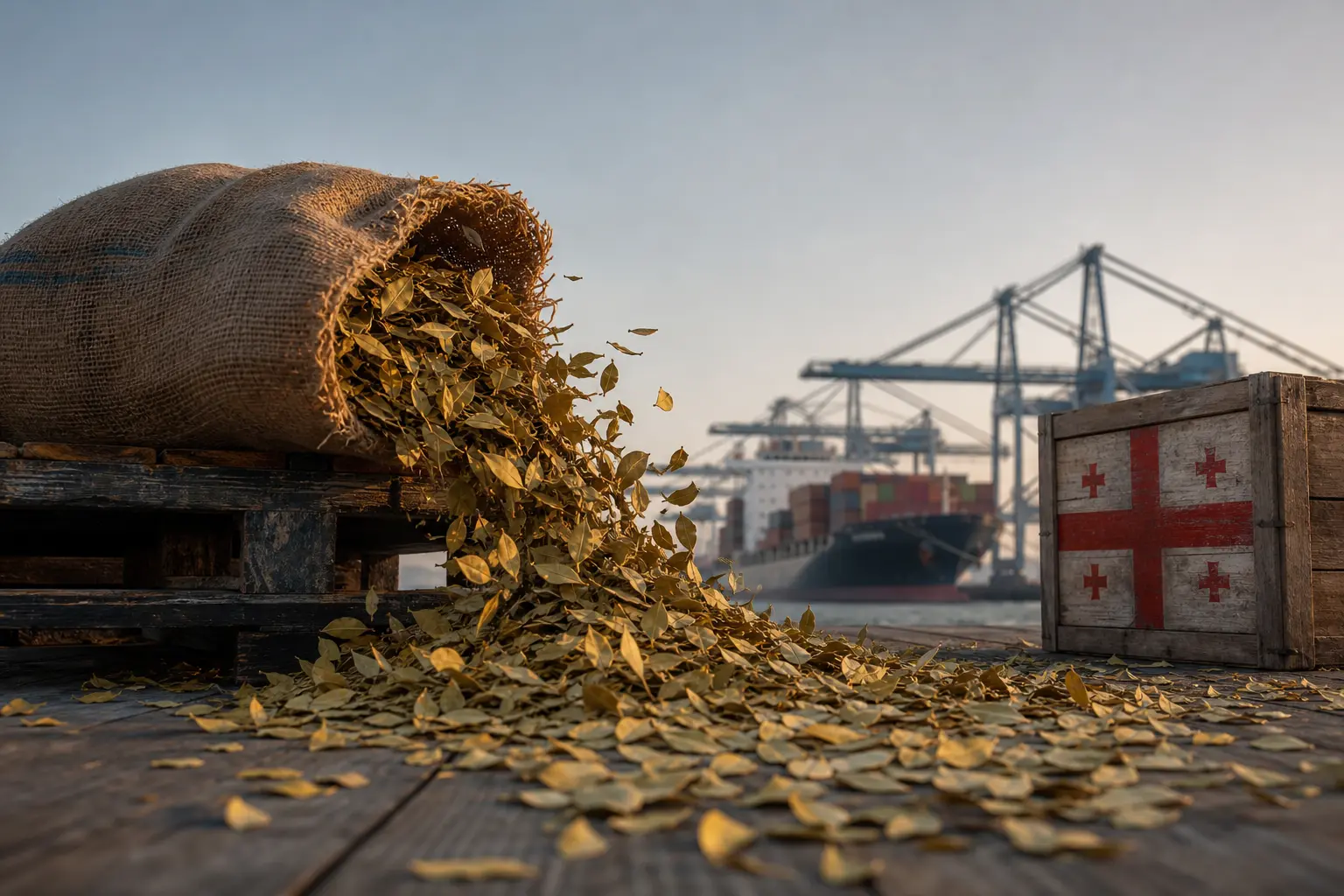
China bought 73% of Georgia’s bay leaf exports in the first half of 2026 and Russia bought another 15%, leaving just 12% for every other country combined, according to ministry data. China’s share has grown since February, when it stood at 68%, while Russia’s slice shrank from 22% over the same stretch.
Some of the answer is bureaucratic. Georgia holds a free trade deal with the European Union and, separately, tariff reduction agreements covering China and Turkey, plus older arrangements across the former Soviet bloc that keep duties low on shipments bound for Russia.
The trade itself follows a shape common to small economies sitting next to giants. Georgia sends raw materials and wine to China, and China sends back machinery, electronics and air conditioners, in what a London School of Economics blog called a “core-periphery” trade dynamic.
Georgian officials credit deliberate policy support for the growth. Vakhtang Tsintsadze, the country’s deputy economy minister, told the Georgian bureau of Sputnik, a Russian state-funded news outlet, that “these trends are driven by the Georgian government’s support programs aimed at increasing the competitiveness” of Georgian goods abroad.
Bay Leaf’s Place in a Bigger Harvest
Bay leaf grew inside a genuinely strong quarter for Georgian farming overall. Exports of agricultural products rose 15% year-on-year in the first quarter of 2026, reaching 88 countries, the ministry said. Russia bought more Georgian farm goods than anyone else, at $131.9 million, ahead of the European Union’s $68.9 million and Azerbaijan’s $44.8 million.
Wine remains the country’s signature export, a product archaeologists trace back more than 8,000 years, and it has grown fast in new markets even as older ones like Russia keep buying heavily.
Bay leaf had company near the top of the growth chart:
- Wine – Georgia’s signature export rose 18% in the first quarter, outpacing the entire agricultural sector’s headline growth rate.
- Mineral water – shipments to Gulf buyers including the United Arab Emirates, Saudi Arabia and Qatar climbed 24% in the first quarter as demand shifted away from sugary sodas.
- Hazelnuts – grown mainly in the western Samegrelo and Guria regions, where Georgia ranks among the world’s five largest producers.
- Nuts, soft drinks, fish meal and sheep – all flagged by the ministry as other categories posting significant first-quarter gains.
Georgian officials describe the wider trend as a decade-long move away from depending on any single buyer. Investment bank Galt & Taggart estimates that the European Union, the Middle East and East Asia together now take in over 45% of Georgian farm exports, up from less than a quarter in 2015. Bay leaf runs the opposite direction. While the rest of Georgian agriculture spreads across more markets, this one crop has concentrated into fewer of them.
The Risk of Selling to Just Two Buyers
Georgia severed diplomatic relations with Russia after their 2008 war and has not restored them. Trade kept moving anyway. Russia remains a top buyer of Georgian bay leaf despite years without an ambassador in either capital.
Georgian exporters more broadly have described Chinese customs rules as inconsistent from province to province, an added complication for a perishable, seasonally harvested crop.
Independent analysts and government officials do not fully agree on how much credit this year’s export boom deserves.
- Government officials credit trade-support programs and rising Asian demand for the growth, framing 2026 as the payoff of a long diversification push.
- Independent economists argue that headline export numbers across categories deserve more scrutiny than officials have given them, since much of the broader national gain traces to a single new refinery.
National export records this year climbed partly on a 922% surge in petroleum product exports tied to a new Black Sea refinery. Roman Gotsiridze, a former head of Georgia’s National Bank, questioned the pattern behind that surge.
“There is Togo in the list, which is the African country that does not need unfinished semi-processed diesel products,” he told OC Media, pointing to shipments going to buyers with little obvious use for the goods.
Georgia’s Farm Sector Braces for a Slower Stretch
The wider forecast for Georgian agriculture runs cooler than bay leaf’s own numbers suggest. The Asian Development Bank expects the sector to stabilize this year and return to 1.7% growth in 2027, following a 6.1% contraction in 2025, as irrigation and productivity improvements take hold.
Whether the third quarter looks more like the first months of 2026 or more like the second will show up whenever the ministry issues its next update, following the same rolling schedule that has produced a new report every few months so far this year.
Frequently Asked Questions
How Big Is Bay Leaf Next to Georgia’s Total Exports?
Bay leaf is a small fraction of Georgia’s trade even at its current pace. The country’s total exports across every sector reached $667.8 million in May 2026 alone, according to Trading Economics, next to roughly $17.3 million for bay leaf across the entire first half of the year. Georgia’s biggest overall export categories remain metals, cars, nuts, fertilizer, wine and mineral water.
Did Bay Leaf Prices Change During 2026?
Yes. The average kilogram fetched around $4.32 in the first quarter, then slipped to roughly $3.71 in the second, even though the full first-half average landed at $4.10. Buyers paid less per kilogram as the year went on, a decline that started before shipment volumes themselves turned lower.
What Is Georgia’s Broader Economic Outlook for 2026?
The Asian Development Bank expects Georgia’s overall economy to grow 5.5% in 2026, down from 7.5% in 2025, as weaker demand from abroad cools a boom year. Agriculture is on a similarly steadier path this year after a difficult 2025, according to the same report.
How Often Does Georgia Publish Bay Leaf Trade Data?
The agriculture ministry has released bay leaf figures on a rolling basis in 2026, starting with monthly snapshots that later get folded into quarterly and half-year totals. On that pattern, a report covering July through September would be expected a few months after this one.