The Caucasus Environmental NGO Network (CENN) toured four small businesses in Georgia’s Guria region to show circular production working far outside Tbilisi. It organized the trip under two European Union-funded projects, Circular Cities and Regions in Georgia and Green Guria. College students, educators and members of an Adjara industrial waste-sharing platform made the trip.
The four stops are a small sample of a much bigger goal. Georgia’s own circular economy, measured nationally, still lags far behind its neighbors in the European Union.
Four Stops on a Guria Back Road
The itinerary ran through Ozurgeti and Chokhatauri municipalities, pairing high-tech agriculture with decades-old crafts.
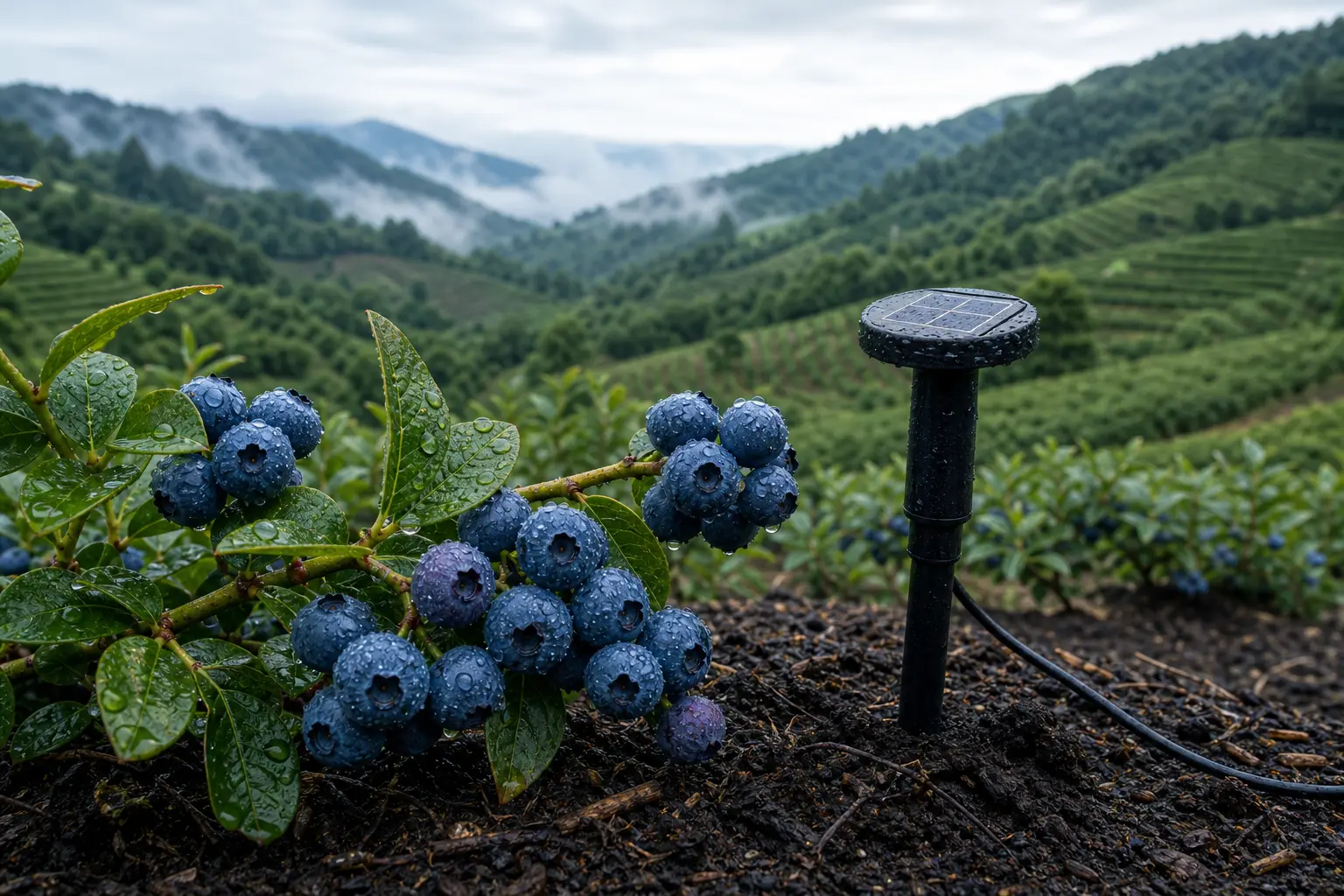
- Blueberry Garden, in Melekeduri village, Ozurgeti Municipality: a blueberry plantation running a smart irrigation system, with sensors that track soil moisture and fertilizer levels.
- Taba Tea House: a restoration of tea plantations first planted in 1933, now producing seven varieties of tea, with a tasting for visitors.
- Kala’s Farm, in Chokhatauri Municipality: a goat cheese workshop that processes about 300 liters of locally sourced goat milk a day, plus a tasting area built for tourists and school groups.
- Skiji House: a family-run producer of dried fruit, fruit teas, fruit candy and jam.
Each stop doubled as a pitch that Guria’s farms and workshops can turn local milk, tea leaves, berries and fruit into finished products without shipping the raw material out first.
Colleges and Businesswomen Join CENN’s Circular Tour
The visiting group belonged to the Adjara Industrial Symbiosis and Circular Economy Platform. CENN built the platform to connect regional factories and farms that can reuse each other’s waste as raw material.
Representatives came from New Wave College, Black Sea College and the Association of Businesswomen of Adjara.
CENN ran the trip under two EU-funded projects. Circular Cities and Regions in Georgia focuses on advancing waste prevention across Georgia’s regions, according to a tracker kept by the global local-government network ICLEI Europe. Green Guria is a three-year push launched in Ozurgeti to reduce poverty in the region’s vulnerable rural communities.
Georgia’s Circular Economy Runs on a 1.48 Percent Rate
The backdrop to the Guria tour is a set of national numbers CENN cites often. The United Nations Development Programme says Georgia’s circularity rate stands at just 1.48 percent, against a European Union average of 12.2 percent.
The gap shows up across the rest of the country’s waste data too.
| Indicator | Georgia | Context |
|---|---|---|
| Circularity rate | 1.48% | 12.2% is the EU average |
| Domestic material consumption | 13.7 tonnes per capita | Close to the EU average |
| Municipal waste generated per year | 900,000 to 1.1 million tonnes | Rising with tourism and urban growth |
| Waste left uncollected | 64% | No hazardous waste treatment facilities exist |
| Avoidable food waste | 576,588 tonnes a year | More than 25% of it is avoidable |
Some of the framework for change is already in place. Georgia adopted an extended producer responsibility system in 2020, along with a Waste Management Code built to align with EU standards, though enforcement on the ground remains uneven.
The push has diplomatic weight behind it. Georgia holds European Union candidate status and a Deep and Comprehensive Free Trade Agreement with the bloc, giving exporters a reason to meet EU packaging and production standards ahead of any requirement to do so.
The government has not adopted a comprehensive national circular economy action plan, even as 24 of the EU’s 27 member states had done so by 2023. Projects like Green Guria and Circular Cities and Regions in Georgia are filling a policy gap that Tbilisi has not yet closed.
Can a Handful of Farms Move a National Number?
Not by themselves. CENN has repeated this same playbook, business by business and municipality by municipality, across western Georgia, and points to earlier rounds as proof the model creates real jobs and real savings long before it moves a national circularity rate.
Green Guria and the Adjara Local Action Groups both trace back to ENPARD, the European Union’s umbrella program for rural development in Georgia, which has put 102 million euro into the countryside since 2013.
In Adjara, the mountainous region next door, CENN-run Local Action Groups backed 170 local development initiatives and over 500 new jobs in Keda and Khulo municipalities alone, the EU’s diplomatic delegation to Georgia reported.
In Tbilisi, a separate CENN pilot produced a sharper, smaller number. Fabrika, a multifunctional space, saved 42,000 GEL by switching to reusable cups instead of buying single-use plastic, under a project CENN ran with the German development agency GIZ and ICLEI.
CENN Keeps Naming the Same Infrastructure Gaps
CENN’s own staff are careful not to oversell the pace of change. When the Tbilisi Circular Labs pilot closed on October 28, 2025, a senior CENN official grounded the celebration in a far more cautious accounting of where Georgia actually stands.
We are just beginning. Reuse approaches are practically new here.
Nino Shavgulidze, CENN’s deputy director, said at the event. Over the last decade, she added, the import and production of disposable tableware in Georgia rose 135 percent, even as reuse pilots like Fabrika’s cup system stay rare across the country.
The national numbers back her up. Plastic alone makes up 12 to 16 percent of Georgia’s municipal waste, and the government has set a target to recycle 80 percent of plastic waste by 2030, up from a 50 percent goal set for 2025.
Businesses trying to hit those targets early describe the same three obstacles: underdeveloped infrastructure, local governments without the capacity to separate waste, and recycling standards that still fall short of EU criteria.
Financing is a separate hurdle. Commercial loans for small recyclers and green businesses often carry interest rates above 16 percent, well above what long payback periods on environmental investments can absorb.
A 2025 survey of 617 Georgians found the gap runs deeper than money. Most respondents understood the basic principles of a circular economy, but their household waste habits skewed neutral to negative, and a high level of education did not predict greener behavior at home.
Other fixes are already being piloted outside Guria, including several new approaches to cutting Georgia’s waste stream.
A Three-Year Project Still Adding Businesses
Green Guria launched at the Ozurgeti Techno Park in March 2023 with a three-year mandate covering Ozurgeti, Lanchkhuti and Chokhatauri, the three municipalities that make up Guria.
Local groups it helped build now sit alongside newer arrivals, including an EU-backed windbreak restoration project in Guria’s Laituri village and the Adjara platform that sent students and businesswomen on this tour.
CENN has not said how many businesses will eventually join the network. For now, the count stands at four, each one a small, working counterpoint to Georgia’s 1.48 percent circularity rate.