The Food and Agriculture Organization (FAO) trained Georgian farm students outside Marneuli this week to mark World Youth Skills Day. Its own new assessment, released the same day, says education keeps rising among Georgia’s rural youth while suitable jobs, land and credit do not. That gap, the United Nations agency found, is what keeps pushing young people toward Tbilisi and abroad.
FAO’s numbers from the training itself run into the hundreds. Georgia’s own labor and migration statistics run into the tens of thousands. Nothing in the new assessment closes that distance.
FAO Turns a Marneuli Greenhouse Into a Classroom
FAO marked World Youth Skills Day by sending students from the Agricultural University of Georgia to a working farm in Marneuli, a farming town in Georgia’s Kvemo Kartli region, about an hour from the capital, Tbilisi. They trained at the farm of Naira Paksadze, an FAO Lead Farmer, alongside FAO agronomy and extension specialists.
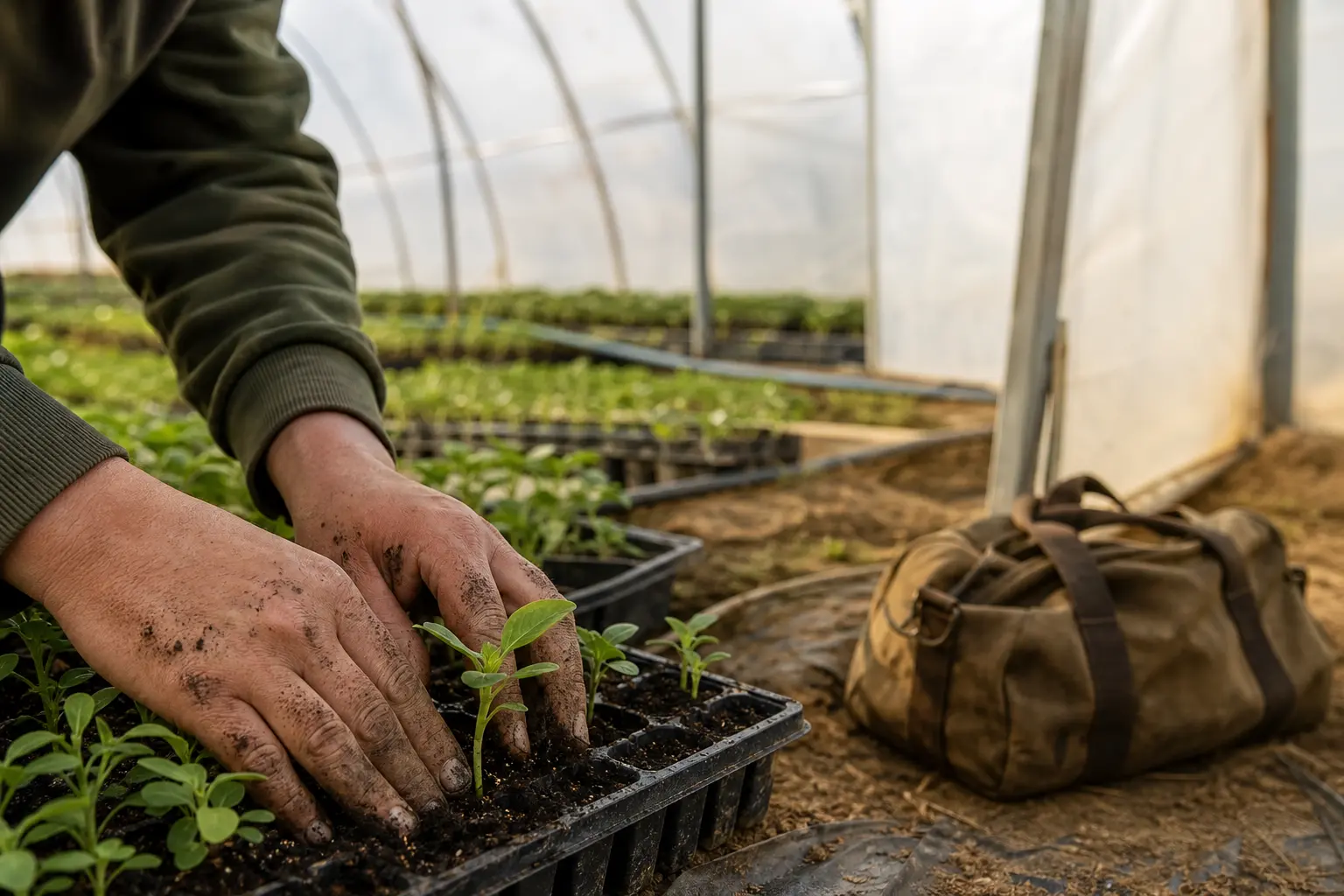
Students toured a seedling nursery and a vegetable greenhouse, compared open-field growing methods, and learned how drip and overhead irrigation systems work before sowing drought-resistant seed varieties themselves. Denis Reiss, a Programme Officer for Sustainable Food Systems at the Delegation of the European Union to Georgia, called the hands-on approach essential.
Learning from experts, as well as from farmers, is crucial for promoting affordable and relevant technologies addressing climate change issues.
Reiss made the comment at the Marneuli training. Guido Agostinucci, FAO’s programme manager for the fourth phase of the European Neighbourhood Programme for Agriculture and Rural Development, said the same hands-on sessions build both technical knowledge and students’ ability to support more resilient food systems.
- ENPARD – the European Neighbourhood Programme for Agriculture and Rural Development, the EU’s main rural development channel in Georgia since 2013, now in a fourth phase co-funded with Sweden.
FAO says the current phase has already put more than 820 university students through practical agricultural training and reached over 4,700 schoolchildren with interactive food-safety lessons. The phase builds on a decade of EU spending in rural Georgia. Under the programme’s earlier phases, the EU channeled more than GEL 600 million into Georgia’s countryside between 2013 and 2022, worth about 179.5 million euros, or roughly 195 million dollars at current exchange rates.
The Emigration Numbers Behind the Training Stats
Set against Georgia’s own labor data, the training cohorts look small. Youth unemployment among 20-to-24-year-olds fell to 17.5 percent in 2024, down from 21 percent the year before, but that is still far above the rate for the workforce as a whole.
The table below lines up FAO’s training totals against the figures Georgia’s own statistics agency and outside researchers report for the same age group.
| Metric | Figure | Year / Source |
|---|---|---|
| University students trained under ENPARD IV | 820+ | 2026, FAO |
| Schoolchildren reached with food-safety training | 4,700+ | 2026, FAO |
| Youth unemployment, ages 20 to 24 | 17.5% | 2024, Trading Economics |
| Youth unemployment, ages 15 to 24 (ILO estimate) | 30.2% | 2023, Statista |
| Share of Georgia’s emigrants aged 15 to 29 | 30% of 105,107 people | 2019, National Statistics Office of Georgia |
| Adults aged 18 to 34 wanting to emigrate temporarily | Nearly 45% | GEOpolitics analysis |
Two of those rows come from outside Georgia’s official statistics. An analysis published by the Georgia-focused outlet GEOpolitics put youth unemployment closer to 35 percent and found that nearly 45 percent of adults aged 18 to 34 want to leave the country, at least temporarily. Georgia’s own 2019 emigration records back the general direction: people aged 15 to 29 made up the largest single age group among more than 105,000 emigrants that year.
Why Can’t Young Georgians Turn Farmland Into a Business?
Land in Georgia is split into parcels too small and scattered for most young farmers to finance or scale, FAO’s assessment found. Combined with weak access to credit and a widening mismatch between what graduates study and what local employers actually need, the barriers push educated young people out of agriculture even when they want to stay.
FAO ties the problem to fragmented land holdings and limited access to productive assets, which it says makes it difficult for young entrepreneurs to build a farming business or qualify for financing. FAO’s assessment on rural Georgia ties the local picture to a wider regional slide, with young people increasingly turning away from farming as a career across Europe and Central Asia.
The same recurring constraints show up across FAO’s research and the CONTEXT of local reporting on the sector:
- Fragmented land – Most rural households hold small, scattered plots too small to support a commercial farm or attract outside investment.
- Thin credit access – Funding schemes and banks often require land titles or collateral that young farmers, who rarely own land outright, cannot produce.
- Skills mismatch – Graduates increasingly hold degrees that do not match the jobs available in their home regions, pushing many into unrelated work or emigration.
- Weak rural services – Limited infrastructure and public services make it harder to run a modern farm business from a village instead of a city.
None of these constraints are unique to Georgia, but FAO says they hit its rural regions at a moment when the country can least afford to lose young workers.
Young Women Face an Even Steeper Climb
FAO says these barriers land hardest on young women, who face greater difficulty accessing land, credit and government support programs needed to build a commercial farm. The agency’s country gender assessment found Georgian women earn about 75 percent of men’s agricultural wages on average, a gap that falls to 35 percent in the fisheries sector.
Much of that gap traces back to land. Because women are less likely to hold land titles, FAO found they often cannot qualify for agricultural funding schemes or bank loans that require proof of ownership. Many rural women who farm every day still do not describe themselves as farmers, the assessment noted, since the work is treated as a family duty rather than an occupation.
FAO says a follow-up review found the sectoral gaps are still there years later, particularly for rural and young women, even as data collection on gender in agriculture has improved. The pattern is not unique to Georgia. Lauren Phillips, FAO’s deputy director for rural transformation and gender equality, said that worldwide, 91 percent of young women in agrifood jobs hold vulnerable, informal positions, against 83 percent of young men.
Inside the National Youth Network for Agriculture and Rural Development
To act on its own findings, FAO is working with Georgia’s Ministry of Environmental Protection and Agriculture and the Ministry of Regional Development on programs that pull young people into local development planning, agricultural and business training, community projects and small-scale investment initiatives. The agency also helped set up the National Youth Network for Agriculture and Rural Development, a platform meant to connect young people directly with government institutions and development partners.
The environmental protection and agriculture ministry has already put its name to specific money. Its minister, Otar Shamugia, and Raimund Jehle, FAO’s Representative in Georgia, signed a 4 million euro project agreement financed by the Austrian Development Cooperation for an inclusive rural development and sustainable agriculture programme aimed squarely at women and youth. Local and international experts will support the work once pilot municipalities are chosen with the ministry.
Rural Georgia Needs More Than a Paycheck to Keep Its Young
FAO’s own conclusion is direct. The agency says attractive rural communities need better schools, stronger infrastructure, expanded public services, more recreational options and real support for entrepreneurship, alongside farm jobs rather than instead of them. Georgia’s statistics agency has, for years, tracked how youth unemployment has moved through repeated cycles without closing the gap with older workers.
Coordinated national policy and targeted investment, FAO concluded, will decide how much of Georgia’s rural population these programs can still keep at home.
Frequently Asked Questions
Does FAO’s Georgia Report Only Focus on Farming Jobs?
No. FAO’s assessment says many young Georgians remain committed to rural development beyond agriculture itself, including through environmental protection, tourism and community initiatives, and argues these paths deserve the same institutional backing as farming.
How Does Georgia’s Rural Youth Problem Compare With the Global Picture?
FAO’s 2025 global report on youth in agrifood systems found that 54 percent of the world’s young people already live in urban areas, while rural youth account for just 5 percent of the population in industrial agrifood systems, a shortage the report warned could worsen labor gaps if farming careers do not become more attractive. An estimated 395 million rural youth worldwide live in areas expected to see declining agricultural productivity.
What Is FAO’s Rural Youth Action Plan?
It is a five-year global framework, running from 2021 to 2025, that FAO’s member states endorsed in 2017 and formally adopted at the 27th Session of the Committee on Agriculture in 2020. The plan is built around five thematic areas meant to make rural areas more attractive to young women and men.
How Bad Did Youth Unemployment Get in Georgia During the Pandemic?
It spiked sharply. By 2020, unemployment reached 43.9 percent among Georgians aged 15 to 19, 38.3 percent among those aged 20 to 24, and 23.2 percent among 25-to-29-year-olds, according to figures compiled after the COVID-19 pandemic’s peak. Rates have since eased but remain well above the working-age average.
What Is RuLIS, and How Does It Track Rural Livelihoods in Georgia?
RuLIS, the Rural Livelihoods Information System, is FAO’s harmonized set of household and individual data covering crop and livestock production, off-farm income, migration and shocks. In Georgia, it draws on the national Integrated Household Survey Database from 2013 to 2016 and the Household Incomes and Expenditures Survey from 2017 to 2021 to track how rural households actually live and work.