
BUSINESS
Eco Material Bets Its Georgia Lab on Harvested Coal Ash
CRH’s Eco Material opened a 16,400-square-foot Taylorsville lab to turn pond ash and other leftovers into cement replacements after a $2.1 billion purchase.

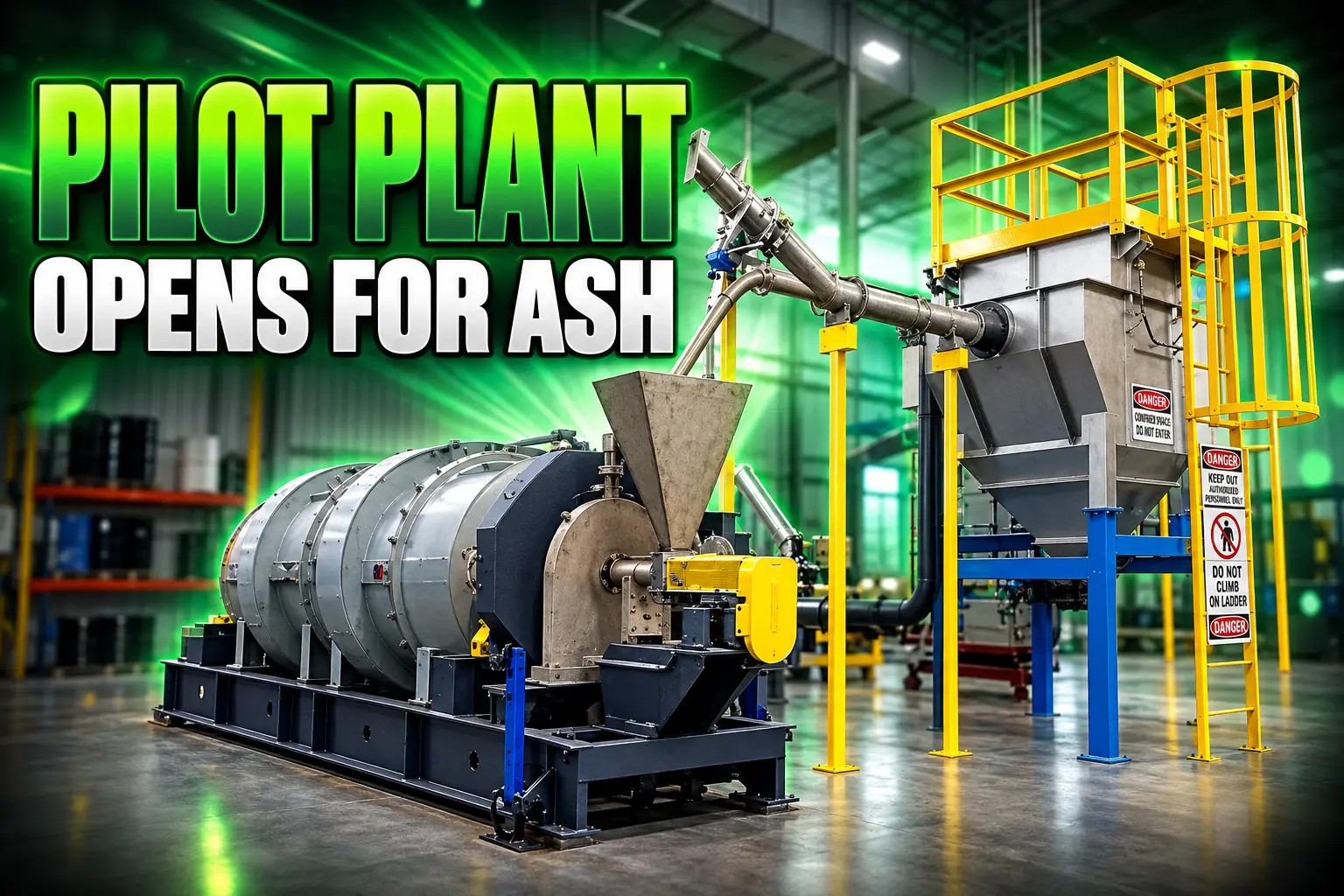
Eco Material Technologies opened a 16,400-square-foot pilot plant in Taylorsville, Georgia, on May 12, 2026, to process harvested coal ash for concrete. CRH closed a $2.1 billion purchase of the company on September 22, 2025. The new mill, dryer, and test bays are where that purchase has to work on real, messy feed.
The hub sits inside Eco Material’s Materials Testing and Research Facility and folds research, trial production, and customer mix work into one floor. Grant Quasha, the company’s president, said the point is to move “from innovation to implementation at scale.”
CRH Paid $2.1 Billion for the Ash Network
CRH announced a $2.1 billion acquisition of Eco Material on July 29, 2025, and funded it with cash. The Utah-based seller came with a national web of fresh and harvested fly ash, natural pozzolans, synthetic gypsum, and low-carbon cement plants. Jim Mintern, CRH’s chief executive, tied the check to a long fuel line for the next round of U.S. concrete, not to a single lab.
This transaction secures the long-term supply of critical materials for future growth and puts CRH at the forefront of the transition to next generation cement and concrete.
Jim Mintern, chief executive, CRH, July 29, 2025 statement
At the sale, CRH said Eco Material partners with utilities to process about 7 million tons of fly ash and 3 million tons of synthetic gypsum and other materials a year, with more capacity then under construction. More than 1,100 Eco Material employees joined CRH. The network ran through over 125 utility sources, plants, and terminals.
THE DEAL CRH STRUCK
- The price: $2.1 billion in cash, announced July 29, 2025, and closed September 22, 2025.
- The payroll: More than 1,100 Eco Material staff moved onto the CRH roster.
- The map: Over 125 utility sources, production plants, and terminals in the United States and Canada.
- The tons: About 7 million tons of fly ash a year, plus 3 million tons of synthetic gypsum and other materials.
Quasha, then chairman and chief executive, said the tie-up would widen what Eco Material could offer utilities and ready-mix plants. By May 2026 he was speaking as president of Eco Material Technologies, a CRH company, with Ash Grove Cement’s labs now in the same family. The Taylorsville floor is the small end of that stack, the place where a new ash pile is supposed to become a spec sheet.
The Georgia Lab Has to Prove Pond Ash
The 16,400-square-foot research hub is accredited by AASHTO and the Cement and Concrete Reference Laboratory, the stamps state highway departments look for before they trust a mix. Eco Material said the lab already tests more supplementary cementitious materials, or SCMs, than any other U.S. laboratory. SCMs replace part of portland cement in concrete, which is how producers cut both cost and the carbon load of a pour.
Cement making accounts for about 8 percent of global carbon dioxide, a figure the Climate Action Reserve uses in its industrial campaign. Harvested ash is one of the few replacements that already has a decades-long record in American pavements. The catch inside the plant is not the chemistry of clean, live fly ash off a running boiler. It is pond ash that sat wet, picked up carbon, and no longer looks like the powder a ready-mix plant is used to.
The new processing center carries a ball mill, a classifier, a rotary dryer, and Eco Material’s ES ECOsystem carbon offloading system, so a sample can be dried, ground, stripped of excess carbon, and then tested as paste, mortar, and full-scale concrete. Quasha said the combined floor with Ash Grove and CRH labs is how the company turns “underutilized resources into reliable, high-performing cementitious products” and gets them to market faster.
We believe the market will increasingly rely on a diversified SCM portfolio. Harvested and beneficiated ash will play a particularly important role because of its scalability, established performance profile and availability.
Grant Quasha, president, Eco Material Technologies
Dedication photographs from the opening put Quasha beside Serge Schmidt, president of CRH Americas cementitious materials, Ian Diaz, Eco Material’s vice president of research and product development, and Hollis Walker, Southern Company’s coal combustion products manager. Southern Company is the parent of Georgia Power, which sits on the ash Eco Material wants to mill. The lab is a research site. It is also a showroom for the utility that has to empty the ponds.
Plant Branch and the Putnam County Pile
Georgia is not a side market for this bet. Eco Material’s second harvest contract with Georgia Power, announced in October 2023, covers landfilled ash at Plant Branch in Putnam County, a coal station retired in 2015. The company said it would take about 600,000 tons a year and more than 8 million tons over a 15-year term, using the same ES ECOsystem carbon offloading method it proved at an earlier harvest site in Danville, Pennsylvania. Most of that ash is aimed at Georgia and Florida concrete plants.
The first Georgia harvest deal, announced June 29, 2022, covers Plant Bowen in Cartersville, one of the largest coal plants still standing in North America. Eco Material said that line would also run about 600,000 tons a year and remove more than 9 million tons. Quasha called Branch a model for how stored ash can be reused. Georgia Power has said the Branch processing plant is due to operate in 2026. Local descriptions of the site include indoor storage, enclosed augers, and rail loading, with some ash trucked in from retired Plant Arkwright near Macon.
FROM THE BORAL MERGER TO THE TAYLORSVILLE FLOOR
- February 2022: Eco Material forms from the merger of Boral Resources, the old national fly-ash marketer, and Green Cement.
- June 29, 2022: Georgia Power and Eco Material agree to harvest ash at Plant Bowen in Cartersville at about 600,000 tons a year.
- October 2023: The companies add Plant Branch in Putnam County at about 600,000 tons a year over 15 years.
- July 29, 2025: CRH agrees to buy Eco Material for $2.1 billion in cash.
- September 22, 2025: The purchase closes and Eco Material becomes a CRH company.
- May 12, 2026: Eco Material opens the expanded Taylorsville pilot plant and testing lab.
Company papers published in April 2026 put southeastern harvested-ash output on a path to about 2 million tons a year once the new processing lines, including a 2026 beneficiation unit, are running. Those papers also list a northeastern monofill harvest, a Texas bottom-ash grind, and plains projects still being built. The Georgia contracts are the ones that sit in the same state as the mill that has to qualify the powder.
On February 12, 2026, the Climate Action Reserve, a carbon-credit registry, named Eco Material’s Bowen harvested fly-ash project in Cartersville and an Oak Grove harvested bottom-ash project in Franklin, Texas, run with ClimeCo, as industrial greenhouse-gas work. Credits will not pour the interstate. They do show that harvest lines are already being written into a second ledger besides the DOT spec book.
The Oak Grove Harvested Bottom Ash (SCM) & Bowen Harvested Fly Ash (SCM) Projects by Eco Material Technologies & @ClimeCo are paving the way for decarbonization in the cement industry. We're excited to highlight their leadership in GHG reductions #IndustrialStrengthClimateResults pic.twitter.com/5Hum7i9Mjc
— Climate Action Reserve (@climatereserve) February 12, 2026
Harvesting Is How the Industry Fills the Gap
Live fly ash off operating coal plants is still the easy product. It is also the one tied to a shrinking boiler fleet. The American Coal Ash Association’s 2025 production and use survey found 14.6 million tons of fly ash went into 2024 concrete, up 2.7 million tons from the year before. That tally is fresh, or live, ash. ACAA said it would add harvested volumes later. Seventy-two percent of the coal ash produced in 2024 was recycled, up from 69 percent in 2023, the tenth straight year more than half was used rather than dumped.
Thomas H. Adams, ACAA’s executive director, said rumors of coal ash’s demise are exaggerated, and that harvesting plus delayed retirements should keep construction markets in supply. The association estimates about 2 billion tons of ash already sit in U.S. landfills and ponds. If that inventory can be cleaned up to spec, the shortage story changes. If it cannot, ready-mix plants keep hunting imported ash and paying freight.
WHERE THE TONS SIT
| Stream | Volume | What it is |
|---|---|---|
| Eco Material live fly ash (CRH, 2025) | About 7 million tons a year | Plus 3 million tons of synthetic gypsum and other materials |
| Plant Bowen harvest (Cartersville) | About 600,000 tons a year | More than 9 million tons stated for the project |
| Plant Branch harvest (Putnam County) | About 600,000 tons a year | More than 8 million tons over 15 years |
| Southeastern harvested ash (company, 2026) | About 2 million tons a year, targeted | Once new processing lines are running |
| U.S. fly ash in 2024 concrete (ACAA) | 14.6 million tons | Live ash only; harvest tons counted separately |
| Ash already in U.S. ponds and landfills | About 2 billion tons | ACAA estimate of disposed inventory |
EPA still treats encapsulated coal ash reuse in concrete as beneficial use, distinct from dumping. The same agency’s May 8, 2024, rule on legacy coal ash surface impoundments pulled inactive ponds at shuttered plants into federal closure and groundwater rules. Utilities that have to dig can sell a fraction of what they excavate, or they can pay to bury all of it. Eco Material’s pitch to those utilities is the first option, with a mill in Georgia that can run the quality tests the second option never needs.
What the Taylorsville Pilot Plant Can Process
Quasha has already put a long menu through the lab. The list is the hedge inside the ash bet, because a plant that can only mill one pond is a plant that goes quiet when that pond’s chemistry drifts.
SCMS ALREADY ON THE TEST BENCH
- Fresh fly ash: Live powder from operating coal plants, still the baseline product Eco Material sells.
- Harvested ash: Pond and landfill material, dried, ground, and stripped of extra carbon until it can pass a concrete spec.
- Natural pozzolans: Volcanic or mineral powders, including the feed for the company’s Lakeview, Oregon, plant.
- Engineered pozzolans: Blended or treated powders built to a target strength and set time.
- Calcined clays: Clays heated to make them reactive, a path European cement makers have used when ash is scarce.
- Ground glass: Cullet milled to a powder that can replace part of the cement.
- Steel slag: A furnace leftover with a long record in some regional mixes.
- Nanotubes: A research-stage additive Quasha listed among materials the company has already tested and, in some cases, deployed.
The company said the Taylorsville expansion will speed trial production of those next binders, widen durability testing, and give customers mix designs they can take to a jobsite. It also said the project will add jobs, without publishing a headcount for the hub. Eco Material’s April 2026 qualifications paper says the business markets SCMs to over 6,000 customer locations from 100-plus sites across 46 states and Canada. A pilot mill does not replace that terminal network. It is how a new pile gets permission to enter it.
Quasha’s own reading of the market is blunt. Many of these powders already go into roads, bridges, and buildings. “The challenge now is less about proving these materials can work and more about ensuring consistent supply, technical support and regional availability,” he said. That sentence is the wager in plain language. The science is mostly done. The factory still has to hit the same test every week.
Glass, Clay and Slag Get a Calciner
Trade coverage of the dedication also showed a new calciner on the Taylorsville floor, alongside the mill, classifier, and dust controls. A calciner is how you cook clay, and how you treat feeds that will never look like fly ash no matter how long you grind them. Eco Material is not waiting on Georgia to learn that lesson. In July 2025 it opened a PozzoSlag plant in Lakeview, Oregon, sized for up to 300,000 tons a year of natural-pozzolan binder. The Georgia calciner is the eastern twin of that idea: a way to trial non-ash feeds next to the ash business that still pays the bills.
That split is also political. Binding pond ash in concrete is one of the few ways to lock up a waste that sat in unlined pits. It is also a product that still depends on coal’s leftovers, which is why some public-health voices refuse to call it green. Joseph Allen, a Harvard exposure-science professor, has argued that treating coal-plant fly ash as a climate win is a leftover of sustainability fashion. The other side of that argument is simpler and less fashionable: the piles already exist, and a spec-grade cubic yard is more stable than a wet pond.
WHERE THE ARGUMENT SPLITS
- The inventory view: ACAA says harvesting and slower coal retirements leave construction markets with enough ash for years, including about 2 billion tons already on the ground.
- The processing view: Quasha says harvested and treated ash will matter because it can scale, and that the hard problem is consistent supply and regional availability, not proof that the chemistry can work.
- The green-brand view: Critics still reject coal waste as a climate input, while carbon-credit registries have started listing harvest projects as industrial reductions.
CRH bought the company that has to live in all three of those arguments at once. The Taylorsville calciner is how Eco Material keeps a door open if pond ash, for spec or political reasons, cannot carry the whole load.
Ready-Mix Plants Will Decide if the Ash Works
The people who will settle the wager do not work in Taylorsville. They batch trucks in Atlanta, Jacksonville, and every county that still writes a fly-ash replacement rate into a paving spec. Eco Material said the expanded lab will hand those plants validated mix designs and field support, which is a polite way of saying a new powder that fails a 28-day break does not get a second chance on a bridge deck.
Company papers describe the Materials Testing and Research Facility as a shop that already walks utilities through how a change in boiler settings moves the ash they sell. That is the unglamorous half of harvest work. Pond ash is not a single product. It is a pile with a history, and the mill has to chase that history every time the excavator moves. Combining research, processing, and customer support on one campus, Quasha said, “dramatically shortens the path from innovation to implementation” and produces performance data earlier in the sales cycle.
The Putnam County processing line is still due to run in 2026. The Taylorsville mill is where that ash has to clear the tests before it hits a Georgia ready-mix plant.

Ukraine Hits the Fuel Hub That Feeds Moscow’s Airports

Gold Lost 3% After the Jobs Print It Usually Wants

XRP’s $31.87 Target Is a $2 Trillion Market Bet

Mortgage Rates at 7.28% Push Buyers Into Adjustable Loans

Six Ex-Bills Return as Patriots Open New Highmark

Microsoft Prints Azure’s $29.42 Billion Quarter and Shrinks the Map

UltraTech’s Ultravolt Launch Puts Cable Multiples on Trial

IXI Autofocus Glasses Still Lack a European CE Mark

The iPhone 16 Pro Flipkart Cut Did Not Last

Little St. Simons Island Hatches Loggerheads at 72.4 Percent
-
 NEWS1 month ago
Microsoft Prints Azure’s $29.42 Billion Quarter and Shrinks the Map
-
 BUSINESS1 month ago
UltraTech’s Ultravolt Launch Puts Cable Multiples on Trial
-
 NEWS9 months ago
IXI Autofocus Glasses Still Lack a European CE Mark
-
 NEWS1 year ago
The iPhone 16 Pro Flipkart Cut Did Not Last
-
 NEWS3 months ago
Little St. Simons Island Hatches Loggerheads at 72.4 Percent
-

 BUSINESS3 months ago
Georgia Furniture Mart Closes a Growing 40-Year Business
-

 NEWS4 months ago
Georgia Beach Bacteria List Leaves Swim Areas Open
-

 NEWS3 years ago
Eyal Waldman Keeps a Two-State Bet After Gaza