For years, every text you sent from an iPhone to an Android was an open postcard. Anyone with the right access to a carrier network could read it in transit. That ends now. Apple and Google have officially launched end-to-end encrypted RCS messaging in beta, closing one of the biggest security gaps in everyday digital communication and giving billions of cross-platform users a serious privacy upgrade.
What Is RCS and Why Encryption Took This Long
RCS, short for Rich Communication Services, is the modern messaging standard built to replace traditional SMS. It brings high-resolution photo and video sharing, typing indicators, read receipts, and emoji reactions to everyday texting. The problem was never the features. It was the security gap on the bridge between the two platforms. iMessage has had end-to-end encryption since 2011. Android-to-Android RCS conversations caught up in 2021. But when an iPhone user texted an Android user, that conversation traveled through carrier networks without real encryption. If an iPhone user messaged an Android user, the conversation defaulted to a protocol that was essentially a digital postcard, readable by anyone with the right access to the network infrastructure. That gap existed not because the technology was impossible, but because it required two fierce competitors to agree on a shared open standard. Back in November 2023, Apple said it would not support Google’s proprietary encryption extension for RCS, but committed to working with the GSMA to create an open standard. Apple and Google formally announced support for Universal Profile 3.0 with E2EE in March 2025. Testing began in February 2026, and the feature finally went live on May 11, 2026 with the release of iOS 26.5.
How the New Encryption Works on Your Phone
The encryption is built on the Messaging Layer Security protocol and is part of RCS Universal Profile 3.0, a spec Apple co-developed with Google and the GSMA. When the feature kicks in, neither Apple, Google, your carrier, nor anyone else in the middle can read your messages while they are in transit. That is a meaningful shift from what existed before.
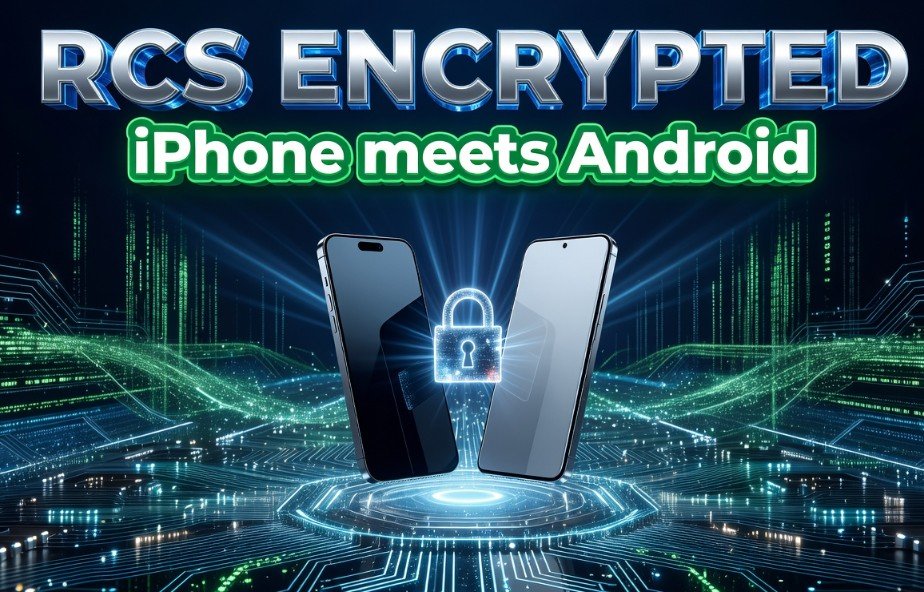
End-to-end encryption is on by default, and there is a toggle for it in the Messages section of the Settings app. Encrypted messages are denoted with a small lock symbol. On an iPhone, the Messages app will display “Text Message – RCS | Encrypted” at the center of the conversation screen when protection is active. In Google Messages on Android, users will see a padlock icon to indicate that the cross-platform conversation is end-to-end encrypted. Beyond encryption, RCS Universal Profile 3.0 also adds:
- Editing and deleting sent messages
- Cross-platform Tapback reaction support
- Replying to specific messages inline during cross-platform conversations
Alex Sinclair, chief technology officer at GSMA, said this progress is “the result of close, cross-industry collaboration between the GSMA RCS Working Group, including Apple, Google, and the wider mobile ecosystem,” adding that “the new secure services are being delivered on an open, globally recognised foundation.”
Which US Carriers Support It Right Now
This is where things get practical. For conversations to be encrypted, both the receiver and the sender must use a carrier that supports the latest version of RCS. All three of the biggest US carriers are on board: AT&T, T-Mobile, and Verizon. A wide range of regional and mobile virtual network operators are also supported at launch.
| Major Carriers | Regional and MVNO Carriers |
|---|---|
| AT&T | Boost Mobile |
| T-Mobile | C Spire |
| Verizon | Consumer Cellular |
| FirstNet | Cox Mobile |
| Cricket Wireless | |
| Metro by T-Mobile | |
| Mint Mobile | |
| US Cellular | |
| Visible | |
| Xfinity Mobile | |
| TracFone / Straight Talk |
Carrier support for encryption is a separate qualification from carrier support for basic RCS traffic. Your carrier may already route RCS messages without supporting the Messaging Layer Security encryption layer added in Universal Profile 3.0. **If the lock icon does not appear in your conversation, the most likely reason is that one party’s carrier has not yet upgraded its infrastructure, not that the software has failed.** As E2EE rolls out, it will be “automatically enabled over time for new and existing RCS conversations.” No manual action is needed once your carrier and both devices are on the supported versions.
What This Lock Icon Cannot Protect You From
The lock icon is a genuine privacy win. But it is not a force field, and knowing its limits is just as important as knowing what it does. End-to-end encryption protects the message in transit. It does not protect against someone with physical access to your unlocked phone. It does not stop screenshots. Here are the key limitations every user should understand:
- Cloud backups: If you back up conversations to the cloud, they may be stored unencrypted unless you enable Advanced Data Protection on iOS.
- SMS fallback: Encryption does not extend to chats where one party falls off RCS and the conversation reverts to SMS. If the lock icon disappears mid-thread, something has downgraded.
- Metadata: Metadata will likely still be collected and stored for these conversations.
- Device-level attacks: It does not shield you from targeted surveillance that compromises the device itself rather than the network.
For sensitive conversations where carrier support has not landed yet, Signal remains the more reliable option. It has always been end-to-end encrypted, works across platforms, and does not depend on carrier adoption of any standard. The Electronic Frontier Foundation welcomed the rollout as a major victory for everyday privacy, while pointing out that metadata transparency and backup protections still need attention from both companies. Adam Boynton, senior enterprise strategy manager at Jamf, called it “a real privacy win” while specifically acknowledging the difficulty of the cross-industry work with Google and the GSMA. What Apple and Google have delivered is not just a software update. It is the result of years of industry negotiation, an open technical standard, and a rare moment where two rivals agreed that user privacy was worth the compromise. For the billions of people who text across iPhone and Android every single day without thinking twice about security, this quiet update in iOS 26.5 is the most important privacy improvement to land on their phones in years. Update your device, look for that lock icon, and know that your everyday conversations are finally a little safer. What do you think about Apple and Google teaming up to secure your texts? Share your thoughts in the comments below.