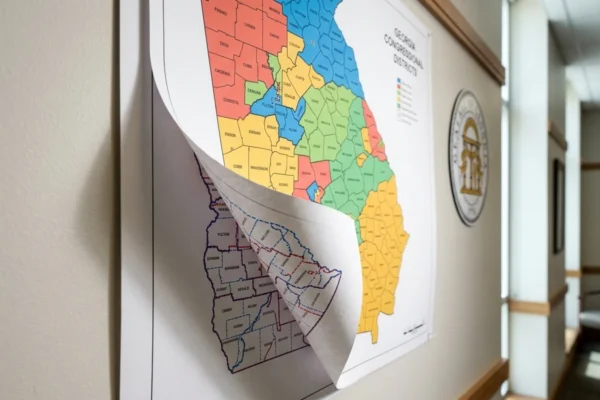
Cherokee County commissioners voted unanimously on July 21 to freeze new data center development for 30 days, a preemptive strike against projects that do not yet exist inside county lines. No application for a data center is currently under review anywhere in Cherokee County. Commissioners froze the door anyway.
The vote makes Cherokee, a fast-growing exurb north of Atlanta anchored by Canton and Woodstock, one of the latest Georgia governments to pause first and legislate later. It joins a list that has grown quickly enough this year that few outside the state have noticed the pattern taking shape, even as it reshapes how Georgia zones land, prices electricity and argues over water.
A 30-Day Pause With No Project in Sight
Brantley Day, Cherokee County’s community development director, told Atlanta News First the county has no ordinance tailored specifically to data centers, so commissioners opted to stop the clock before one showed up. The board’s public hearing on extending the freeze is set for Aug. 18 at 6 p.m. at the county administration building on Bluffs Parkway in Canton, according to WSB-TV.
At that hearing, officials said they plan to ask for a 180-day extension, stretching the moratorium into mid-February 2027. That is seven months of zoning limbo for a use case the county has, so far, never had to zone for.
Cherokee County’s government posted the moratorium’s terms for residents shortly after the vote, framing the pause as research time rather than a rejection of the industry outright.
Why Is Cherokee County Moving So Fast?
Cherokee has no pending data center applications, but its neighbors do. Officials pointed to proposals and construction already underway in surrounding parts of metro Atlanta as the reason to act now instead of after a developer files paperwork.
Critics of moratoriums like this one often warn they delay construction jobs, future tax revenue and tech investment the industry brings. Supporters counter that a short pause beats approving a massive facility with no rules on noise, traffic, landscaping, backup generators or resource use already on the books. With no application yet filed, Cherokee’s commissioners had room to pick caution without turning away a specific project or employer.
Georgia’s Quiet Wave of Local Moratoriums
Cherokee is not even close to first. Douglas County adopted a 90-day pause in March after a cluster of data center projects converged on the area, making it an early mover in what has become a statewide reflex. Coweta County, south of Atlanta, built a data center ordinance by December, then found itself weighing a second moratorium by June after Atlas Development LLC pitched Project Sail, a $17 billion server campus that would rank among the largest ever proposed in Georgia. DeKalb and Clayton counties have also halted data center applications, and the city of Atlanta now restricts the use in parts of its commercial zones.
| Local Government | Action Taken | Key Detail |
|---|---|---|
| Cherokee County | 30-day pause approved July 21 | Seeking 180-day extension to mid-February 2027; no applications pending |
| Coweta County | Ordinance adopted December; second pause weighed in June | Triggered by Atlas Development’s $17 billion Project Sail campus |
| Douglas County | 90-day moratorium adopted March | Acted ahead of the wider 2026 wave |
| DeKalb County | Applications halted | Part of the same metro Atlanta pattern |
| Clayton County | Applications halted | Part of the same metro Atlanta pattern |
| City of Atlanta | Zoning restrictions adopted | Limits data centers in select commercial districts |
A tally published in early June by Northwest Georgia News counted 34 counties and 23 cities across the state that had already passed, drafted or were drafting data center rules, roughly one in five Georgia counties. Cherokee’s 30 days barely register against that backdrop. It is a county catching up to a conversation the rest of the state started months earlier.
Fayette County’s 29-Million-Gallon Warning
Part of what is pushing counties like Cherokee to act before a proposal lands sits about an hour south, in Fayette County. Atlanta News First reported that two industrial-scale water hookups fed a data center campus there, one connected without notice to county utilities and the other left unbilled for more than 29 million gallons of water. Residents of the Annelise Park subdivision in Fayetteville first noticed the strain last year, when their water pressure dropped and they began asking questions.
County officials have not fined the developer behind the 6.2 million square foot facility, according to Tom’s Hardware. The episode has circulated widely in Georgia local government circles this year, and it is the kind of cautionary story that makes an empty field in Cherokee County look like a liability worth studying before it fills up.
Research from the University of Georgia’s College of Agricultural and Environmental Sciences has tracked how data center cooling systems strain surface and groundwater supplies, a body of evidence county planners across the state are now being asked to read before, not after, a facility breaks ground.
The Power Math Behind Every Pause
Water is only part of the strain. Electricity is the bigger number, and Georgia’s utility regulator has already put a figure on it.
- 10,000 megawatts of new generation and grid infrastructure has been approved by state regulators, roughly five Hoover Dams worth of capacity, driven largely by projected data center demand
- 8,500 megawatts of electricity load growth is projected over six years under Georgia Power’s approved 2025 resource plan
- Base rates for Georgia Power customers are frozen through 2028 under a Public Service Commission order issued last summer
- $102 a year in downward rate pressure has been promised to a typical residential customer between 2028 and 2031, funded by new industrial revenue
A fact sheet published by Georgia’s Public Service Commission lays out the tradeoff regulators are managing: protect residential ratepayers now, while betting that the data center demand behind the buildout actually shows up. Commission staff have warned that if it does not, Georgia Power would have to unwind wholesale power contracts, retire less efficient plants early and go hunting for other customers to cover the cost of capacity nobody used. Cherokee’s commissioners are not setting electricity rates. But the county’s caution mirrors the same wait-and-verify posture regulators have taken at the state level.
What Cherokee’s Ordinance Could Require
Day’s team and the county’s legal department will spend the pause studying how other Georgia jurisdictions, and states beyond it, have written their rules. The goal is a policy built before pressure arrives instead of during a permit fight.
- Location and zoning – where a data center is allowed to sit within county lines
- Setback distances – how far a facility must sit from existing homes and neighborhoods
- Screening and buffering – landscaping or barriers required to soften sightlines and sound
- Noise and backup generators – limits on the diesel generators large facilities run during outages
- Energy and water review – a process for weighing strain on the grid and local utility systems before approval
We need ample time to research, learn what has worked and what has not in other jurisdictions, and craft policy that works for Cherokee County.
Day told Atlanta News First that framing captures the county’s position: not opposed to the industry, but unwilling to write the rules under deadline pressure from a live application.
Canton’s August Hearing Sets the Clock
Commissioners reconvene at the county administration building on Aug. 18 to decide whether Cherokee’s pause runs out in three weeks or holds until mid-February 2027. A yes vote on the 180-day extension buys Day’s staff most of the winter to finish the ordinance.
That timeline lands in the same stretch in which Coweta County, on the opposite side of metro Atlanta, is still rewriting its own rules after a second moratorium fight. Georgia’s data center map is being redrawn one county meeting at a time, and Cherokee is simply the newest name on a list that keeps getting longer.
Frequently Asked Questions
How Many Data Centers Does Georgia Have Today?
Georgia now counts 213 data centers statewide, Fortune reported in May, a figure that has climbed alongside the wave of local moratoriums as counties try to get ahead of where the next ones might land.
How Much Water Do Data Centers Use Nationally?
The Environmental Protection Agency estimates U.S. data centers directly consumed 17.4 billion gallons of water in 2023, a figure projected to climb to between 38 billion and 73 billion gallons by 2028 as AI-driven construction accelerates nationwide.
Is There a Statewide Data Center Law in Georgia?
State lawmakers have introduced House Bill 1059, the Data Center Impact Assessment and Development Moratorium Act of 2026, which would layer a statewide review framework on top of the patchwork of county and city rules. Its final fate in the legislature remains undecided.
What Happens if Cherokee County Does Not Extend the Pause?
Because the county has no ordinance written specifically for data centers, letting the freeze lapse without an extension would leave new proposals to be reviewed under Cherokee’s general zoning code, without the setback, buffering or resource rules commissioners are currently drafting.
Do Data Center Moratoriums Affect Facilities Already Operating?
No. Moratoriums like Cherokee’s target new development and new applications going forward. They do not retroactively apply to data centers or other facilities already built and running, in Cherokee County or the neighboring counties that have passed similar pauses.