July’s full Buck Moon reaches peak illumination at 10:36 a.m. EDT on Wednesday, July 29, 2026, then rises after sunset for skywatchers across North America and Europe. It is the second full moon of Northern Hemisphere summer and the opener for a compressed eclipse stretch that delivers a total solar eclipse on August 12 and a deep partial lunar eclipse later that month.
The global full moment finds the moon below the horizon from most of the continent, so the show begins at local moonrise in the southeast during dusk. Forbes notes New York City moonrise at 8:33 p.m. EDT and Los Angeles at 8:18 p.m. PDT.
Exact Rise Windows Across Major Cities
Best views come minutes after the listed moonrise as the disk clears local trees or buildings. Find an open southeast horizon. The moon looks largest and most colorful while low.
| City | Full Moon Local Time | Approx. Moonrise Focus |
|---|---|---|
| New York | 10:36-10:53 a.m. EDT July 29 | After 8:33 p.m. EDT |
| Los Angeles | 7:36 a.m. PDT July 29 | After 8:18 p.m. PDT |
| London | 3:35 p.m. BST July 29 | Evening rise |
| Chicago | ~9:36 a.m. CDT July 29 | Post-sunset southeast |
Times shift slightly by source and exact longitude. Use a local moonrise calculator for your street. The disk stays near full the night before and after, so July 28 and 30 also reward clear skies.
Why the Horizon Turns the Moon Orange
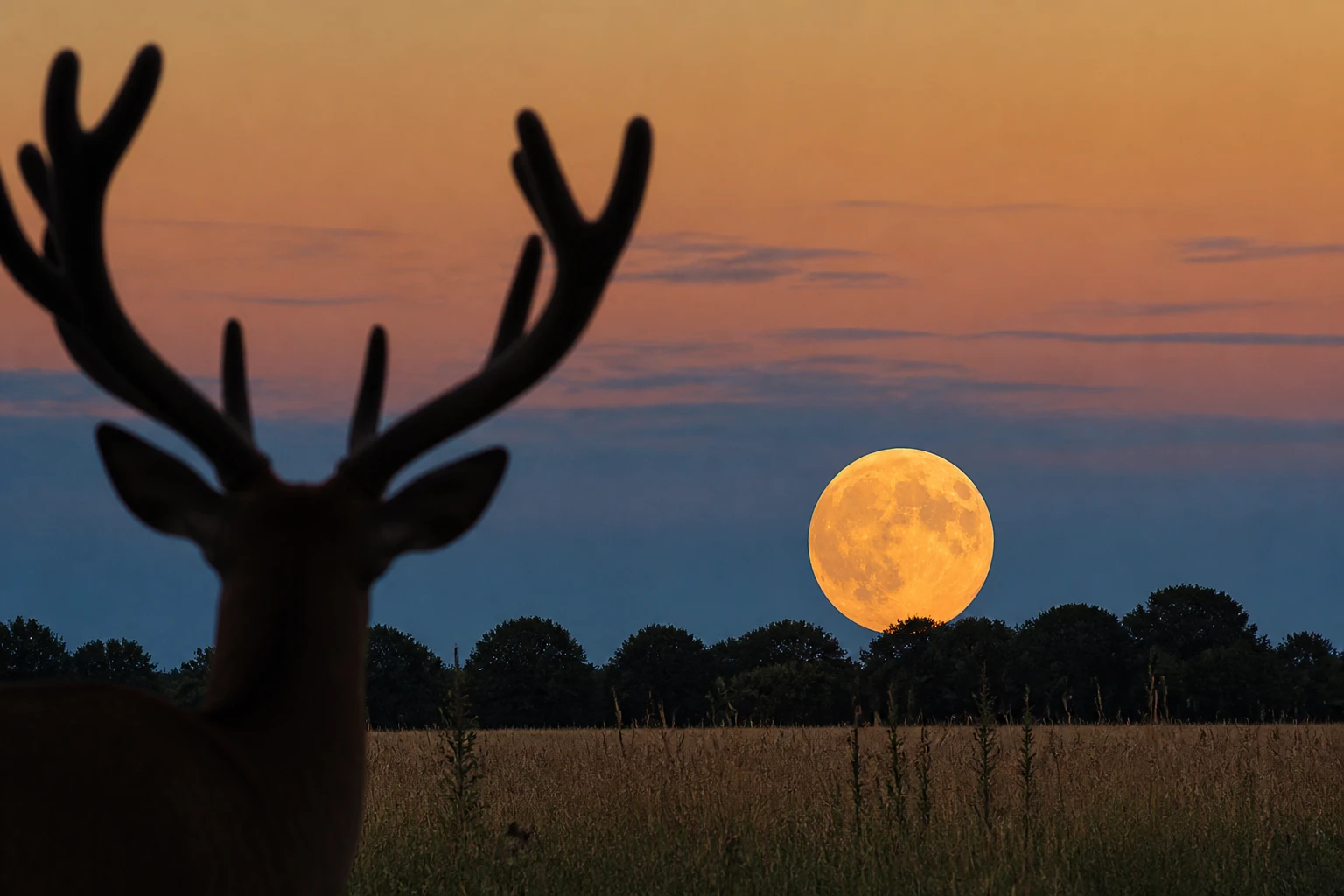
Low full moons often glow deep orange or copper. Rayleigh scattering is the reason. Short blue wavelengths bounce off nitrogen and oxygen molecules in the thick air near the horizon. Longer red and orange wavelengths pass through more easily and reach your eyes.
The same process reddens sunsets. Once the moon climbs higher, the color fades toward white as the light path shortens. Photographers chase the first 30-60 minutes after rise for the dramatic hue and the classic Moon Illusion that makes the disk look oversized against trees or buildings.
The Many Names Behind July’s Full Moon
Colonial Americans adopted the Buck Moon label from Algonquin and related traditions. It points to the season when male deer grow their new antlers, still covered in soft velvet. Time and Date notes the name marks the new antlers that emerge on deer bucks around this time of year.
- Thunder Moon, Western Abenaki, for frequent summer storms
- Raspberry Moon or Berry Moon, Algonquin, Ojibwe, Anishinaabe, for ripening fruit
- Salmon Moon, Pacific Northwest groups, for fish runs
- Hay Moon, Anglo-Saxon, for the hay harvest
- Mead Moon, Herb Moon, Wyrt Moon, Claiming Moon, Celtic and medieval English references to gathering and midsummer
The Old Farmer’s Almanac records the full phase at peak illumination at 10:36 a.m. Eastern on July 29. Other July moon names include Feather Moulting Moon (Cree) and Month of the Ripe Corn Moon (Cherokee). The variety shows how different cultures tied the same sky event to local plants, animals, and weather.
Two Weeks to Europe’s Rare Totality
Fourteen days after the Buck Moon, the moon turns new and slides directly in front of the sun. On August 12 a total solar eclipse crosses eastern Greenland, Iceland, the Atlantic, northern Spain, and a sliver of Portugal. Maximum totality lasts 2 minutes 18 seconds near the Icelandic coast.
NASA confirms the total solar eclipse will sweep across Greenland, Iceland, northern Russia, the Atlantic, Spain, and a corner of Portugal. It is the first total solar eclipse for mainland Europe since 1999 and the first for Spain since 1905. Cities such as A Coruña, Bilbao, Zaragoza, Valencia, and Palma sit inside or near the path. Madrid and Barcelona fall just outside.
Time and Date supplies the interactive path map and local eclipse times for any spot. Greatest eclipse occurs at 17:47 UTC. The moon is near perigee, so its apparent size is larger than average and the path is relatively wide.
North America Partial Bites
No U.S. or Canadian site sees totality. Eastern Canada and the northeastern United States still catch a partial eclipse. Forbes lists approximate coverage: St. John’s 53 percent, Halifax 31 percent, Québec City 24 percent, Boston 16 percent, New York 10 percent. Solar eclipse glasses remain essential for any partial phase. The same evening the Perseid meteor shower peaks, creating a doubleheader for clear-sky observers in the east.
Sturgeon Moon and the Deep Lunar Shadow
The next full moon is the Sturgeon Moon on August 27-28. It drifts into Earth’s umbral shadow for a deep partial lunar eclipse. Roughly 96 percent of the moon’s diameter enters the dark shadow, producing a dramatic copper-red “bite” visible across the Americas, Europe, and Africa. Maximum occurs around 4:13 UTC on August 28.
That sequence-full Buck Moon, total solar two weeks later, deep partial lunar two weeks after that-packs three major lunar-solar events into a single summer window. 2026 already carries 13 full moons because May produced two. Skywatchers who step outside tonight are effectively starting a short campaign that ends under a near-blood moon.
Readers who tracked the earlier Strawberry Moon viewing window or the smallest full moon of 2026 will notice the same pattern: each named full moon offers a simple free show and a marker for the next larger event.
How to Catch the Best View Tonight
Arrive 15-20 minutes before local moonrise. A park, beach, or open field facing southeast works best. Binoculars show crater detail once the moon climbs higher; no equipment is required for the orange rise itself. Smartphone night mode or a short telephoto captures the color against foreground silhouettes.
Cloud cover is the main risk. Check a reliable local forecast and have a backup clear horizon in mind. Light pollution dims the surrounding stars but does little to the bright full disk. The Summer Triangle (Vega, Deneb, Altair) sits high and remains easy to spot even in moonlight. Venus sets soon after the sun in the west; Saturn, Mars, and Mercury form a pre-dawn arc for early risers the following morning.
On X, early posts already show orange horizon disks and casual jokes about the name “bringing in the bucks.” Japanese weather accounts flagged viewing chances for large regions. The crowd treats the rise as both a photo opportunity and a midsummer checkpoint.
The Buck Moon itself is ordinary in size and brightness. Its timing is not. It sits two weeks before a total solar eclipse that most Europeans have never seen from home soil and four weeks before a near-total lunar eclipse visible to hundreds of millions. Clear skies tonight put the whole sequence in motion.
Frequently Asked Questions
Why is July’s full moon called the Buck Moon?
The name comes from Algonquin and related Native American traditions that noted male deer (bucks) growing new velvet-covered antlers in July. Alternate cultural names include Thunder Moon, Raspberry Moon, Salmon Moon, and Hay Moon, each tied to local weather, fruit, fish, or harvest cycles.
What time does the Buck Moon peak on July 29 2026?
The instant of greatest illumination is 10:36 a.m. EDT (14:36 UTC). Because that moment falls in daylight for North America, the practical viewing window opens at local moonrise after sunset, typically between 8 and 9 p.m. depending on longitude and latitude.
How long will totality last during the August 12 2026 solar eclipse?
Maximum totality reaches 2 minutes 18 seconds just off the western coast of Iceland. On land the longest durations occur in western Iceland and parts of northern Spain, generally between 1 and 2 minutes depending on exact location inside the path.
Why does a full moon look orange near the horizon?
Rayleigh scattering removes shorter blue wavelengths of light as moonlight travels through a thicker slice of atmosphere when the moon is low. Longer red and orange wavelengths continue forward, producing the warm color that fades as the moon rises higher.
When is the next full moon after the Buck Moon?
The Sturgeon Moon occurs on August 27-28 2026 and coincides with a deep partial lunar eclipse that covers about 96 percent of the moon’s diameter. It is visible across the Americas, Europe, and Africa under clear dark skies.