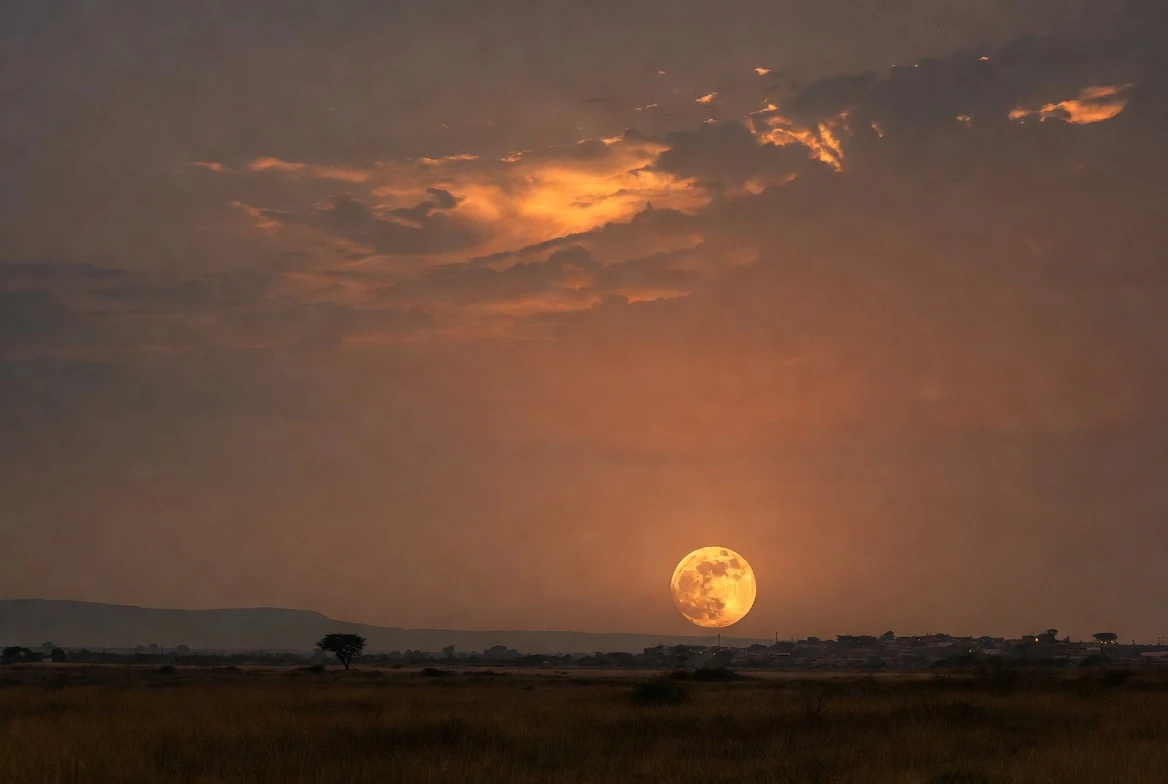
The Strawberry Moon rises over Telangana on Monday evening, with prime viewing in Hyderabad running between 7:30 and 8:30 PM IST. The full phase lands at 5:26 AM IST on Tuesday, June 30, after the moon has set in the city. The show is tonight, low and amber on the southeastern horizon.
Nothing about the disk itself turns pink, despite the name. The label traces to Native American harvest calendars, and this year’s Strawberry Moon is also the third and final micromoon of 2026, the lowest-arc full moon of the year in the Northern Hemisphere, and a rare case where the moon is smaller and dimmer than average even as it traces the year’s lowest-hanging full-moon arc.
Tonight’s Window Over Telangana
In Hyderabad, the moon rises at 6:36 PM IST and the sun sets 18 minutes later, at 6:54 PM. Per Hyderabad’s moonrise, sunset, and peak-illumination data, the full moon breaks the southeastern horizon at azimuth 119°, roughly as twilight begins. The first hour, when the sky is darkening and the moon is still low, is when the warm tone reads strongest.
The technical peak of 100% illumination is hours behind the visual peak. Time and Date’s Hyderabad ephemeris puts full at 5:26 AM IST on Tuesday, June 30, well after moonset at 4:51 AM. So tonight’s window between roughly 7:30 and 8:30 PM is not the technical peak; it is when the lunar disk dominates a darkened sky and still rides low enough to filter amber and honey-gold light through Earth’s atmosphere.
Across the rest of Telangana, sunset and moonrise shift by minutes rather than hours. Cloud cover, not geography, decides who sees what.
Where the Name Comes From, and Why Nothing About Color
The “strawberry” in Strawberry Moon has no color link. The reference page on the Strawberry Moon name and timing traces the label to Native American Algonquian peoples of the northeastern United States, and to the Ojibwe, Dakota, and Lakota, who used the June full moon to mark the ripening of “June-bearing” strawberries ready to be gathered.
Other Indigenous traditions reach for related names tied to the same moment in the season. The Haida call it the Berries Ripen Moon; the Anishinaabe, Blooming Moon; the Cherokee, Green Corn Moon; the Western Abenaki, Hoer Moon; the Tlingit, Birth Moon; Cree communities use Egg Laying Moon and Hatching Moon. Europeans reached for Honey Moon and Mead Moon, the latter because June coincides with the traditional month of meadow-mowing, while the Old Farmer’s Almanac also notes June as the month of marriages, named for the Roman goddess Juno.
Any pinkish or amber tint tonight comes from the atmosphere, not the moon. As the Almanac puts it, “A Moon usually appears reddish when it’s close to the horizon because the light rays must pass through the densest layers of the atmosphere.” Tonight’s geometry puts that condition into effect.
By the numbers, Hyderabad, Monday June 29:
- Sunset: 6:54 PM IST
- Moonrise: 6:36 PM IST, azimuth 119° (east-southeast)
- Moonset: 4:51 AM IST, Tuesday
- Distance at full: 405,494 km
- Peak illumination: 5:26 AM IST, Tuesday June 30
It’s Also the Year’s Third and Final Micromoon
As a full moon, the Strawberry Moon would carry enough weight on its own. This year it pulls a second role. June’s full moon sits roughly a day past apogee, the moon’s farthest point from Earth in its orbit, which puts it in a small 2026 club of micromoons. EarthSky’s micromoon guide notes that the label is loose: “There’s no strict definition of how close to apogee the moon should be to be called a micromoon.” What every source consulted agrees on is that this one qualifies.
How much smaller? The estimates vary. EarthSky puts a full micromoon at about 7% smaller than a full moon at average distance. Forbes’s June explainer cites NASA’s framing of about 12-14% smaller and dimmer than average. A widely cited estimate pegs the difference at roughly 10% smaller and 15% dimmer than an average full moon. None of these are stark to the naked eye.
The number that matters for Hyderabad is distance. At full phase, the moon sits about 405,494 km from the city, per Time and Date’s ephemeris for June 30. By the next full moon in late July, the gap narrows. Tonight’s disk is real but trimmed.
This is also the third and final micromoon of 2026. Coverage of the June 29 full moon calls it the year’s third and final micro moon, tracking a year in which the May 1 Flower Moon and the May 31 Blue Moon are listed as earlier micromoons by some sources. After tonight, the next full micromoon is in 2027.
Why It Hangs Lower Than Any Other 2026 Full Moon
Per the June 2026 full Strawberry Moon explainer, “June’s full moon will hang lower in the sky than any other full moon of 2026” in the Northern Hemisphere. A full moon sits opposite the sun in Earth’s sky. When the sun is at its peak altitude, the moon traces its lowest-arc full moon path.
The summer solstice landed on June 21 at 13:55 IST, putting the sun at the top of its daily climb. Tonight’s full moon traces the inverse. Moonrise lands well to the southeast. The disk climbs only a fraction of the sky’s height before it sets in the southwest.
For Hyderabad, that low transit drives both the deep amber glow (since low-moon light filters through more of Earth’s atmosphere than high-moon light) and the foreground framing that sets up the next visual trick. The moon sits just above Telangana’s trees, ridges, and skyline for most of the night. Last June’s Strawberry Moon carried a similar low-arc geometry; for related coverage, see a viewer guide to the 2025 Strawberry Moon over India.
The Moon Illusion Will Make It Look Bigger Than It Is
Once the moon clears the rooftops, the brain takes over. NASA’s moon-illusion explainer, summarized in the Forbes full-moon guide, frames the effect as a psychological trick: the brain reads the moon’s size by comparing it to nearby objects, and without those reference points the disk shrinks back.
The moon appears much larger when it’s near the horizon than when it’s high overhead, even though its actual size and distance haven’t changed.
That phrasing is NASA’s, as carried in the Forbes guide. The moon illusion peaks during moonrise and moonset, and tonight amplifies it because the moon hangs unusually low for most of the evening.
What You Can Actually See Tonight
The setup is forgiving. Three ingredients match tonight in Hyderabad: a low full moon, a moonrise that lands 18 minutes before sunset, and a full moon sitting opposite a sun that peaked just over a week ago. The combination gives viewers about an hour of warm-glow viewing before the moon climbs past the rooftops into steadier white light.
- Face southeast. The moon rises at azimuth 119° in Hyderabad, per Time and Date; any phone compass reads that as east-southeast.
- Find a horizon break. A rooftop, open field, or riverbank keeps trees and buildings from blocking the moon’s first hour.
- Start at 7:30 PM. By then the sky is dark enough that the amber disk dominates; the warm tones fade as the moon climbs.
- Look low for color, high for craters. Earth’s atmosphere strips blue light only near the horizon. Once the disk whitens overhead, the lunar maria stand out more cleanly.
- Use a tripod or night-mode camera. Telephoto captures work best during the warm low-arc phase; for a cleaner disk, wait until after 9 PM.
If clouds cover the eastern horizon tonight, the show reruns Tuesday evening, June 30. Moonrise in Hyderabad that night lands around 7:25 PM, and the disk is at 99.8% illumination by early morning, per Time and Date.
Frequently Asked Questions
Will the Strawberry Moon actually look pink or red?
The moon reflects white sunlight, and the disk itself does not change color. Any pink, amber, or honey tone tonight comes from Earth’s atmosphere scattering blue light as the moon rides low. Higher in the sky, the same disk looks pearly white.
What time does the moon rise in Hyderabad tonight?
At 6:36 PM IST on Monday, June 29, with sunset at 6:54 PM, per Time and Date’s Hyderabad astronomical page. The deepest amber sits between roughly 7:30 and 8:30 PM IST.
Why is it called a micromoon if it is also the Strawberry Moon?
Both names describe the same full moon. “Strawberry Moon” is the seasonal name from Native American harvest calendars. “Micromoon” describes the moon sitting near apogee, its farthest point from Earth, so the disk appears slightly smaller and dimmer than an average full moon.
Do I need a telescope or binoculars?
No. The view is naked-eye. Binoculars sharpen the lunar maria once the moon climbs above the rooftops, and a tripod-mounted telephoto camera will pick up more detail if you want to photograph it.