
NEWS
AMD Bets Strix Halo Still Beats Nvidia RTX Spark
AMD spent CES 2025 building a 128GB local AI PC. Gorgon Halo now sells 192GB boxes as RTX Spark Windows laptops arrive in October.

AMD’s client chief said at Computex that Nvidia had joined a local-AI PC market Strix Halo already occupied, and that skipping those notebooks was a mistake. Rahul Tikoo, senior vice president and general manager of AMD’s client business, spent June 3, 2026, treating RTX Spark as a late arrival, not a reset.
The follow-on he promised for the third quarter is now a 192GB machine with a four-figure luxury tag. The first Windows RTX Spark laptops are due in the same October window.
Tikoo Spent Almost Two Years Waiting for Nvidia
Tikoo did not pretend Spark was a small launch. He framed it as Nvidia walking into a category AMD had been shipping since CES 2025, when the Ryzen AI Max 300 family, known as Strix Halo, showed up as a 16-core x86 APU with a fat pool of on-package memory.
I’m really excited that Nvidia has joined the game. You know, we were the only game in town for almost two years now, and the large local memory is becoming super critical in the agentic AI workloads.
Rahul Tikoo, senior vice president, Computex 2026 roundtable
He added that he was “actually happy to see Nvidia join the race for these great products.” The welcome was the point of the appearance. AMD wanted the category named in public, then wanted the next sentence to be that Strix Halo machines already in the market had done the 128GB job first.
Andrej Zdravkovic, AMD’s chief software officer, went further on the buyer’s choice. He told the same roundtable that developers building AI apps on a Strix Halo notebook were making the right call, and that CUDA’s pull was weaker than it had been three years earlier because ROCm was easier to live with and moving between stacks was no longer a career decision. That is the wager. Memory and an x86 APU against Nvidia’s software default.
Where the Two Spec Sheets Diverge
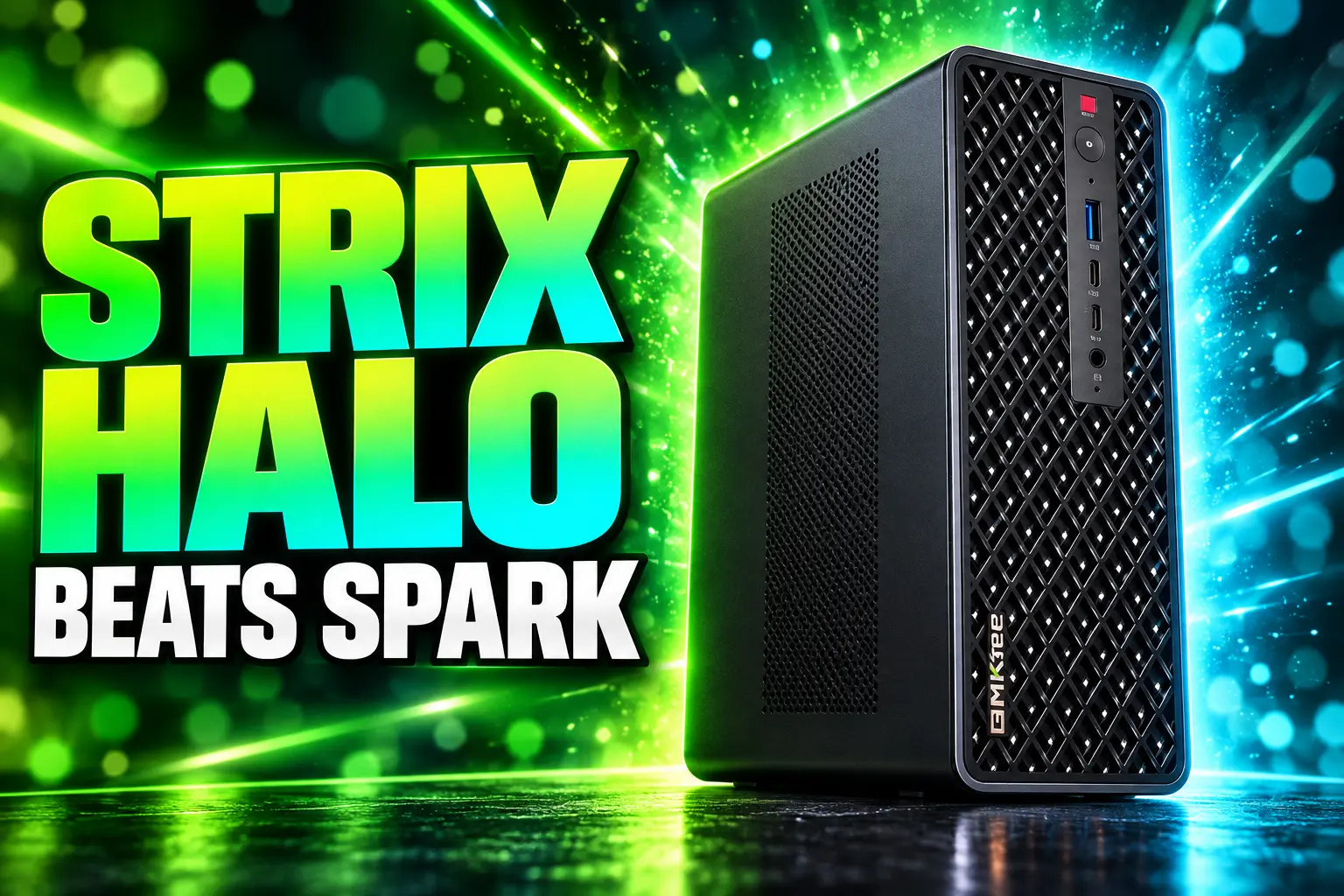
Tikoo’s slide version of the fight was blunt. Spark’s headline is up to 128 GB of unified memory and a 20-core Grace CPU beside a Blackwell RTX GPU. Strix Halo already ships that memory class with a 16-core, 32-thread Zen 5 CPU. Gorgon Halo, he said, “is going to be a better product.”
Nvidia’s own product page splits RTX Spark N1X two ways. The top chip is a 6,144-core Blackwell RTX GPU with a 20-core Grace CPU, Windows 11, and up to 128GB of LPDDR5X. A laptop-only cut uses a 5,120-core GPU, an 18-core CPU, and up to 64GB. Nvidia rates the platform at up to 1 petaflop of FP4 AI performance. Laptop TDP is listed at 45-80W. A small desktop SKU is listed at 140W.
The Linux cousin is DGX Spark, a 150mm cube that weighs 1.2kg. Nvidia’s hardware guide puts a 20-core Arm CPU (10 Cortex-X925 plus 10 Cortex-A725) next to 128GB of LPDDR5x at 273 GB/s and says a single box can hold models up to 200 billion parameters on the desktop, or 405 billion if two units are linked. The GB10 superchip is rated at 140W, with a 240W brick.
THE TWO LOCAL-AI SUPERCHIPS
| Platform | CPU | GPU | Unified memory | AMD or Nvidia claim |
|---|---|---|---|---|
| RTX Spark N1X (top) | 20-core Grace | 6,144-core Blackwell RTX | Up to 128GB | 1 petaflop FP4, Windows 11, CUDA |
| Ryzen AI Max+ 395 (Strix Halo) | 16-core / 32-thread Zen 5 | Radeon 8060S, 40 CUs | Up to 128GB | 200-billion-parameter models on the Halo box |
| Ryzen AI Max+ PRO 495 (Gorgon Halo) | 16-core / 32-thread Zen 5, 5.2GHz | Radeon 8065S, 40 CUs | 192GB, 160GB to the GPU | 300-billion-plus parameters at 4-bit |
Those are not the same scoreboard. Nvidia is selling peak FP4 and CUDA. AMD is selling model size in a shared memory pool, plus x86 so the box still runs the rest of a Windows or Linux desk. Bandwidth sits in the same neighborhood on both 128GB designs, which is why the software argument refuses to die.
Thirty-Five Strix Halo Products Were Already Shipping
Tikoo’s inventory line was the one Nvidia could not match in June. “We have 35 products with Strix Halo in market.” The chip had been in HP’s ZBook Ultra G1a, the Framework Desktop, GMKtec mini PCs, and later gaming notebooks such as the ASUS TUF Gaming A14. It was a real catalog, not a render.
On May 20, 2026, AMD put its own name on the form factor. The Ryzen AI Halo developer platform uses a Max+ 395 with up to 128GB of unified memory, Windows and Linux, and a promise that the same box can take a model from Linux prototyping to a Windows deploy. Pre-orders were exclusive to Micro Center from June. Listings put the Halo box at $3,999.
FROM CES 2025 TO THE OCTOBER RECEIPT
- January 2025: AMD launches Ryzen AI Max 300, Strix Halo, as a 16-core APU with up to 128GB of unified memory.
- May 20, 2026: AMD announces the Halo developer box and Ryzen AI Max PRO 400 Series processors with 192GB for the third quarter.
- June 3, 2026: Tikoo and Zdravkovic answer RTX Spark at Computex. Tikoo counts 35 Strix Halo products already shipping.
- September 4, 2026: HP details OmniBook laptops on RTX Spark for fall, with pricing later.
- September 28, 2026: The first Gorgon Halo PCs go on sale with 192GB.
- October 2026: Windows RTX Spark systems begin to arrive. ASUS sets a ProArt event for October 7. Nvidia’s 64GB DGX Spark SKU is due October 23.
Jack Huynh, AMD’s computing and graphics chief, used the May launch to repeat the local-agent pitch in plainer words than the Computex trash talk.
AI is no longer confined to the cloud. It is now something developers can build, train, and run locally.
Jack Huynh, SVP and GM, Computing and Graphics Group, AMD
CUDA Is the Bet AMD Wants Buyers to Drop
Zdravkovic’s software claim is the part of the June roundtable that still has to clear a lab, not a slide. Nvidia’s Spark page says CUDA “runs natively” on the chip and calls that stack the one “the world’s AI is built on.” AMD’s Halo box is built around ROCm and a list of tools that already sit on most local-AI desks.
WHAT AMD SAYS THE HALO BOX RUNS
- PyTorch: The training and fine-tune path AMD wants sitting next to the 128GB pool.
- vLLM: The serving layer for people who keep a model up as a local API.
- llama.cpp: The GGUF path that already has Vulkan and ROCm backends on Strix Halo.
- Ollama and LM Studio: The click-to-run front ends for people who will not touch a Docker file.
- ComfyUI: The diffusion graph the same box is supposed to run without a discrete GPU.
That list is real, and it is also the whole fight. People who have run the same 30-billion-class model on a Strix Halo mini PC and a DGX Spark keep finding the gap in prompt processing, the long prefill that coding agents and RAG jobs live on, while the tokens that print on screen land much closer. Spark’s premium is CUDA plus that prefill. Halo’s premium is x86, a lower ticket at 128GB, and a Windows desk that still plays games on the side.
The ugly version of the same point showed up in AMD’s own backyard years ago: teams that wanted Flash Attention and training libraries on Radeon had to wait, or they went back to an older Nvidia card because it simply ran. ROCm 10 and the Halo playbooks are AMD’s answer to that history. They are not a court verdict. A CUDA-only tool still turns a 192GB AMD box into a midnight debugging session, and anyone selling these machines as drop-in Spark killers is skipping that tax.
Gorgon Halo’s 192GB Comes With a Luxury Sticker
AMD’s May table is the spec Tikoo was pointing at. The Ryzen AI Max+ PRO 495 is 16 cores and 32 threads at up to 5.2GHz, 80MB of cache, a Radeon 8065S with 40 compute units, a 45-120W cTDP, and an NPU rated at up to 55 TOPS. Unified memory goes to 192GB, with 160GB allocatable as graphics memory. AMD’s footnote says that 160GB pool can run 300-billion-plus parameters at 4-bit. The Max PRO 490 is 12 cores at up to 50 TOPS. The Max PRO 485 is 8 cores at the same 50 TOPS NPU rating. All three list 192GB.
HP and Lenovo were named as commercial OEM partners for the third quarter. The machines that actually took a card in late September were smaller names with bigger stickers, because LPDDR5x is the scarce part, not the silicon.
192GB BOXES ON A PRICE TAG
| System | Chip | Memory | Listed price |
|---|---|---|---|
| AMD Ryzen AI Halo, Micro Center | Max+ 395 | 128GB | $3,999 |
| GMKtec EVO-X5 Pro | Max+ 495 | 192GB | $6,799 regular; $6,399 for the first 30 with a 2TB SSD |
| Minisforum MS-S1 MAX-P495 | Max+ PRO 495 | 192GB, 2TB SSD | $7,399 |
| HP ZBook Ultra G3a | Max+ PRO 495 | 192GB, 512GB SSD, FHD | $7,449; 128GB listed at $5,999; 64GB at $3,899 |
Framework opened pre-orders on September 30 for a 192GB Desktop in the same mini-ITX shell as its Strix Halo machine, with a Noctua fan and a Fedora option, and did not post a price. Partners list the 192GB pool as LPDDR5X-8533 on a 256-bit bus, the same class of number Nvidia quotes as 273 GB/s on DGX Spark. Linux can hand nearly the whole 192GB to weights. Windows, on AMD’s own split, parks 160GB on the GPU and keeps less for the rest of the OS.
The 192GB win is real at the package. It is also why a Halo successor that was supposed to look like a better Spark is showing up as a used-car payment. Memory, not CUDA, is the first filter on who can even take the bet.
RTX Spark Laptops Reach Stores in October
Nvidia’s consumer pitch is not the 150mm Linux cube. It is a Windows-on-Arm laptop with RTX lighting, DLSS 5, Reflex 2, and the same unified memory story AMD has been telling since CES 2025. HP used IFA to put dates on two of those notebooks.
The HP OmniBook Ultra 16 and OmniBook X 14 are Spark machines with up to 128GB of unified memory and up to 1 petaflop of FP4 on the 16-inch model. HP calls them the world’s thinnest RTX Spark laptops. The Ultra 16 gets a 16-inch 3K OLED panel, a 99Wh battery HP rates at up to 17 hours, and a claim of 50 percent charge in about 30 minutes. The X 14 is the thin 14-inch, rated at up to 15 hours, with a 140W USB-C GaN brick. Both are due this fall at HP.com, with the Ultra 16 also headed to Best Buy. Prices come later. An OmniDesk Spark desktop is still a teaser.
ASUS has set October 7 for a ProArt RTX Spark event covering a P16, a P14, and a Mini PC GR1X. Nvidia’s own Spark account, two days before this piece’s window closed, cut the other way on memory for the developer cube.
DGX Spark is getting a 64GB option.⚡
With the GB10 Grace Blackwell Superchip, DGX Spark 64GB runs capable local agents on device and works with our new NVIDIA Sync Cluster Assistant to seamlessly pair systems for larger workloads. pic.twitter.com/hsoBwETAYW
— NVIDIA RTX Spark (@NVIDIARTXSpark) October 2, 2026
WHAT WE KNOW
- Windows Spark: HP, ASUS, and the rest of Nvidia’s OEM bench are aiming at October and “this fall,” with HP’s two OmniBooks the most fully specced so far.
- DGX Spark 64GB: Nvidia says the cut-down cube arrives October 23 from OEM partners and can pair with another unit through a new Sync Cluster Assistant.
- Gorgon Halo 192GB: Minisforum, GMKtec, HP’s ZBook tool, and Framework’s pre-order page already treat the SKU as a live product.
WHAT IS UNCONFIRMED
- Spark laptop prices: HP has not posted them. No other major OEM has posted a US street price for an N1X notebook either.
- Framework’s 192GB tag: The pre-order opened September 30 without a number.
- How many 192GB Halo units actually ship: LPDDR5x supply is the constraint the listings already advertise by their size.
People who bought the original 128GB DGX Spark did not ask Nvidia for a smaller pool. The replies under that 64GB post wanted 256GB and 512GB. AMD just sold them the 192GB version of that wish, at $6,799 and up, while Nvidia used the extra SKU to get a cube onto a lower shelf and to pair two 64GB boxes when one will not hold the model.
HP Now Stocks Both Superchips
The quiet stakeholder in Tikoo’s roundtable was never a chip vendor. It was the PC maker that has to fill a catalog either way. Ketan Patel, president of Personal Systems at HP, was already on AMD’s May 20 stage promising Halo boxes and Max PRO 400 systems for people who want to go from a local experiment to a local deploy without sending the weights out of the building. Four months later HP’s consumer line is previewing Spark OmniBooks, and its workstation tool is quoting a 192GB ZBook Ultra G3a at $7,449.
Samuel Chang, HP’s consumer personal systems president, said the OmniBook Ultra 16, OmniBook X 14, and OmniDesk are for “developers, creators, gamers, and innovators who want local intelligent assistants and AI-powered applications, including open-source tools working alongside them.” That sentence fits a Strix Halo ZBook as easily as a Spark OmniBook. HP is not settling Tikoo’s wager. It is invoicing both sides of it.
Lenovo is on AMD’s Max PRO 400 slide and on Nvidia’s Spark OEM list. ASUS has a Strix Halo TUF and a ProArt Spark event in the same calendar. The 35 Halo products Tikoo counted in June were a head start. They were not a lock. The lock, if there is one, is still the stack a developer already has in their repo, and the amount of LPDDR5x a factory can solder before the quote expires.
Tikoo told the room that large local memory had become the thing that matters for agentic work, and that Nvidia had arrived late to a party AMD had been throwing since CES 2025. Gorgon Halo made the memory number larger. RTX Spark made CUDA a laptop SKU. The October invoices will show who actually collects.

Ukraine Hits the Fuel Hub That Feeds Moscow’s Airports

Gold Lost 3% After the Jobs Print It Usually Wants

XRP’s $31.87 Target Is a $2 Trillion Market Bet

Mortgage Rates at 7.28% Push Buyers Into Adjustable Loans

Six Ex-Bills Return as Patriots Open New Highmark

Microsoft Prints Azure’s $29.42 Billion Quarter and Shrinks the Map

UltraTech’s Ultravolt Launch Puts Cable Multiples on Trial

The iPhone 16 Pro Flipkart Cut Did Not Last

IXI Autofocus Glasses Still Lack a European CE Mark

Little St. Simons Island Hatches Loggerheads at 72.4 Percent
-
 NEWS1 month ago
Microsoft Prints Azure’s $29.42 Billion Quarter and Shrinks the Map
-
 BUSINESS1 month ago
UltraTech’s Ultravolt Launch Puts Cable Multiples on Trial
-
 NEWS1 year ago
The iPhone 16 Pro Flipkart Cut Did Not Last
-
 NEWS9 months ago
IXI Autofocus Glasses Still Lack a European CE Mark
-
 NEWS3 months ago
Little St. Simons Island Hatches Loggerheads at 72.4 Percent
-

 BUSINESS3 months ago
Georgia Furniture Mart Closes a Growing 40-Year Business
-

 NEWS3 years ago
Eyal Waldman Keeps a Two-State Bet After Gaza
-
 LIFESTYLE3 years ago
What is a Corpak Feeding Tube: A Comprehensive Guide