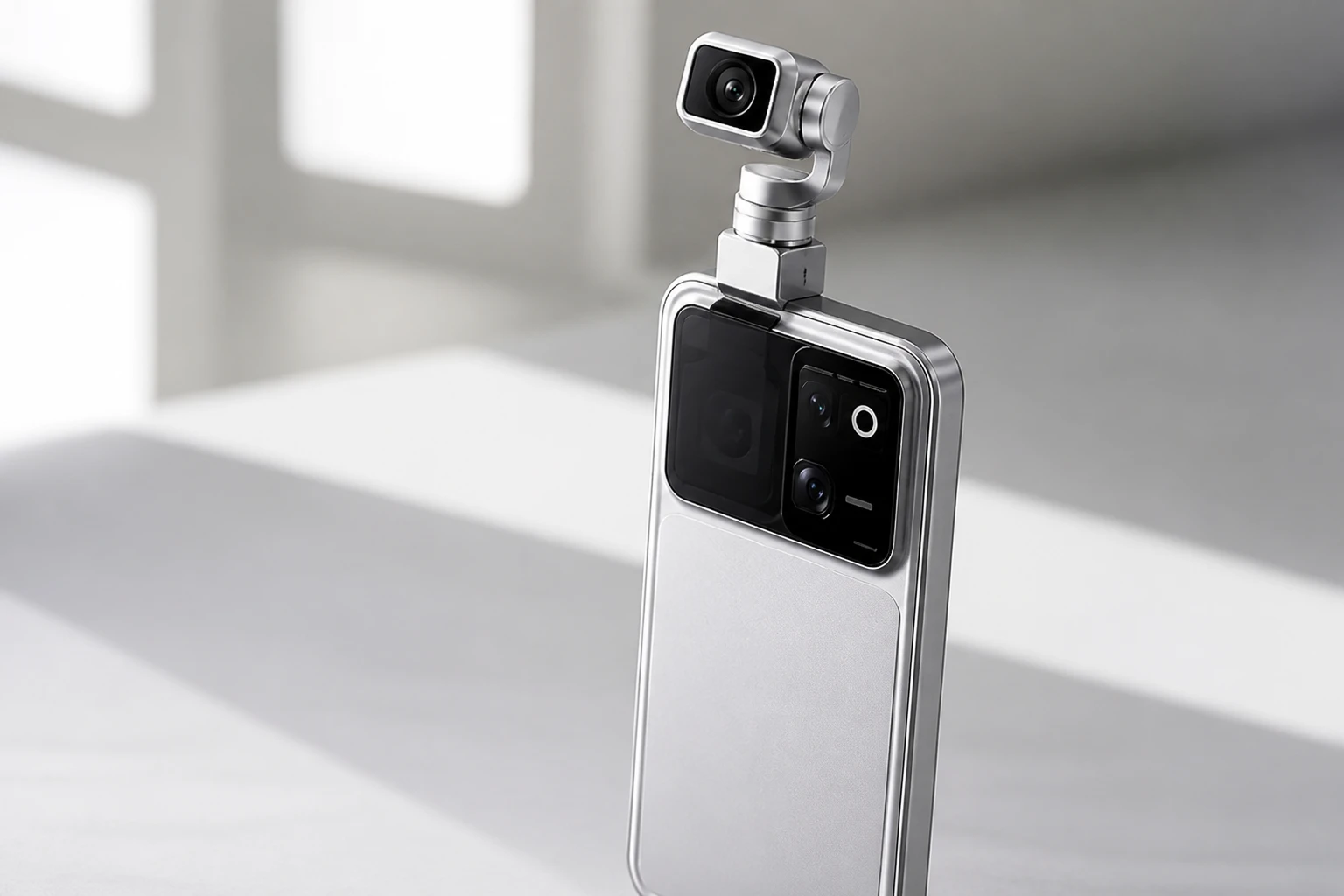
Honor opened sales of its Robot Phone in China on August 18 starting at ¥9,999 (about $1,375-1,480) for the 12GB/512GB model, after an August 12 launch event in Shenzhen. The device mounts a 200MP main camera on a titanium alloy arm that physically pans, tilts, rolls and rotates, pairing the hardware with ARRI cinema color science and the Yoyo AI assistant.
That combination is the bet. Honor is asking creators to pay flagship money for a single slab that tries to replace both a phone and a separate compact gimbal.
The pitch is simple on paper. Carry one device, deploy a motorized main camera when the shot needs motion, then fold the arm away and use the handset like any other flagship. Whether that pitch survives daily carry, heat and repair risk is the open question early buyers will answer first.
The Gimbal That Folds Into 9.6mm
Honor calls the mechanism the industry’s smallest 4DoF gimbal system. The ultralight titanium motor weighs 2.6 grams and measures roughly 6mm thin. The company says the motor package is 65-70 percent smaller than traditional units such as those in DJI’s Osmo Pocket line.
When stowed, the arm sits inside a rear module protected by a sliding plastic cover. Slide the cover aside, trigger the software, and the arm deploys. Dimensions shift with the camera folded or extended: unfolded roughly 190.5 × 72.9 × 9.6 mm, folded camera position 151.4 × 72.9 × 9.6 mm. Weight is a solid 248 grams.
| State | Dimensions | Notes |
|---|---|---|
| Camera folded | 151.4 × 72.9 × 9.6 mm | Daily carry profile |
| Camera unfolded | 190.5 × 72.9 × 9.6 mm | Arm extended for motion |
| Whole device | 248 grams | Titanium motor: 2.6 g, ~6 mm thin |
- Four degrees of freedom: pan, tilt, roll and rotate
- Nearly 360-degree movement range with modes for FPV, spin shot (90 or 180 degrees), super steady and AI subject tracking
- Voice and on-screen joystick control, plus double-tap lock for tracking
- Real-time auto-framing for vlogs, livestreams and video calls
The primary sensor is a 1/1.28-inch 200MP unit with f/1.6 aperture. It is joined by a second 200MP 1/1.4-inch periscope telephoto (2.7x optical) and a 50MP ultrawide that doubles as macro. A custom H1 imaging chip handles the pipeline.
That dual-200MP stack matters because the moving arm is not a secondary selfie unit. The main sensor itself travels. Spin shots, auto-framing and mechanical multi-frame capture all draw on the same high-resolution pipeline rather than a lesser fixed module.
ARRI Color Science Finally Reaches a Handset
This is the first commercial phone to carry elements of ARRI Image Science under a co-engineered designation. The collaboration delivers native 10-bit LogC3 recording, ARRI Wide Gamut 3 color space and pre-loaded ARRI Looks for on-device grading. A dedicated Cinema Mode aims to match the look of ARRI cinema cameras.
The HONOR Robot Phone is an important milestone in ARRI’s expansion into Content Creation. Together with HONOR, we are translating ARRI’s perspective on image quality, color, and visual storytelling into a new category.
David Bermbach, ARRI’s chief product officer, said the work gives more creators access to greater creative control and a stronger link between capture and post-production. Footage recorded in LogC3 can move into the same professional workflows used with ALEXA cameras. The LUT processing runs on-device, so there is no cloud round-trip.
ARRI confirmed the initial availability is China-only and positioned the project as the first tangible outcome of a broader Cinematic Imaging Partnership that also includes a joint lab exploring sensors, end-to-end workflows and AI-era aesthetics.
In practice the Cinema Mode path is capture first, grade second, without leaving the handset if the shooter wants a finished look on the spot. LogC3 holds latitude for later color work; the pre-loaded Looks and on-device LUTs cover faster turnarounds. That split is the core of the handset pitch to solo filmmakers who already know ARRI pipelines from larger cameras.
Full Flagship Specs Under the Moving Arm
The gimbal sits on a conventional high-end Android chassis. Qualcomm’s Snapdragon 8 Elite Gen 5 (3 nm) drives up to 16GB RAM and 1TB storage. The 6.31-inch LTPO OLED runs 1216 × 2640 at up to 120Hz with a claimed local peak of 6,800 nits and AR anti-reflective coating. Battery is a 7,060mAh silicon-carbon cell with 120W wired and 50W wireless charging. Software is MagicOS 10 on Android 16. Colors are Silver and Gray. IP54 dust and splash resistance applies only when the camera is fully stowed.
| Configuration | Price (China) | Approx. USD |
|---|---|---|
| 12GB + 512GB | ¥9,999 | ~$1,375-1,480 |
| 16GB + 1TB | ¥12,999 | ~$1,790-1,930 |
Pre-orders opened earlier; reservations across channels exceeded 200,000 units by late July according to Chinese reports. First sales began at 10:08 a.m. local time on August 18.
IP54 only in the stowed state is a practical limit. Deploy the arm and the splash rating no longer applies. Creators shooting outdoors will treat the open configuration as fair-weather hardware even though the rest of the chassis is built like a modern flagship.
Yoyo Turns Tracking Into Body Language
Yoyo AI, previously a task agent on other Honor devices, gains a physical body through the gimbal. The arm can nod, shake, peek, backflip for emphasis and dance to music with more than 100 programmed expressions. Natural-language commands such as “turn left 45 degrees” or “turn around for five seconds” produce direct motion.
In Robot Mode the system combines multimodal perception, gesture recognition and independent observation of surroundings. Yoyo Auto Execution can run multi-step phone tasks while the gimbal stays active. The result is less a pure camera accessory and more an embodied interface that reacts in real time. This fits a wider pattern of Chinese makers pushing AI robot phones and agents, even as the hardware race intensifies.
Voice direction plus on-screen joystick gives two parallel control paths. A creator can speak a relative move, lock tracking with a double-tap, or take manual control when the AI framing drifts. The programmed expressions sit on top of that utility layer, turning the same motors into a visible character for livestreams and short-form bits.
Hands-On Reality Check From Early Testers
TechRadar’s two-hour session called the device “ridiculous” but “remarkable,” comparing it to a science-fiction gadget that still made the reviewer feel like a kid again. The Verge spent an hour with a unit and came away cautiously optimistic. Stabilization felt close to a current Osmo Pocket, though not quite as locked. Photos gained from the mechanical help in multi-frame capture, especially in lower light. The phone got hot during sustained video, a trait shared with dedicated gimbals.
Controls live mostly on the 6.3-inch screen: a virtual joystick for manual moves, plus pro options for aspect, speed, focus peaking and LogC3. Selfies with the main sensor become practical, and panoramic selfies stitch multiple frames as the arm spins. Tracking works for people and objects and extends to supported video calls.
The same testers flagged the obvious trade-offs. The phone is thicker and heavier than typical flagships. Moving parts raise long-term reliability questions. Repair costs outside the one-year warranty look steep. On X, some retailers already declined to stock it, citing the near-certainty of intensive-use damage claims. That crowd skepticism lands next to the engineering praise: the tool works, yet it is still a phone people drop, pocket and use in rain.
Heat under sustained video is the clearest shared limit with pocket gimbals. The mechanical advantage in lower-light multi-frame work is the clearest gain. Early sessions therefore sketch a split profile: strong for controlled creator shoots, less forgiving as an all-day unthinking pocket phone.
China Opens Sales While the World Waits
Honor has listed the Robot Phone on its global site and earlier confirmed international plans around WAIC and MWC timelines, yet the commercial launch remains China-exclusive for now. No confirmed overseas pricing or ship dates exist. Typical Honor cadence suggests a broader announcement could arrive within two to three months, but nothing is locked. US availability faces additional market restrictions that have limited other Honor models.
The pricing itself became part of the story. Early supply-chain chatter floated figures above ¥15,000. Landing the full dual-200MP, ARRI-tuned package at ¥9,999 undercuts those expectations and signals a manufacturing bet that volume can absorb the patent-heavy titanium mechanism. Whether that bet holds depends on how many livestreamers, solo filmmakers and vloggers decide the integrated package beats buying a strong phone plus a separate Osmo-class gimbal for less total money and lower risk.
The device also sits inside a larger Android push beyond the flat screen and the ongoing AI agent phone race heating up among Chinese brands. Embodied interaction and cinematic mobile capture are no longer concept-stage talking points.
For now the Robot Phone is a China-first experiment that works well enough in early hands-on sessions to make the wager feel serious. Creators who can get one will test whether a folding arm and LogC3 are worth the bulk, the heat and the durability gamble. Everyone else waits to see if the same hardware ever leaves the domestic market in volume.
How The Launch Calendar Unfolded
The commercial path compressed into a few public markers. Interest showed up in reservation volume before the formal stage event, then sales opened on a fixed morning clock time in China.
- Late July – Reservations across channels passed 200,000 units, per Chinese reports, while pre-orders were already open.
- August 12 – Honor held the launch event in Shenzhen and detailed the gimbal, ARRI pipeline and full flagship chassis.
- August 18, 10:08 a.m. local – First retail sales began, led by the ¥9,999 12GB/512GB configuration.
International timing stays looser. Honor has pointed at WAIC and MWC windows and keeps the product listed on its global site, yet no overseas price or ship date is firm. The two-to-three-month cadence familiar from other Honor rollouts is only a guide until a date lands.
Where The Integrated Package Wins Or Loses
The product asks buyers to compare one bill of materials against two. A strong phone plus a separate Osmo-class gimbal can still cost less in total and leaves a failed motor as a swappable accessory rather than a phone-level repair. The Robot Phone counters with zero pairing friction, main-sensor motion, on-device LogC3 and a single pocket when the arm is stowed.
- Integrated path: one device, ARRI-tuned main camera on a 4DoF arm, Yoyo motion and tracking in the same body
- Split path: flagship phone plus compact gimbal, lower combined risk, two gadgets to charge and carry
- Shared limits: heat in long video sessions, and careful handling around rain once any gimbal is active
Reservation volume above 200,000 units suggests the integrated story found an audience before open sales. Retailer hesitation on damage claims points the other way. The next signal is whether livestreamers and solo shooters keep the arm in daily rotation or park it after the novelty window closes.
Pricing under the early ¥15,000 chatter keeps that test honest. At ¥9,999 the dual-200MP, titanium-motor package is no longer a pure prototype tax. It is still a durability and bulk tax. China buyers will decide first whether the cinematic and embodied features repay both.
Frequently Asked Questions
How much does the Honor Robot Phone cost in China?
The 12GB RAM / 512GB storage model starts at ¥9,999. The 16GB / 1TB version is priced at ¥12,999. Global pricing has not been announced. Reservation perks earlier included lifetime Yoyo SVIP and a one-year gimbal replacement service.
What exactly is the 4DoF gimbal camera?
It is a motorized 200MP main camera on a titanium alloy arm offering pan, tilt, roll and rotate freedom. The arm deploys from a rear module, supports AI tracking and spin modes, and folds back to keep the phone near 9.6 mm thick when stowed. A plastic cover protects it when closed.
Does the phone really use ARRI cinema technology?
Yes. It is the first phone carrying certified ARRI Image Science elements, including 10-bit ARRI LogC3 and Wide Gamut 3 plus on-device ARRI Looks and a dedicated Cinema Mode. ARRI and Honor jointly calibrated the pipeline.
What processor and battery does it use?
Qualcomm Snapdragon 8 Elite Gen 5 with up to 16GB RAM and 1TB storage. The battery is a 7,060mAh silicon-carbon cell supporting 120W wired and 50W wireless charging. Display peak brightness is rated at 6,800 nits.
Will the Honor Robot Phone launch outside China?
Not yet. Honor confirmed earlier global intentions and lists the device on its international site, but the commercial release and pricing remain China-only as of the August 2026 launch. No firm international date has been set.