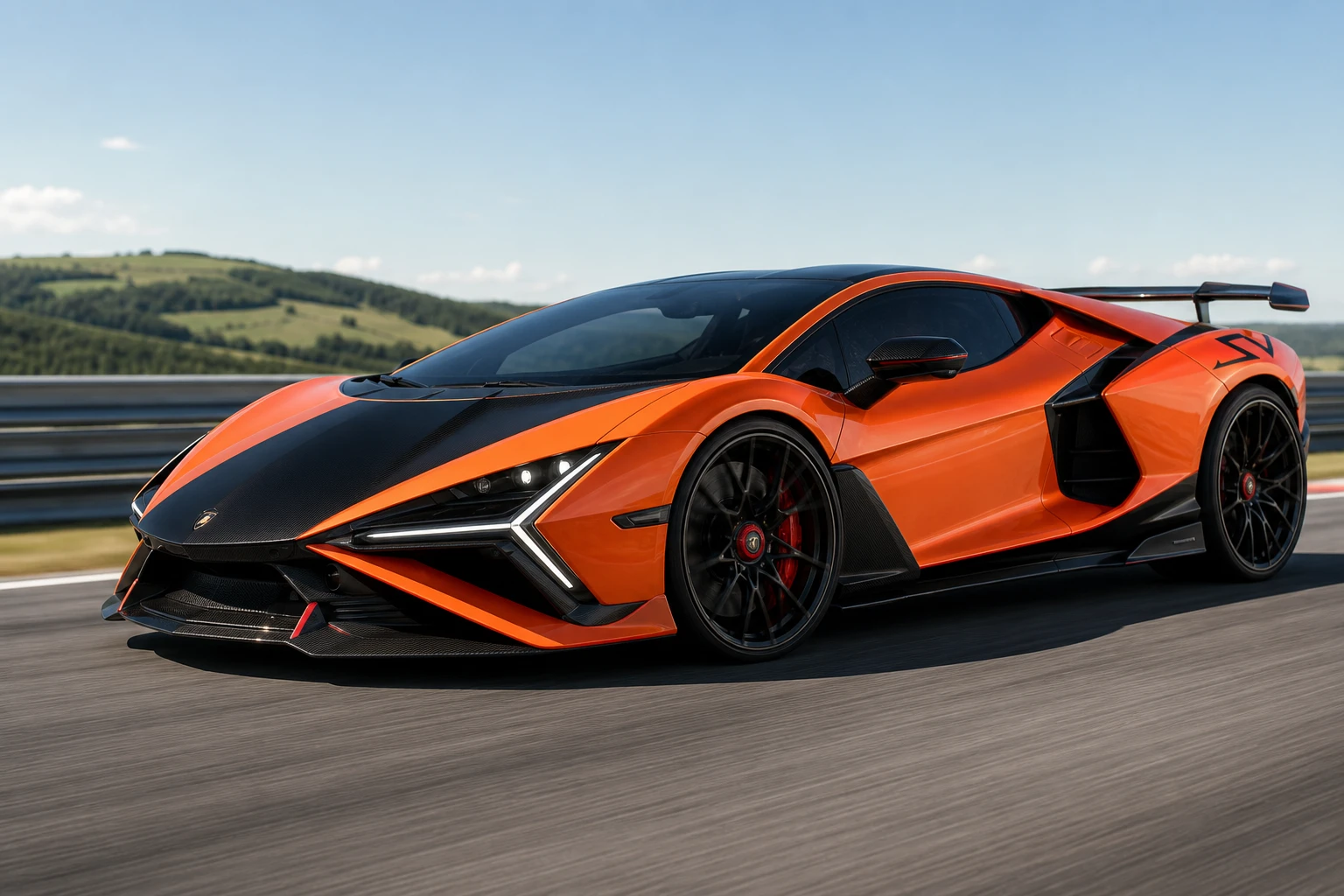
Lamborghini unveiled the Revuelto SV at The Quail during Monterey Car Week on 14 August 2026, capping production at exactly 1,963 units and packing a hybrid V12 system good for 1,065 CV. The car posts 0-100 km/h in 2.4 seconds, 0-200 km/h in 6.7 seconds and a top speed above 345 km/h while claiming the fastest production-car lap ever timed at Germany’s Hockenheimring.
It is the fifth model to wear the Super Veloce badge and the first hybrid in that line. Buyers will be drawn from the brand’s most loyal customers and collectors only.
Those claims set the frame for every choice that follows: more system power, tighter chassis response, sharper aero and a hard production ceiling that keeps the car inside the Super Veloce tradition.
The Numbers That Separate It From the Base Revuelto
The 6.5-litre naturally aspirated V12 still makes 825 CV at 9,250 rpm and spins to 9,500 rpm. Three electric motors and a revised 7.3 kWh battery now contribute more power, lifting the system total by 50 CV to 1,065 CV (783 kW). Peak system torque hits a class-leading 1,425 Nm.
Power-to-weight improves to 1.66 kg/CV. A new sports exhaust and extensive carbon use help. The eight-speed dual-clutch and all-wheel-drive layout stay, but the motors now deliver faster torque vectoring.
- 1,065 CV combined output
- 1,425 Nm system torque
- 2.4 s 0-100 km/h
- 6.7 s 0-200 km/h
Base Revuelto figures sit lower across the board. The standard car starts near $608,000 in the United States; the SV opens at $741,172 before options and Ad Personam personalisation. In India the standard model lists at ₹8.89 crore ex-showroom, so the SV will carry a clear premium.
The price gap is not cosmetic. It tracks the hardware delta: higher combined output, the revised battery pack, CCM-R Plus brakes, fixed double-element wing and the limited run itself. Buyers who already know the base car will read the SV sticker as payment for stopwatch gains rather than cabin theatre.
| Metric | Revuelto | Revuelto SV |
|---|---|---|
| Combined power | 1,015 CV | 1,065 CV |
| 0-100 km/h | ~2.5 s | 2.4 s |
| 0-200 km/h | N/A exact | 6.7 s |
| Top speed | >350 km/h | >345 km/h |
| Downforce vs base | baseline | +80 % |
| Production | open | 1,963 units |
The official Revuelto SV quantum of driving brief frames these gains as a shift in state rather than simple addition.
Top speed sits a shade under the base car’s quoted ceiling, a trade the aero package accepts in exchange for the large downforce step. Straight-line bragging rights give way to lap-time priorities, which is the Super Veloce pattern in miniature.
Chassis, Aero and Brakes Built for the Stopwatch
Manually adjustable dampers drawn from GT3 racing technology sit at each corner. Lamborghini claims the revised geometry lifts agility 17 percent and lateral grip 10 percent versus the standard Revuelto. Suggested setups cover flat, bumpy or wet tracks.
Brakes move to next-generation CCM-R Plus carbon-ceramic discs: 420 mm front, 410 mm rear. Peak deceleration rises 11 percent, heat dissipation improves 23 percent and disc temperatures fall 12 percent. A dedicated cooling channel feeds the rear rotors.
Aerodynamics deliver the biggest visual and measured jump. A new front splitter, underbody, vertical Omega nose treatment and large fixed double-element rear wing produce 80 percent more total downforce than the base car and 10 percent more than the old Aventador SVJ. Downforce-to-drag efficiency climbs 60 percent. Brake cooling itself gains 12 percent from the aero package.
- GT3-derived adjustable passive dampers
- CCM-R Plus carbon-ceramic brakes with improved cooling
- Fixed motorsport-style rear wing and Gurney flap
- Bespoke Bridgestone Potenza Race R tyres on 20/21-inch centre-lock wheels
- New Pilota driving mode with five-stage traction control
Factory driver Marco Mapelli put the package on record with a 1:41.6 production car lap at Hockenheimring. Lamborghini calls it the fastest official production time at the circuit. Some observers noted earlier AMG One claims on different configurations, yet the brand stands by the figure as its own benchmark.
The chassis, brake and aero percentages stack rather than stand alone. Higher grip loads the brakes harder; better cooling keeps those brakes consistent; the wing and underbody create the load that the dampers and tyres then manage. Pilota mode with its five-stage traction control is the software layer that lets a driver meter that stack on track.
Super Veloce Line That Started With the Miura
SV has meant Super Veloce since 1971. The original Miura SV took the world’s first modern mid-engine supercar, raised power to 385 hp, separated engine and gearbox oil, widened the rear track and deleted the headlight eyelashes. Roughly 150 examples left Sant’Agata.
Every later SV followed the same recipe: more power, less weight, sharper aero, limited numbers, higher emotion. The Aventador SuperVeloce of 2015 ran 600 units at 750 PS. The SVJ that followed reached 900 coupes plus roadsters and specials. Each one became a collector lodestone.
- 1971, Miura SV launches the Super Veloce name with 150 units and chassis refinements that tamed the original Miura’s high-speed manners.
- 2015, Aventador SV arrives with 750 PS, 50 kg weight cut and 600-unit cap.
- 2018, Aventador SVJ adds ALA active aero and 770 PS across roughly 900 coupes.
- 2026, Revuelto SV hybridises the formula at 1,065 CV and 1,963 units.
Lamborghini marked the 55th anniversary origin of Super Veloce weeks before the Monterey reveal, making the timing deliberate. Chairman and CEO Stephan Winkelmann put it plainly: every SV has pushed boundaries of performance and driving experience since the Miura.
Unit caps have grown as the brand’s collector base has grown, yet the logic never flipped to open production. The Revuelto SV’s 1,963-unit ceiling is the largest in the line and still finite. That balance keeps the badge rare without starving demand that already spans multiple regions.
Monterey Stage and the Scarcity Strategy
The Quail lawn has become Lamborghini’s preferred launch pad for halo cars. This year the SV shared the stage with a US debut for the Urus Performante and a Miura 60° Homage, tying the new car to the brand’s founding V12 mythology.
Limited cars like the Super Veloce, or the few-offs and one-offs, are always something our customers look forward to, because they are going to be collectible sooner or later. All the Super Veloces, since the Miura in ’71, are becoming icons of the era.
Winkelmann told Yahoo Finance those words while standing beside the car. He confirmed strong pre-selling worldwide and called the response expected. At roughly $741,000 base and 1,963 units, the run represents well over $1.4 billion in potential revenue once options stack. Deliveries begin in 2027.
Volume still comes from the Urus, Temerario and standard Revuelto. The limited cars carry the mythology and the margins. An earlier look at the Super Veloce collector extension already flagged how tightly Lamborghini guards these allocations.
Sharing the lawn with the Miura homage was not accidental staging. It put the newest hybrid flagship beside the car that started the Super Veloce name, so the continuity argument landed visually before any brochure text did.
Cabin That Puts the Driver First
The layout stays familiar, yet every touchpoint sharpens. Standard Sport seats use a carbon shell. Optional monocoque carbon Race seats cut weight and raise lateral support. Carbon door panels, more exposed weave than any prior Revuelto, and twelve contrasting leather colours expand choice.
A red Pilota mode selector sits on the right spoke of the motorsport-inspired wheel. ANIMA drive-mode lever also wears red. Door-open animation and SV-specific graphics greet the driver. The “Feel Like a Pilot” philosophy is the explicit target.
Customers can specify rear lettering in shiny black, matt black or matt bronze. Exhaust tips arrive in matt grey standard, with black or bronze options. Centre-lock wheels carry a hexagonal inner structure that echoes the brand’s geometric language.
- Carbon-shell Sport seats standard; monocoque Race seats optional
- Red Pilota selector and red ANIMA lever on the wheel
- Rear lettering in shiny black, matt black or matt bronze
- Exhaust tips in matt grey, black or bronze
None of these choices alter the powertrain figures, yet they reinforce the same message the chassis hardware sends: the car is built around a driver who will use Pilota mode, not around a passenger who will admire stitch patterns.
What the Allocation Means for Collectors
Only existing high-volume clients and proven collectors will see allocation offers. Most previous SV runs sold out before public debut. Residual values for those cars have held or climbed precisely because supply stayed tight.
The 1,963 figure nods to the company’s 1963 founding year, the same logic that produced the Aventador SVJ 63 series of 63 cars. That numerical storytelling has become part of the product. Owners who already park an Urus or standard Revuelto gain first refusal; public figures who turn heads with special plates, as in recent high-profile Lamborghini ownership moments, sit in the same orbit.
On X the official reveal post drew more than 450,000 views and 10,000 likes within days. Reply threads split between pure power worship and notes that the aggressive surfaces still read as Aventador descendants. The debate itself keeps the car visible while the engineering claims stand unchallenged.
The Revuelto SV does not invent a new category. It simply executes the Super Veloce playbook that has worked for 55 years, now with hybrid torque and GT3 hardware. For the 1,963 buyers who clear the list, that continuity is the point.
Electric Motors Tighten Every Corner Exit
The Super Veloce line never carried hybrid hardware before the Revuelto SV. The three electric motors and the revised 7.3 kWh battery are therefore the clearest break with Miura, Aventador SV and SVJ practice, even while the badge recipe stays intact.
Faster torque vectoring is the practical payoff. The eight-speed dual-clutch and all-wheel-drive layout remain, yet the motors can now meter torque across the axle with less delay than the base Revuelto. On corner exit that shortens the gap between throttle input and usable drive.
System torque of 1,425 Nm gives the driver a wide plateau to work with once Pilota mode and the five-stage traction control are engaged. The V12 still supplies the high-rpm drama at 9,250 rpm peak and 9,500 rpm redline; the motors fill the moments when a pure combustion car would wait for the next gear or the next cam lobe.
That split of duties explains why Lamborghini can claim both a class-leading torque figure and a production-car lap record without rewriting the entire platform. The hybrid layer sharpens response. The carbon, aero and brake work then keep the car stable while that response is used.
Production Caps Tell the Collector Story
Across four Super Veloce generations the volume ceiling has moved in one direction, yet it has never opened into unrestricted series production. The pattern itself is part of what collectors buy.
| Model | Year | Output | Production cap |
|---|---|---|---|
| Miura SV | 1971 | 385 hp | ~150 units |
| Aventador SV | 2015 | 750 PS | 600 units |
| Aventador SVJ | 2018 | 770 PS | ~900 coupes |
| Revuelto SV | 2026 | 1,065 CV | 1,963 units |
Each step lifted power and widened the buyer pool the brand was willing to serve, while the hard cap preserved the scarcity that later supported residuals. The Revuelto SV inherits that structure at hybrid power levels and at a founding-year unit count.
Pre-selling was already strong at the Monterey reveal, which matches the sell-out pattern of earlier SV runs. Deliveries begin in 2027, so the gap between deposit and driveway will itself act as a filter. Clients who clear allocation, hold through the wait and take the car are the same group that has kept prior Super Veloces on collector shortlists.
Frequently Asked Questions
How much power does the Lamborghini Revuelto SV make?
The hybrid system produces a combined 1,065 CV (783 kW) and 1,425 Nm of torque from the 6.5-litre V12 plus three electric motors, 50 CV more than the standard Revuelto’s 1,015 CV total.
Why is the Revuelto SV limited to 1,963 units?
The number commemorates the year Automobili Lamborghini was founded in 1963 and follows the brand’s long practice of tying special-series volume to heritage dates.
What does the Hockenheimring lap time prove?
Marco Mapelli’s 1:41.6 run is claimed by Lamborghini as the fastest production-car lap officially recorded at the German circuit, serving as the brand’s chosen dynamic benchmark for the SV package.
What does SV stand for on a Lamborghini?
SV means Super Veloce, Italian for super fast; the designation first appeared on the 1971 Miura SV and has marked every subsequent extreme, limited-run V12 flagship.
What is the starting price of the Revuelto SV?
The car opens at $741,172 in the United States before options, Ad Personam custom work or taxes; the standard Revuelto begins near $608,000.