Prime Minister Irakli Kobakhidze signed Decree No. 1586 transferring 100 percent of Georgian Roads Operator LLC to the Ministry of Infrastructure for unlimited free management. The new state firm will handle maintenance of international and domestic roads with a planned GEL 63 million startup package and 163 staff, yet that capital remains outside the 2026 budget.
The move ends a stretch of reliance on private contractors the government now calls inadequate and puts specialized equipment under direct state control.
Decree Hands the Ministry a Ready Shell
The National Agency of State Property under the Ministry of Economy must execute the transfer. The company arrived free of charge and for an unlimited period. Business registry records show the entity began life in 2012 under the same identification number as Kutaisi David the Builder International Airport LLC, then owned by United Airports of Georgia.
- July 21, 2026, Ownership flipped to full state control.
- July 22, 2026, Name changed to Georgian Roads Operator.
- August 2026, Decree No. 1586 places it under Ministry management; Alexander Zabakhidze named director.
The Ministry of Infrastructure confirmed the company will take responsibility for road maintenance. The shell gave Tbilisi a legal vehicle already in the registry instead of incorporating from scratch.
What the GEL 63 Million Package Buys
Legislative amendments set the initial capital at approximately GEL 63 million excluding VAT. Officials say the money builds the technical base, buys specialized gear, constructs support infrastructure and installs modern systems. Annual operating costs are projected near GEL 30 million, of which salaries for 163 people take about GEL 7 million. The government plans to cover running costs by optimising and redistributing existing budget lines.
| Category | Amount (GEL million) | Items |
|---|---|---|
| Winter maintenance equipment | 30.9 | 65 units |
| Summer maintenance equipment | 16.4 | 54 units |
| Infrastructure, IT, initial supplies | 15.6 | Base and systems |
| Total initial capital | ~63 | Excluding VAT |
At recent rates near 0.38 USD per lari the package equals roughly $24 million. The funds have not been written into the 2026 state budget, so the company starts with a balance-sheet plan rather than cash in hand.
Private Contractors Lose the Maintenance Lane
At a June briefing Kobakhidze said previous private contractors had not delivered satisfactory quality. He framed the state company as a way to secure both stable resources and better service, including specialised equipment that can answer natural events quickly. The legislative package lets the Ministry shift full or partial responsibility for highways and sections of international and domestic importance to the new entity.
- Private firms lose the recurring volume-based maintenance contracts that once covered routine work.
- The state gains an in-house fleet of 119 specialised units instead of renting or tendering seasonally.
- Competition on the maintenance side shrinks as the operator can perform the work itself.
- Analysts such as financial commentator Giga Bedineishvili warned in June that the model could push private firms out of the market altogether.
The shift matches a longer pattern of the Roads Department retaining construction and rehabilitation while farming out day-to-day upkeep. That split is now closing on the maintenance side.
The Network the New Operator Must Keep
The Roads Department currently manages the core network that the operator will service. Official figures list 1455 km of international roads and 6943 km of secondary roads. The high-intensity E-60 (Poti-Tbilisi-Red Bridge) and E-70 (Poti-Batumi-Sarpi) corridors alone total about 450 km of main transit spine.
- International network: 1455 km under central responsibility.
- Secondary network: 6943 km.
- Key transit pair: E-60 and E-70, roughly 450 km combined.
- Priorities listed by the department: EU-standard integration, safety, monitoring and competitive environment.
Those kilometres include mountain passes that demand heavy winter gear and summer surface work. A 2011 2011 World Bank workshop on local road maintenance already flagged chronic under-funding, low competition among contractors and the tendency to chase failed pavements rather than protect good ones. The new operator inherits that backlog on the national and secondary tiers.
Budget Hole Meets Capital Squeeze
The GEL 63 million has not been booked in the 2026 state budget. Transparency International Georgia’s reading of the draft shows capital projects overall falling to 6.1 billion GEL for capital projects, a 565 million GEL drop from 2025. Highway construction funding is among the largest reductions. Officials say operating costs will come from optimisation and redistribution, yet the one-time equipment outlay still needs an appropriation or reallocation later this year.
The Ministry of Infrastructure retains overall Ministry of Infrastructure road responsibilities for development and coordination. The new company sits under its management right, so any shortfall lands on the same ministry that must also deliver the big construction programme.
Winter Kit and the Double-Effect Claim
We want to create a stable resource that will also be a guarantee of quality.
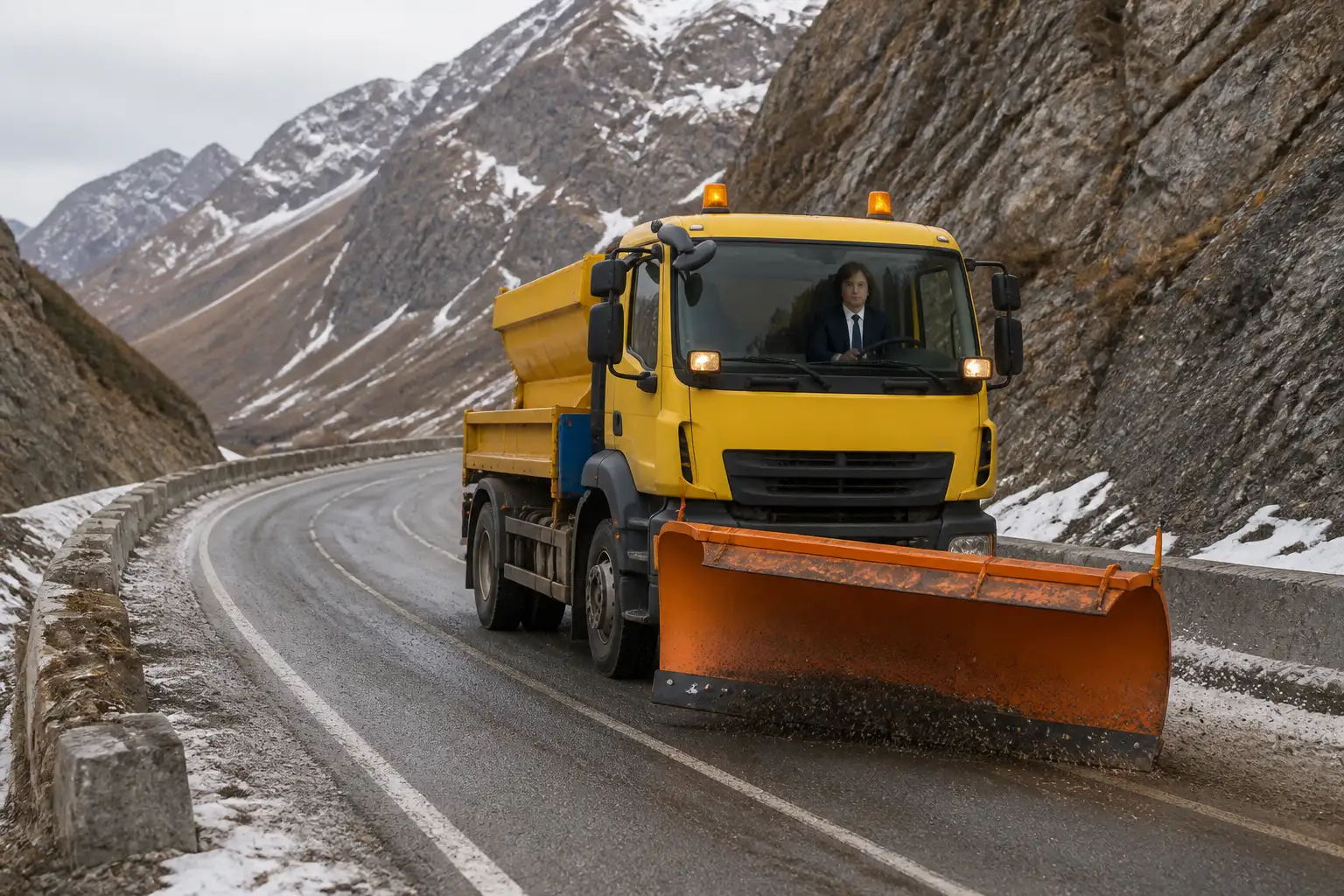
Kobakhidze made that statement at the June briefing when the legislative package was unveiled. He added that the company would deliver a double effect: steady maintenance capacity plus specialised equipment ready for natural events. The 65 winter units form the largest single line in the capital plan, a direct response to the mountain corridors that close or turn hazardous every season.
The package also tightens the Law on Motorways against unauthorised roadside construction, a long-running source of safety and infrastructure damage.
Startup Lag Leaves the Operator on Paper
Alexander Zabakhidze is director. The company exists in the registry, the decree is signed and the Ministry has confirmed its role. What is still missing is the GEL 63 million cash, the physical fleet and the 163 hires. Until the money appears, maintenance continues under the previous arrangements while the legal shell waits.
The state has chosen ownership of the fleet and the labour force over continued tendering. Private contractors that once bid for the volume work now face a smaller market. Drivers and freight operators will judge the choice by whether the mountain roads stay clearer and the pavement lasts longer once the orange trucks actually roll.
Frequently Asked Questions
How much initial capital is planned for Georgian Roads Operator?
Approximately GEL 63 million excluding VAT, broken into 30.9 million for 65 winter units, 16.4 million for 54 summer units and 15.6 million for infrastructure, IT and supplies; the sum is not yet in the 2026 budget.
How many people will the new road company employ?
The plan calls for 163 employees whose salaries are estimated at around GEL 7 million inside a total annual operating budget near GEL 30 million.
What roads will Georgian Roads Operator maintain?
International and domestic sections of importance currently under the Roads Department, a network of 1455 km international plus 6943 km secondary roads.
Who is the director of Georgian Roads Operator?
Alexander Zabakhidze (also rendered Aleksandre) was appointed director when the name change took effect on 22 July 2026.
When was the company shell originally created?
The legal entity dates to 2012 under the identification number of Kutaisi David the Builder International Airport LLC; ownership became fully state-held on 21 July 2026 and the name changed the next day.
Why did the government move away from private road contractors?
Prime Minister Kobakhidze stated that previous private contractors had not delivered satisfactory quality and that a state resource would guarantee both stability and better service, including rapid response equipment for natural events.