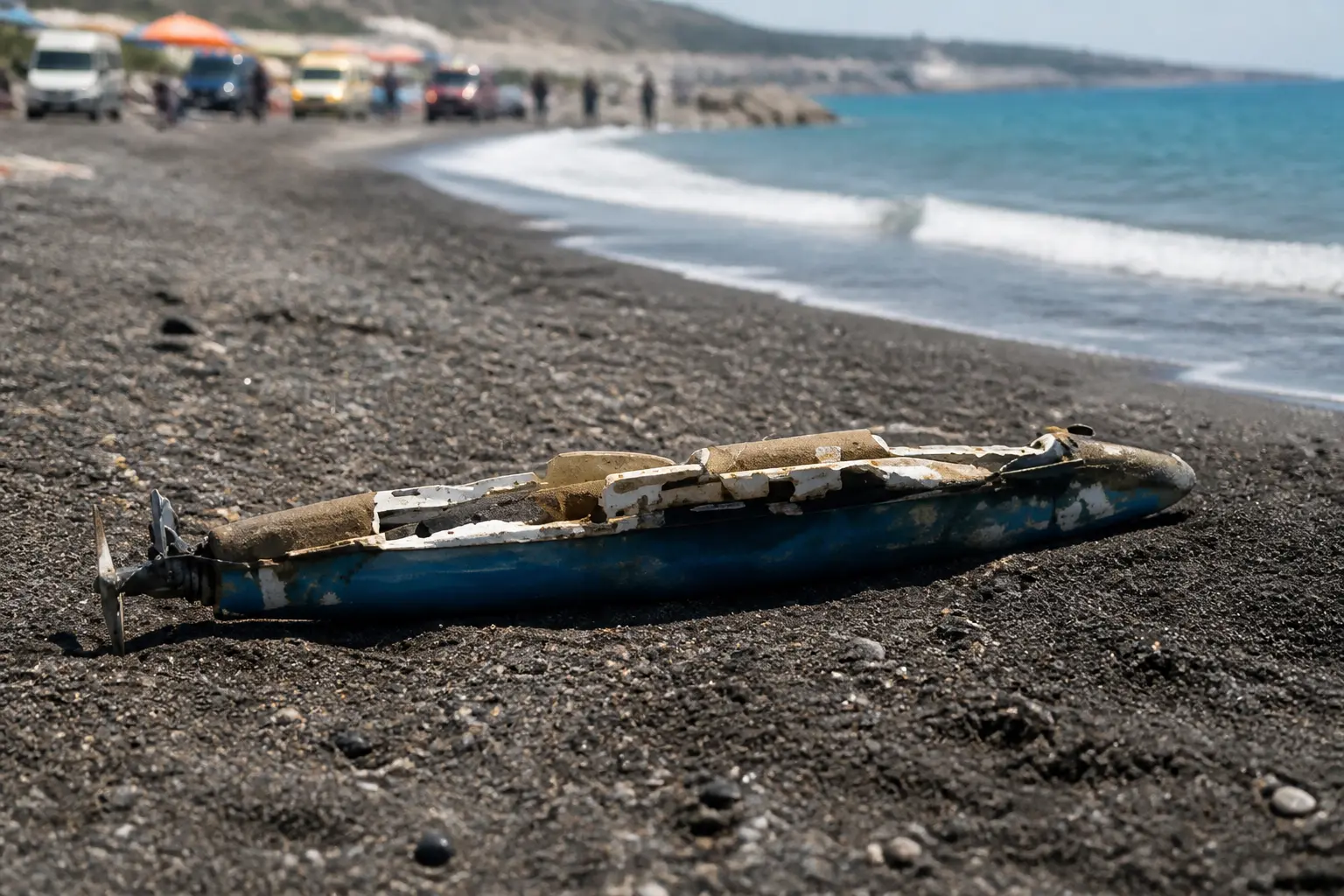
A third suspected Russian drone munition washed ashore near Kaprovani on Shekvetili beach in early August 2026, drawing police and rescue teams while beachgoers remained nearby. United National Movement member Tatia Nikolashvili posted video of the object and said officers on site described it as Russian combat drone debris. Georgia’s Ministry of Internal Affairs opened an investigation under flight rules, yet no detailed public identification followed.
The finds sit inside a wider pattern of war debris drifting onto Black Sea coasts far from the main fighting.
Three Objects in a Handful of Days
Nikolashvili reported the latest object on social media around August 8. She wrote that it was already the third similar discovery along the coast in recent days and that authorities had offered no official explanation at the time of her post. Police and rescue crews sealed parts of the shoreline while the item stayed under examination.
- First and second objects appeared in the days immediately before the Kaprovani find, according to local social reports and Nikolashvili’s account.
- The third lay on the sand near Kaprovani, close to the Shekvetili resort stretch.
- Video from the scene showed officers, emergency vehicles and ordinary visitors still present on the beach.
Sova News and other outlets confirmed the Interior Ministry’s response to the Interpressnews agency: an investigation under Article 280 of the Criminal Code covering violations of international flight rules. Beachgoers can be seen in the background of the footage, underscoring how quickly the debris reached a working holiday shore.
What Officials Have Said So Far
The Ministry of Internal Affairs confirmed the probe and the legal basis. Beyond that single statement, public detail stayed thin. Nikolashvili stressed that officers at the scene spoke of a Russian unmanned combat aerial vehicle, yet no ministry release named the type, origin or whether explosives remained.
Another suspected Russian drone munition has washed ashore near Kaprovani, close to Shekvetili. This is what police officers at the scene were saying. No other explanation has been provided by the authorities. This is already the third such object found along the coast in the past few days, and no official statement has been made so far.
Nikolashvili, a United National Movement member, posted that assessment with the video. Georgian media across outlets carried the same core facts: the location, the third-in-days count, the police presence and the limited official line. The choice of Article 280 of the Criminal Code frames the case as an airspace or flight-path breach rather than an explosives or terrorism matter, at least at the opening stage.
Readers can consult the full text of Georgia’s criminal law for the precise wording on international flight rules. Failure to follow allowed routes, altitudes or landing areas falls under the article, which carries penalties once liability is established.
Black Sea Coasts Keep Collecting War Trash
Georgia is not alone. Russian Geran-type and other unmanned systems have washed up repeatedly on Turkish Black Sea beaches in 2026, sometimes with explosives still aboard, sometimes inert. Turkish defense officials assessed several as likely Russian and deployed bomb squads and naval units. Similar fragments appeared in occupied Abkhazia in March 2026 after a mass drone raid that local de facto authorities said involved about 30 aircraft; debris landed in at least 11 settlements and knocked out power in one village.
| Location | Approximate date | Description | Response |
|---|---|---|---|
| Shekvetili / Kaprovani, Georgia | August 2026 | Third munition or drone fragment in days | Police, rescuers, Art. 280 probe |
| Ordu / Ünye, Türkiye | February 2026 | UAV debris assessed likely Russian | Defense ministry inspection, no explosives |
| Zonguldak / Filyos, Türkiye | July 2026 | Military-grade drone | Bomb squad, naval commandos |
| Multiple sites, Abkhazia | March 2026 | Fragments after ~30-drone raid | Local air defense claims 99% destroyed |
Currents and prevailing winds in the eastern Black Sea carry floating wreckage from Ukrainian and Russian operations onto non-combatant shores. Tourist beaches become the accidental collection points. Georgia’s short coastline sits between the main theater and the Turkish resorts that have logged the same problem for months.
Holiday Sands Meet Unexploded Risk
Shekvetili markets itself as a quieter family stretch of black magnetic sand, pine forest and low water depth, roughly 45 km north of Batumi. The Shekvetili Black Sea resort page highlights the three-kilometer beach and its health claims for the sand. Luxury properties and seasonal hotels line the same coast that now hosts bomb-disposal style responses.
Visitors in the videos stand within sight of the cordoned object. Local reports note the shoreline stayed in public use nearby while crews worked. For a resort economy that depends on summer footfall, even inert debris raises practical questions: how often will beaches close, who pays for clearance, and what liability exists if a live round surfaces later.
Crowd discussion on open platforms treated the silence as the sharper problem. Repeated finds without clear inventories or origin statements leave room for rumor that the government is downplaying Russian-linked hardware or simply lacks the capacity to track every floater. Either reading damages confidence in a coast sold as safe and scenic.
Georgia’s Awkward Middle Ground
Tbilisi maintains no formal combat role in the Ukraine war and has kept diplomatic language measured. Russian forces still occupy Abkhazia and South Ossetia after the 2008 conflict. Drone fragments landing on government-controlled beaches therefore carry political weight that a pure technical recovery does not.
Opposition voices such as Nikolashvili use the incidents to press for transparency. Government channels stay minimal, consistent with a preference for de-escalation and trade continuity. The Art. 280 framing keeps the matter inside aviation rules rather than broader security theater. That choice may limit domestic alarm; it also leaves the second-order effects unaddressed: tourism branding, public trust, and the slow normalization of war debris as a coastal fact of life.
March’s Abkhazia raid already showed how drone campaigns can spill into Georgian-claimed space. The August Shekvetili cluster moves the same phenomenon onto open resort sand under full Georgian jurisdiction.
Clearance Work Continues Without Full Answers
As of mid-August reporting, the objects remained under examination and no comprehensive inventory or origin confirmation had been released. Rescue teams and police handled the immediate scene. Further finds remain possible while Black Sea operations continue at high tempo.
For beach operators and visitors the practical sequence is simple: report unusual metal, stay clear, wait for trained crews. For the state the harder task is deciding how much detail the public receives each time another fragment arrives. The pattern already stretches from Türkiye through Abkhazia to Shekvetili. Georgia’s stretch of coast is now part of that map whether officials expand their statements or not.