Georgia’s seaports and railways moved more cargo in the first six months of 2026 than in any first half of the past ten years. Seaports and terminals handled 9.7 million tons between January and June, up 22% from a year earlier. Georgian Railways carried 6.9 million tons, up 10%, the country’s Ministry of Economy and Sustainable Development said.
Most of that growth traces back to a war Georgia is not fighting. Russia’s invasion of Ukraine rerouted Eurasian freight around Russian territory, and Georgian ports and rail lines sit on the detour that benefited most.
Ports and Rail Post Their Best Half in Ten Years
The ministry’s tally spans every terminal on Georgia’s Black Sea coast, chiefly the deep-water ports of Poti and Batumi, plus the state railway linking them to Azerbaijan, Armenia and Turkey. Every category the ministry tracks, imports, exports, transit and domestic freight, grew at once.
The figures below cover the first six months of 2026 against the same period in 2025.
| Metric | H1 2026 | Year on Year | Decade Standing |
|---|---|---|---|
| Seaport and terminal cargo | 9.7 million tons | +22% | Highest H1 total in 10 years |
| Port container traffic | 409,397 TEU | +9% | Highest H1 total in 10 years |
| Georgian Railways cargo | 6.9 million tons | +10% | Best H1 in a decade |
| Rail container traffic, June only | 12,049 TEU | Monthly record | Highest single month in 10 years |
Container volume is measured in twenty-foot equivalent units (TEU), the standard unit for comparing cargo regardless of box size. Working back from the ministry’s own growth percentages puts first-half 2025 seaport cargo at roughly 7.9 million tons. That means Georgian ports added close to 1.8 million tons of cargo in a single year.
The ministry said the growth was recorded across “all ports, terminals and cargo categories,” language that rules out one lucky contract explaining the whole jump.
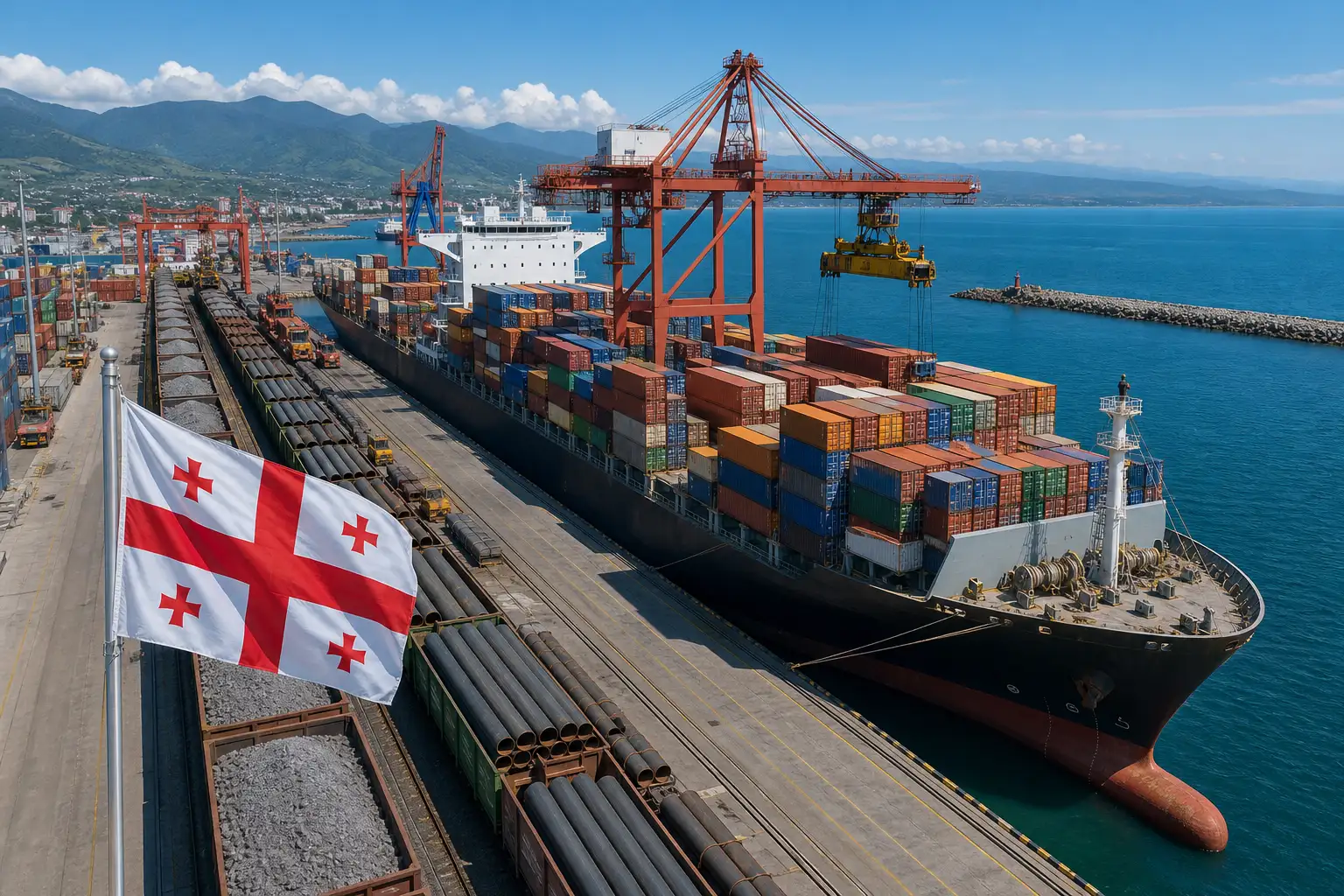
New Cargo Is Showing Up on the Manifest
The ministry flagged cargo categories that had not moved through Georgian ports and rail lines in the same period last year.
- Steel
- Several types of pipes
- Gold and copper concentrates
- Multiple categories of liquid cargo
The copper and gold concentrate line did not appear out of nowhere. In July 2025, RailFreight.com reported that the first shipment of Georgian-origin copper concentrate, 6,500 tonnes in bulk bags, left Poti Port bound for European buyers, loaded by rail and shipped out under a new export link between APM Terminals and the KCB Alliance.
Poti’s rail connections also carry cargo that never touches Georgia as a final destination. Armenia has no coastline of its own, and Poti’s on-dock rail link makes it the country’s main gateway for goods headed to Europe and beyond.
How a War Next Door Rerouted Eurasia’s Freight
Georgia’s coast and railway sit on the Trans-Caspian International Transport Route (TITR), known more commonly as the Middle Corridor. It carries goods from China and Central Asia across the Caspian Sea, through the Caucasus and Georgia’s ports, and on to Europe, bypassing Russia entirely.
That routing barely mattered before 2022. Once Russia invaded Ukraine and Western sanctions closed off the rail corridor running through Russian territory, shippers began hunting for another way around it. Georgia’s ports and railways were already sitting on the alternative.
Central Asian governments have leaned harder onto the corridor since, treating it as a safer alternative to routes through Russia. How much more the corridor can absorb is where the agreement ends.
- Kazakh and European officials – point to rising targets and treat the corridor as a long-term bet worth billions in new investment.
- Carnegie Endowment for International Peace analysts – warn the route could prove a dead end without heavier investment in ships and rail capacity.
- Regional shipping analysts – argue the binding constraint is not demand but a shortage of vessels able to cross the Caspian Sea.
Georgia does not control the Caspian shipping fleet, the Kazakh rail network, or the pipeline politics that decide how much cargo reaches its own ports in the first place. Its record numbers depend on decisions made in Astana and Brussels as much as in Tbilisi.
Anaklia’s Funding Shrinks Just as Construction Starts
Georgia’s answer to a bigger, deeper port has been Anaklia, a planned deep-water harbor on the Black Sea north of Poti. Officials said the project entered its active construction phase in 2026. Belgian contractor Jan De Nul began work on a breakwater roughly 1.38 kilometers long, dredging an access channel to about 18 meters deep.
Prime Minister Irakli Kobakhidze’s government redesigned the financing after years of false starts, including a scrapped concession with a private international consortium. Officials now say the state will own the port outright, leasing individual berths to operators on long-term contracts instead of handing the whole project to one investor.
Contract changes cut projected costs by more than a quarter, saving an estimated $52.5 million, according to Georgian officials. Yet the 2026 state budget cuts Anaklia’s own financing line by 100 million lari, roughly $37 million, down to 50 million lari. That lands in the same year the ministry is celebrating record throughput at the ports Anaklia is meant to eventually outgrow.
Once its first phase is finished, Anaklia is projected to handle about 600,000 TEU and 7.8 million tons of cargo a year. Its seabed will be deepened to at least 16 meters. That is real added capacity Georgia does not have yet, arriving on a funding schedule the government just made slower.
Brussels Pulls Back While Cargo Pours Through
This cargo growth did not require Georgia’s relationship with the European Union to improve. That relationship has gone the other way instead.
Georgian Dream, the ruling party, suspended EU accession talks in late November 2024 and rejected European budget support until at least 2028. The US Embassy in Georgia issued a formal statement on the move, one of several Western objections that followed.
The fallout kept building into 2026. European lawmakers have pushed for coordinated sanctions against Georgian officials over what they call repression and state capture. Brussels has also floated suspending the visa-free travel Georgians have held since 2017. Tbilisi has additionally brought in legal mechanisms mirrored on Russian law that now shape how Georgian organizations operate.
That political rupture has not slowed the freight moving through Poti and Batumi. The ports and the politics are running on separate tracks.
Where Could Georgia’s Cargo Boom Hit a Wall?
Three things could cap it: a shortage of Caspian Sea vessels limiting how much more freight the Middle Corridor can carry, a deep-water port at Anaklia now funded more slowly than officials promised, and a political rift with the EU that keeps raising the cost of doing business with Tbilisi.
Georgia’s own infrastructure has already shown how much can hinge on forces outside its control. The country’s power grid tripped twice this year in blackouts tied to a shared Abkhazia dam it doesn’t fully operate. Ports and rail carry a version of the same exposure, just routed through Kazakh rail capacity and Caspian shipping schedules instead of a dam.
Anaklia is built to move 600,000 TEU a year once its first phase opens, on top of everything Poti and Batumi already carry. Georgia’s government just decided to spend less money getting there.
Frequently Asked Questions
What New Products Is Georgian Railways Carrying?
The ministry said Georgian Railways widened the range of products it transports in 2026, beyond the steel, pipe, mineral concentrate and liquid cargo categories now showing up at the ports. It did not break out a full product list, only confirming growth across import, export, transit and domestic freight alike.
What Does TEU Mean and Why Do Ports Track It Separately from Tons?
TEU stands for twenty-foot equivalent unit, a standard measure based on a 20-foot shipping container. Ports report both tonnage and TEU because bulk cargo like ore or grain is weighed by the ton, while containerized goods are counted by the box regardless of contents, so tonnage alone would hide how much growth is coming from containers specifically.
Could Western Sanctions on Georgian Officials Disrupt the Ports Themselves?
Nothing so far suggests it. The sanctions discussed by the EU and European Parliament target individual Georgian Dream officials, not trade flows, and Georgia’s cargo numbers kept climbing through 2026 even as the political rift with Brussels widened. A shift toward broader trade restrictions is a different and far more disruptive step than anything proposed to date.