Georgia’s draft law on the universal cash register system would replace every shop’s separate cash register and bank terminal with a single device, register only the new standard from January 1, 2027, and cap card interchange fees at 0.3%. The bill centralises the supply and servicing of the new equipment through one company picked by a government commission that includes the Revenue Service and the National Bank of Georgia.
Card payments already significantly exceed cash transactions in Georgia, the bill’s explanatory note adds, yet part of non-cash operations are not directly recorded in cash registers under the current system. The draft’s six initiators are Paata Kvizhinadze, Irakli Kheladze, Bezhan Tsakadze, Zurab Rurua, Giorgi Barvenashvili, and Levan Machavariani, per GBC.ge.
A Single Box for the Whole Bill
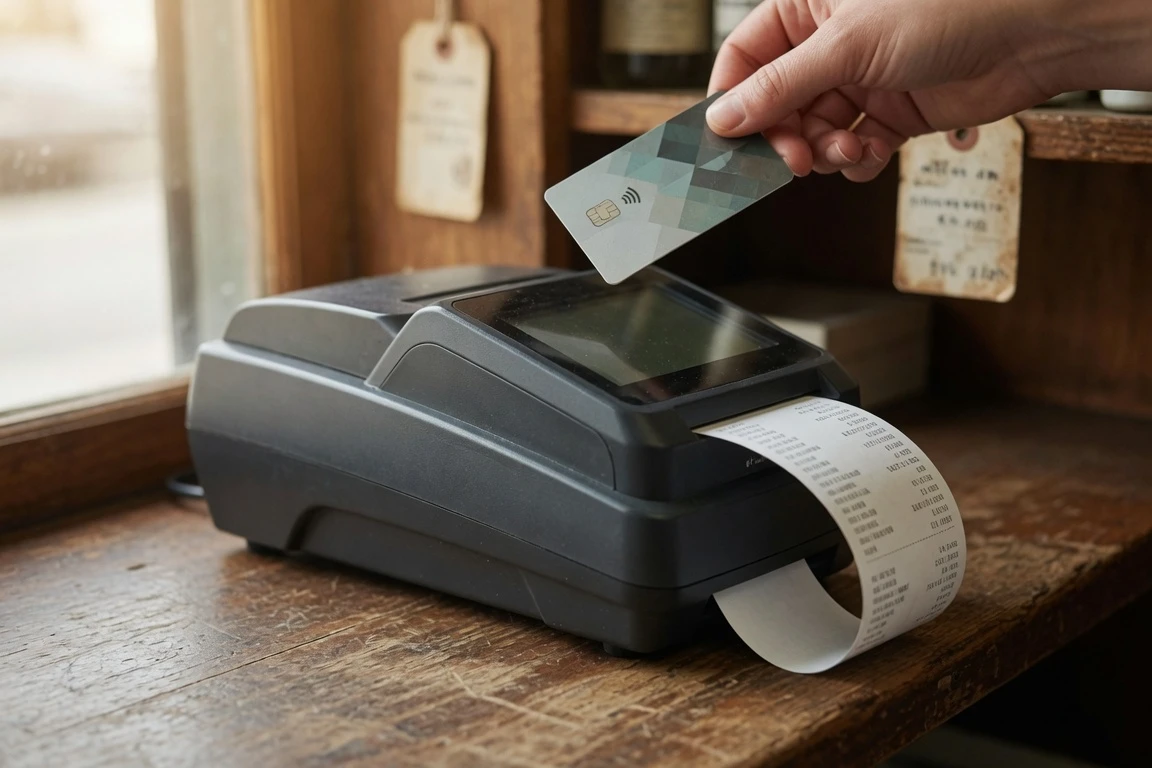
The draft introduces a universal cash register that will handle card payments, record cash and non-cash transactions, store data, and transmit it to the tax authority through a unified system. In place of the current patchwork, each business would rely on a single device at the till. That single device is the spine of the bill.
The explanatory note to the bill states that a single payment operation in business establishments is often currently recorded using several interconnected or separate devices, including various bank terminals. The initiators say this complicates both business operations and customer service. So the bill’s framing is that one box, run by one operator, is the simpler architecture for the country’s retailers. The device would replace the array of separate cash registers and terminals at every checkout.
The reform aims to ensure the Revenue Service receives full information on both cash and card transactions in real time. That real-time data feed is the bill’s other payload beyond the new device. The single operator model is the structural choice the bill locks in. The reform bundles three structural pieces into one draft law: a single device, a single operator, and a cap on card interchange fees. All three are in the same package, initiated in Parliament by six MPs.
- 0.3% maximum interchange fee for card transactions.
- January 1, 2027 start of registration of new universal cash registers.
- May 1, 2028 the date the new system becomes mandatory.
- 200 GEL fine for operating without a cash register or failing to use one.
Two Years to Switch Over
From January 1, 2027, only the new type of cash registers will be registered with the tax authority, the bill’s text says. Existing devices can stay in use during the transition. The transition period runs until May 1, 2028, after which the new system becomes mandatory. Businesses are not required to rip out their old hardware the day the law takes effect.
The cash register state registry will only register the new standard devices after 2027, with existing equipment to be gradually phased out. The bill’s six initiators are Paata Kvizhinadze, Irakli Kheladze, Bezhan Tsakadze, Zurab Rurua, Giorgi Barvenashvili, and Levan Machavariani, per GBC.ge. Penalties for businesses that operate without a cash register or fail to use one during customer transactions will be a 200 GEL fine, with the new standard cash registers becoming mandatory in 2028. The June 23, 2026 draft says the main provisions are due to take effect from January 1, 2027, with the mandatory requirements phased in through 2027 and 2028. The single-operator model that runs the new equipment will be selected by the Government of Georgia, GBC.ge reports, with the service fees and payment procedures to be determined at a later stage.
- January 1, 2027: New universal cash registers begin to be registered with the tax authority. Only compliant devices are accepted.
- January 2027 through May 2028: Transition window in which existing registered cash registers and terminals can still be used.
- May 1, 2028: The new system becomes mandatory for all businesses.
Who Runs the New Cash Registers
Centralised supply is one of the draft’s key provisions. A single company would handle supply and technical servicing of cash registers and e-commerce terminals. That single-operator model is the architecture the bill locks in.
The company would be picked by a government-appointed commission. The Revenue Service and the National Bank of Georgia will sit on that commission. The setup gives the tax authority and the central bank direct influence over who runs the country’s till hardware. The commission’s role is structural rather than operational.
Under the same arrangement, the company would also service e-commerce terminals. The law does not name the firm that will be selected. The selection process and the contract terms are still to be set.
The government will set the service fee and payment procedures through a separate decree. The price of using the device at the till is not in the draft law itself. That is a separate decision the government will make after the bill is in force. GBC.ge reports that the single operator, once selected by the Government of Georgia, will handle both the supply and the subsequent technical maintenance of the new equipment.
A 0.3% Ceiling on Card Fees
The same bill amends the Law on Payment Systems and Payment Services. The new ceiling binds every card transaction in the country, the draft text says.
The cap applies across the card network, the bill states. The reform also tightens the definition of what counts as interchange. The cap is part of the broader push to give the Revenue Service real-time information on cash and card transactions.
The cap is filed in the same legislative package as the universal cash register device. The next step is the separate government decree that will set the service fee and payment procedures for the new equipment.
The cap is a hard ceiling on the country’s card transactions, the explanatory note adds. The text ties the cap to the same Revenue Service data feed that the cash register device enables. The 0.3% figure is the binding number, not a target.
The cap and the device are the two biggest structural changes the draft introduces. Both pieces are part of the same legislative package the six MPs filed in Parliament.
- Maximum interchange fee of 0.3% for card transactions.
- Any equivalent charges are treated as part of the cap.
- Splitting or reclassifying fees to bypass the cap is prohibited.
The Markets Want a Longer Runway
The Union of Trade and Commercial Centers asked Parliament to postpone the cash register mandate for market traders until January 1, 2030, in a letter dated June 9, 2025. The Parliamentary Bureau referred the appeal to the Finance and Budget Committee on June 11. The letter, signed by the union’s chairman Mukhran Bagrationi, argues the mandate is misaligned with socio-economic realities on the ground.
The cash register requirement has technically been in place since 2005 but has never been enforced, the union noted, “raising serious questions about its practical applicability.” The union also flagged the people behind the stalls, many of them from vulnerable social groups including elderly individuals and those with limited education and financial resources.
Our appeal is aligned with the state’s broader fiscal goals, but we advocate for a phased and humane approach that respects the economic constraints of small traders.
Mukhran Bagrationi, chairman of the Union of Trade and Commercial Centers, signed the June 9, 2025 letter to Parliament. The union offered two options: postpone enforcement to 2030, or introduce a voluntary system, and pressed Parliament to review fines for non-compliance. The pushback came ahead of the current draft, which extends the market trader exemption to January 1, 2028, for individuals conducting economic activity at non-stationary trade locations within markets who do not employ hired labour.
The Penalties Already on the Books
Operating without a cash register, or failing to use one during customer transactions, will be a 200 GEL fine for business entities, GBC.ge reports. The new device, the centralised supply chain, and the cap on card interchange are the three structural pieces of the bill, in the broadcaster’s reading. Per GBC.ge, the core components of the legislative changes have already taken effect, with the mandatory requirements phased in incrementally through 2027 and 2028. The Revenue Service’s role in the procurement commission puts the tax authority at the centre of both the equipment and the data it produces. The transitional framework was set out in amendments authored and initiated by Paata Kvizhinadze, Irakli Kheladze, Bezhan Tsakadze, Zurab Rurua, Giorgi Barvenashvili, and Levan Machavariani.
The draft is explicit on what is still to be decided. The government will set the service fee and payment procedures through a separate decree. The price of using the new device at the till is not in the bill itself. The Markets union’s June 2025 request to push the market trader exemption to 2030 has not been addressed in the draft under discussion, leaving the next extension of the market carve-out a live question for the Finance and Budget Committee.
Frequently Asked Questions
When does Georgia’s new universal cash register take effect?
The main provisions of the Tax Code amendments are due to take effect on January 1, 2027, when only the new type of cash registers will be registered with the tax authority. The new system becomes mandatory for all businesses on May 1, 2028.
What does the universal cash register do?
It is a single device that handles card payments, records cash and non-cash transactions, stores the data, and transmits it to the tax authority through a unified system, replacing the separate cash registers and bank terminals businesses use today.
Why is a 0.3% interchange fee cap part of the same bill?
The same bill also amends the Law on Payment Systems and Payment Services, setting a maximum interchange fee of 0.3% for card transactions. The text treats any equivalent charges as part of the cap and prohibits splitting or reclassifying fees to bypass the ceiling.
Are market traders covered by the new rules?
The obligation for market traders to use cash registers was first introduced in 2019 and has been postponed several times, most recently to January 1, 2028. The current draft extends the market trader exemption to January 1, 2028, for individuals conducting economic activity at non-stationary trade locations within markets who do not employ hired labour.
What happens to businesses that don’t switch over by May 1, 2028?
Per GBC.ge, operating without a cash register or failing to use one during customer transactions will be a 200 GEL fine for business entities under the new framework.