Georgia’s wild pigs caught a break this spring from an unlikely place: the state’s own ledger. Georgia feral hog eradication funding lost roughly $1.2 million when Gov. Brian Kemp signed the $38.5 billion budget in May, using line-item vetoes to strike a $1 million public-private pilot program and a separate $200,000 eradication effort. A new law expanding drone-assisted hog hunting survived untouched.
That split tells you which tool Georgia is reaching for. The funded, coordinated programs that wildlife managers tend to favor went onto the cutting-room floor. The cheap option, a deregulation bill that hands hunters drones and waives license rules, is now on the books.
The Two Hog Programs That Died by Line-Item Veto
When the governor signed the spending plan, he highlighted some of the bigger reductions for reporters. He said nothing about the pig money buried deep in the 171-page document. Both hog items vanished with a stroke of the veto pen.
The first was a pilot project meant to pair public dollars with private operators to trap and remove feral swine. The second read, at least to one critic, like a bounty scheme. Nick Atwood, an Atlanta volunteer with a loose-knit group called Rooting for Pigs, took the $200,000 line to mean payments for dead hogs. His group wrote the governor’s office in mid-April to argue the idea would waste money.
Here is what the veto actually erased from the FY2027 plan:
- A $1 million pilot to manage feral hogs through a public-private partnership
- A $200,000 wild pig eradication program lawmakers had pushed, especially in the House
Atwood says he cannot prove his April letter swayed anything. He thinks it might have. Kemp’s office declined to engage on the specifics and pointed instead to the governor’s public comments at the May signing.
Kemp’s Billion-Dollar Hole and the Spending He Cut
The governor framed the whole exercise as cleanup. He said he had inherited a structural deficit that left a hole of roughly $1 billion in the budget, and that he could have ignored it but chose not to.
“So what we’re doing now is making some tough choices,” he told reporters who gathered in his office on May 12 to watch him sign the document. He said he did not want to leave “a mess” for whoever takes over as governor next year, or for the next Legislature. The hog programs were two casualties among hundreds of millions of dollars in new spending he trimmed.
The hog money was a House priority from the start. Rep. Matt Hatchett, R-Dublin, who chairs the House Appropriations Committee, made room for it when he walked colleagues through the $38.5 billion budget the House approved in March, alongside the heavyweight lines for education, health care and prisons. “Feral hogs are wreaking havoc statewide,” he said on the floor, “causing millions of dollars of damage to crops and farms each year.” The cut lands as the state also weighs income tax reductions against the same budget shortfall risk.
Drones Live On as the Eradication Cash Disappears
The funded programs died, but the legislative push against hogs did not. House Bill 946, signed in May, rewrites Georgia’s rules for chasing feral swine and costs the treasury nothing.
The bill cleared both chambers with almost no resistance, 163-1 in the House and 46-0 in the Senate. Before the Senate vote, Sen. Lee Anderson, R-Grovetown, kept it blunt. “I just ask each and every one of you vote green so we can go kill some hogs this afternoon,” he told the chamber.
The new rules loosen long-standing limits on how and when hunters can go after pigs:
- Drones may be flown to locate feral hogs, though arming a drone stays illegal
- Trapping no longer requires a license, as long as every captured hog is killed on site
- Hunters may shoot from a moving vehicle on private land
That approach leans on private landowners and hunters rather than a state-run removal crew. The federal experience suggests it has limits. The USDA’s national feral swine damage program, run by Animal and Plant Health Inspection Service (APHIS, the agency that manages invasive-species control), has spent more than a decade and over $100 million on coordinated trapping and aerial work to clear hogs from whole states.
Rooting for Pigs Makes the Case Against Bounties
Atwood’s group is small and easy to caricature, a handful of volunteers defending an animal most farmers want dead. His argument is narrower than affection, though. He points to research showing that paying people per carcass rarely thins a population for long.
Bounty programs have a poor track record across species, he says, whether the target is prairie dogs, raccoons or feral hogs. Hunters take the easy animals, the survivors breed back the loss, and the checks keep going out. It is a critique wildlife biologists have made for years, and it is partly why federal managers favor systematic trapping over piecemeal rewards.
Atwood also wants people to see the animal differently than the farm-damage headlines do.
Pigs are intelligent, curious, adaptable animals that are often misunderstood.
That is Atwood, describing wild hogs in roughly the terms a parent might use for a difficult teenager. The state’s farmers, looking at chewed-up fields, tend to land somewhere else. The intelligence and adaptability he praises are exactly what make the animal so hard, and so expensive, to control.
What 600,000 Wild Hogs Cost Georgia Each Year
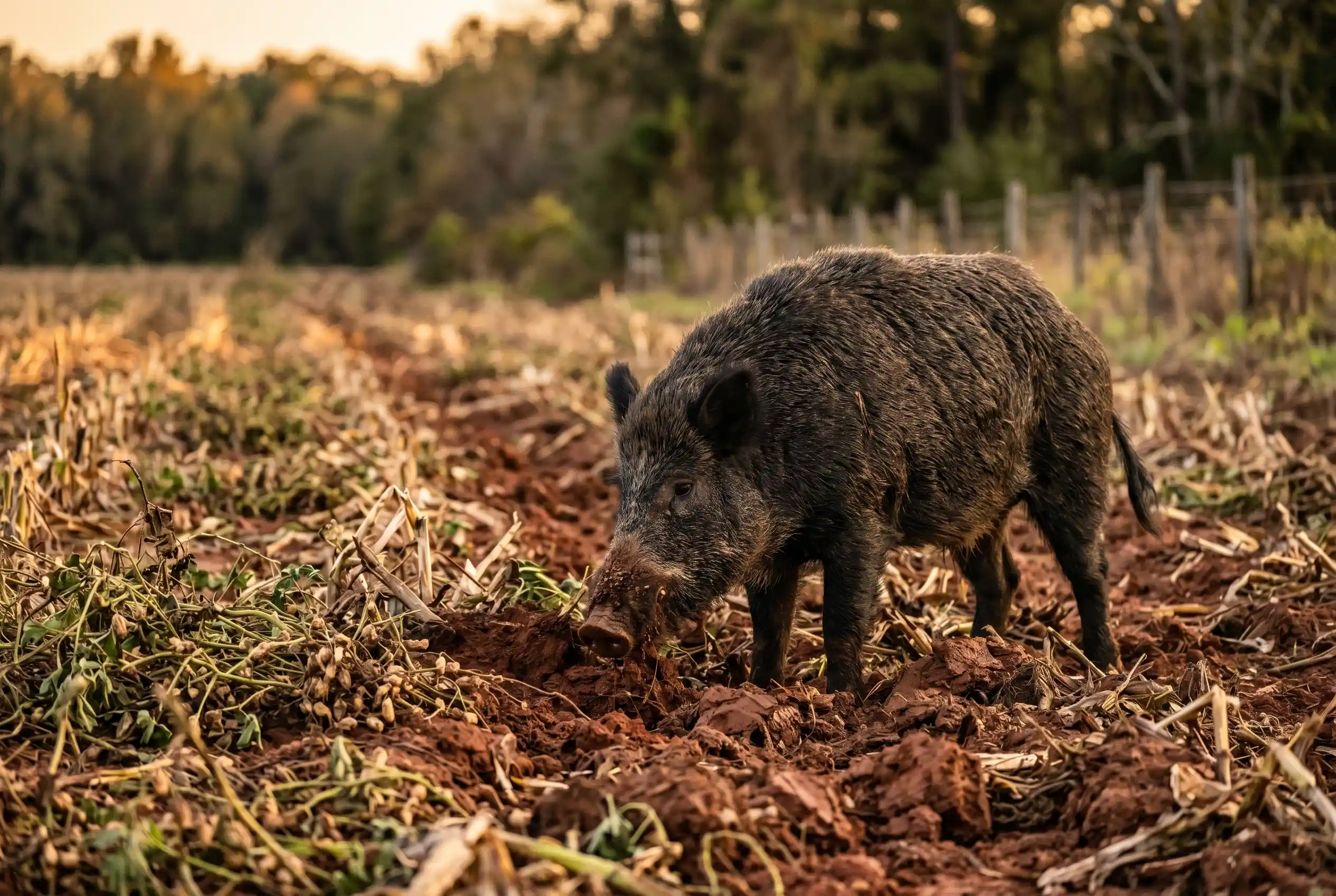
The damage numbers are why this fight exists at all. Georgia’s feral hog population sits at an estimated 600,000 animals, spread across all 159 counties, and the herd does an estimated $150 million in damage to the state’s farms each year. Hogs root up planted fields, foul water and tear through pasture overnight.
Zoom out and the scale gets worse. Feral swine occupy at least 35 states, number more than 6 million nationally and run up as much as $2.5 billion in agricultural damage a year, according to USDA estimates. The American Farm Bureau Federation tracks the price tag feral hogs put on farmers across the South in particular.
| Measure | Georgia | United States |
|---|---|---|
| Estimated feral hog population | ~600,000 | 6 million+ |
| Annual agricultural damage | ~$150 million | Up to $2.5 billion |
| Geographic spread | All 159 counties | 35+ states |
Against those totals, the vetoed $1.2 million was always a small bet. Georgia spent the session reaching for the free lever instead of the funded one, and the pigs that survived this budget will keep eating into next year’s.
Frequently Asked Questions
Can you hunt feral hogs with drones in Georgia now?
Yes, for locating them. House Bill 946 legalizes flying a drone to find feral hogs, but arming a drone remains illegal. The drone helps you spot the animals; the kill still has to come from a hunter on the ground or in a vehicle.
Do you need a license to trap feral hogs in Georgia?
Not anymore, under the new law, provided every captured hog is killed on site. The bill waived the previous trapping license requirement for that situation. A standard hunting license still applies in other cases except on your own private property.
What did Gov. Kemp actually veto for feral hogs?
He used line-item vetoes to remove two items from the FY2027 budget: a $1 million public-private pilot program to manage feral hogs and a $200,000 wild pig eradication program. Both were priorities for House lawmakers.
Why were the hog programs cut?
The governor said he was closing a structural deficit of roughly $1 billion and made what he called tough choices across the budget. The hog items were two of many spending lines he trimmed when he signed the plan in May.
How much damage do feral hogs cause in Georgia?
State officials estimate Georgia’s roughly 600,000 feral hogs cause more than $150 million in agricultural damage each year, part of a national problem the USDA pegs at up to $2.5 billion annually.