
BUSINESS
Savannah Starts a Fourth Harbor Study After Bigger Ships Arrive
Georgia Ports opened a fourth Savannah Harbor deepening study after 16,000-TEU ships began using a channel designed around 8,200-TEU vessels.

The Georgia Ports Authority opened a Savannah Harbor deepening study on June 2, 2026, after 16,000-TEU ships began using a channel built around 8,200-TEU vessels. Those ships already call the 47-foot river. The new work is meant to make that routine, and to guess the next class before another 20-year lag sets in.
GPA sent a letter of intent to Adam Telle, the assistant secretary of the Army for civil works, and will run the study with the U.S. Army Corps of Engineers under Section 203 of the Water Resources Development Act. Congress authorized the work in WRDA 2024 and seeded it with $500,000 in the fiscal 2026 budget.
Four Years After the 47-Foot Channel Opened
On March 25, 2022, Gov. Brian Kemp stood with Corps and port officials to mark the end of the Savannah Harbor Expansion Project. Dredging had started in September 2015. The first studies dated to 1997. GPA’s own completion notice said the new 47-foot channel at mean low water would give ample draft for 16,000-TEU vessels, with more hours in the day to move them.
A 7-foot tidal swing takes that water to 54 feet at high tide, and GPA said ships could load about 1,000 extra containers a trip. A Corps study cited at the ceremony put national benefits at $291 million a year, or about $7.70 for every dollar spent. Col. Joseph R. Geary, then the Savannah District commander, said the shipping gains, paired with a large remediation package, would support growth in the Southeast “for decades to come.”
Four years and two months later, the same port is back in the study queue, and the ships named in 2022 are the reason.
The shipping channel needs to be deepened and widened to better accommodate the largest ships currently serving Savannah, and to prepare for even larger, more efficient vessels expected to serve the U.S. East Coast.
Griff Lynch, Georgia Ports president and CEO, June 2, 2026
Lynch called the channel work “the next step” in a package that already includes five new container berths, the Gainesville Inland Port, and Georgia DOT road projects. Board chairman Alec Poitevint said the study is “a proactive step” to keep Savannah competitive. The ships, though, are not a future case. They are already on the berth.
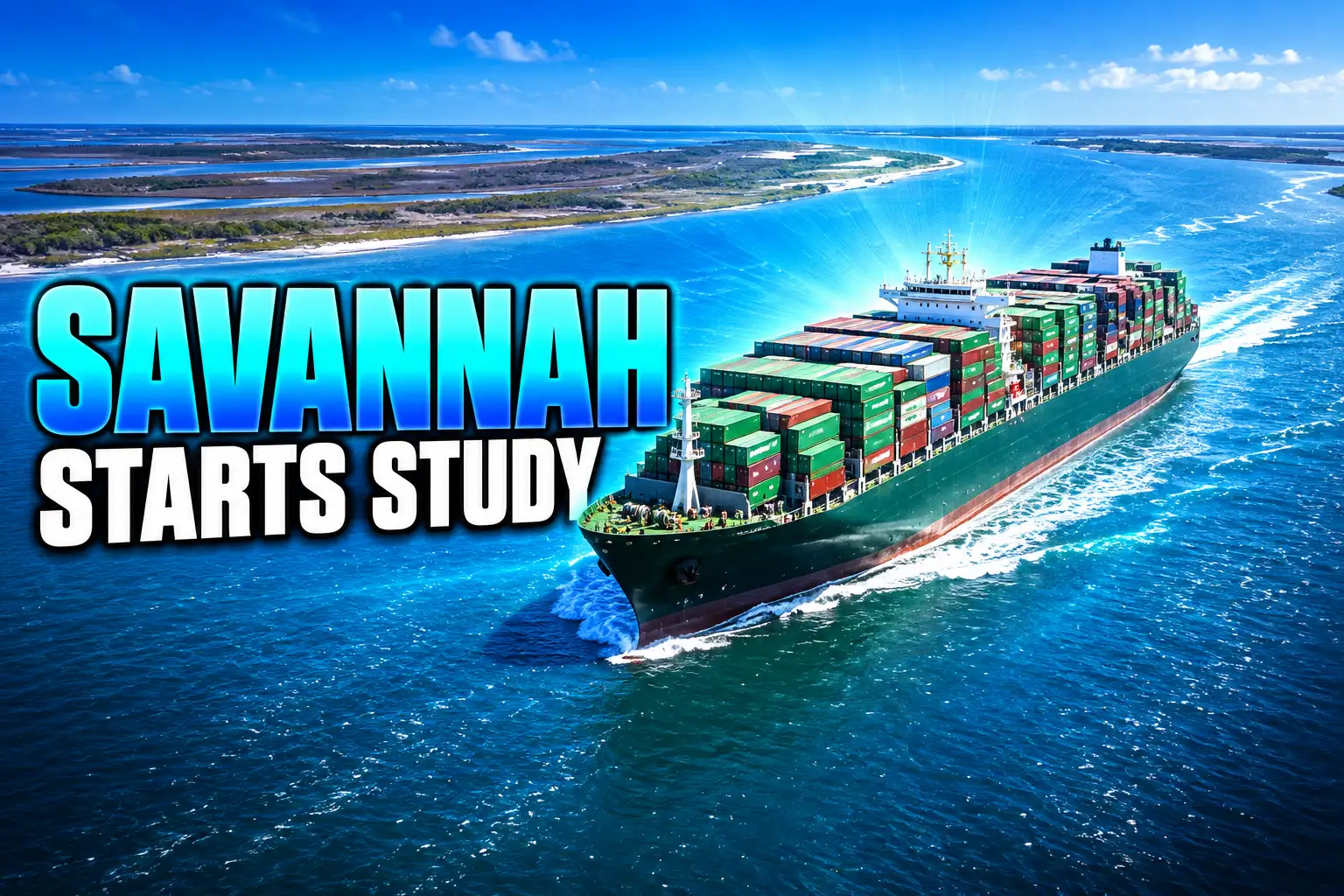
Twice the Ship Class the Channel Was Built For
GPA now says the port is serving vessels able to carry 16,000+ twenty-foot equivalent units, twice the size the channel is designed to handle. The original SHEP design treated 8,200-TEU ships as the East Coast workhorses. Federal reviews and construction pushed the project more than 20 years past that drawing, and the fleet did not wait.
THE SAVANNAH CHANNEL IN FIGURES
- Authorized depth: 47 feet at mean lower low water after the 2022 project, and 54 feet at high tide with the 7-foot swing.
- Design ship then: 8,200-TEU vessels were the class SHEP was drawn around.
- Ships calling now: 16,000+ TEU, which GPA calls twice the channel’s design size.
- Last project’s return: $291 million a year in national benefits, or $7.70 per dollar, per the Corps figures GPA cited in 2022.
Cargo has stayed heavy even without a deeper cut. GPA closed fiscal 2026, from July 1, 2025 through June 30, 2026, at 5.67 million TEUs, just under the 5.7 million moved in fiscal 2025. Calendar 2025 was the port’s second-busiest year, at nearly 5.7 million TEUs, up 146,000 or 2.6 percent from 2024, and still short of the 2022 peak of about 5.9 million. In 2025 the port worked 1,669 container ships and averaged 1,878 boxes on and off each one, with 40 weekly services by the authority’s October 2026 count.
A University of Georgia Terry College of Business study released Oct. 1, 2026, found Georgia’s ports support more than 605,000 jobs and $181 billion in annual sales, equal to 12 percent of state output. Mason Mega Rail moved 541,405 containers in fiscal 2026, 17 percent of Savannah’s box trade, and GPA counted about 15,000 truck gate moves a day. The channel is not the only bottleneck. It is the one that still runs on tide and traffic rules written for a smaller ship.
Passing Lanes Would Let Ships Pass Each Other
The study is not only about extra feet. GPA says it will look at widening stretches of the river so arriving and departing ships can move at the same time. A deeper hole helps a heavy ship on a low tide. Passing lanes help the next ship that is already in the channel.
Savannah’s federal channel is a long, relatively narrow run up the river to Garden City Terminal. Large vessels still work around one another and around the clock. Lynch said in 2022 that the 47-foot project was about cutting tidal waits and loading more cargo. The 2026 letter treats those same ships as the ones the river now has to process two at a time.
That is the quieter half of the job. A 16,000-TEU ship can already reach Savannah on the tide. It cannot share the ditch as if the river were a two-lane road. GPA’s $5 billion, 10-year plan adds five big-ship berths in Savannah, the most of any U.S. container port on the authority’s count, and the board has approved $4.13 billion of infrastructure over the past 10 years. More steel on the dock does not help if inbound and outbound mega-ships still take turns in the cut.
1945, 1994 and 2022 Set the Pattern
GPA lists three navigation deepenings on the Savannah River before this study. Each one raised the floor a few feet. Each one was overtaken by a larger common ship.
THE HARBOR’S DEEPENING RECORD
- 1945: The channel is dredged to 38 feet.
- 1994: The river is taken to 42 feet.
- 1997: Corps feasibility work begins on a further deepening that becomes SHEP.
- September 2015: Dredging starts on the 47-foot project.
- March 25, 2022: GPA, the Corps, and the state mark SHEP complete at 47 feet.
- June 2, 2026: GPA issues a letter of intent for a fourth-deepening study, including passing lanes.
The last round was sold as a long-life upgrade. It did what it was built to do, which is why the next round is here so soon. Ships that needed 47 feet showed up, filled the berths, and then kept getting bigger. The study’s first technical task is to name the next design vessel before anyone orders a dredge.
The New Study Must Pick a Design Ship First
Section 203 lets a non-federal sponsor, here GPA, write a feasibility study and send it to the Army instead of waiting in the Corps’ own study queue. The Corps still gives technical help and keeps final review, including the environmental and economic chapters. Army rules give the secretary 180 days after a finished 203 study lands to tell Congress whether the project is feasible. Separate from that track, feasibility studies typically cost-shared with sponsors on the Corps-led path run 50-50 after a small federal stake, which is the process GPA is trying to shorten by doing the writing itself.
Port officials have put the full study in the $8 million to $10 million range and said they want it done in two years. The $500,000 in the fiscal 2026 budget is only the start. GPA says the work will test market demand, pick a design ship class, then measure what that class would do to the estuary and what it would return to the country.
WHAT THE FEASIBILITY STUDY WILL TEST
- Design vessel: Which ship class will be most common in Savannah, then size the channel to that ship.
- Depth and width: How much extra water, and where passing lanes would let two large ships transit at once.
- Estuary effects: What the next cut would do to salinity, habitat, and the mitigation systems already in the river.
- National benefits: Whether a new project clears the Corps’ economic test the way SHEP’s $7.70-to-$1 case did.
When the study is done, the Corps recommends to Congress whether to expand the harbor. Construction would still need a fresh authorization and a split of federal and state money. Poitevint told a May 2026 board audience that GPA had “just been through this process” and wanted to push the next one along. Lynch said no other U.S. port had a capacity plan like Savannah’s, and that the Southeast would be the fastest-growing slice of the country.
East Coast Harbors Savannah Has to Match
Savannah is not deepening into empty water. After the Panama Canal expansion, East Coast ports spent a decade chasing a deeper hole, and several of them finished ahead of 47 feet. A transport-geography compilation of major North American channels lists East Coast harbors that already reach 50 feet, with Charleston at 52 feet.
EAST COAST CHANNEL DEPTHS
| Port | Channel depth | Year cited |
|---|---|---|
| Charleston | 52 feet | 2022 |
| New York | 50 feet | 2016 |
| Miami | 50 feet | 2014 |
| Norfolk / Hampton Roads | 50 feet | Listed at 50 |
| Baltimore | 50 feet | Listed at 50 |
| Mobile | 50 feet | 2025 |
| Savannah | 47 feet | 2022 |
| Houston | 46.5 feet | 2025 |
The same compilation notes that ships above 10,000 TEUs generally need about 50 feet of water when fully loaded. Savannah already works 16,000-TEU ships because of tide, not because the authorized cut matches that rule of thumb. Charleston’s 52-foot channel, finished the same year as SHEP, is the comparison GPA’s customers can make without a briefing book. The 2026 study has drawn little public argument so far. The last deepening did, and the competitive gap with 50- and 52-foot harbors is the part of that fight that never closed.
The Last Project Put About Half Its Money Into Mitigation
The Corps deepened the federal channel to 47 feet only after a long environmental review with the EPA, the U.S. Fish and Wildlife Service, and the National Marine Fisheries Service. Corps figures put SHEP near $973 million, and mitigation took about half. The Savannah District still lists the project in post-construction environmental monitoring and flags it as separate from GPA’s 2026 study.
SHEP MITIGATION BUILT WITH THE LAST CUT
- Dissolved oxygen: A system installed to offset lower oxygen in a deeper, saltier river.
- Freshwater flow: Upper-harbor water rerouted to hold back the salt line.
- Wetlands: 2,245 acres preserved for the Savannah National Wildlife Refuge.
- Fish passage: A bypass at the New Savannah Bluff Lock and Dam, plus recovery of the ironclad CSS Georgia from the riverbed.
Those features exist because a deeper Savannah River pushes salt farther upstream, which is the same physical problem a fourth cut would reopen. Coastal pumping from the Floridan aquifer has already created a cone of depression around Savannah and Hilton Head, and the city has been shifting wells and building surface-water capacity to slow saltwater intrusion. GPA has not published a target depth for the new study. The letter of intent leaves that to the design-ship step, which is also where the next oxygen, wetland, and aquifer arguments will be fought.
If the Corps later backs a project, Congress still has to authorize it and both sides have to fund it. Port officials have described a construction period that could run 8 to 10 years after the paper is done. The 2022 channel was supposed to last for decades. The ships it invited are why Savannah is studying the fourth dredge before the third one has aged out.

Greed Held After a $697 Million Crypto Long Flush

Fed Minutes Keep a Year-End Rate Hike Alive

A Nanny-Cam Tape Follows Tyreek Hill Into Free Agency

Star Wars Galactic Racer Makes a Crash End the Tour

Amazon Puts Apple’s June MacBook Prices Back on Sale

The iPhone 16 Pro Flipkart Cut Did Not Last

Sophia Wootten Turns the Miss Georgia Crown Toward Cleft Care

Georgia Beach Bacteria List Leaves Swim Areas Open

Microsoft Prints Azure’s $29.42 Billion Quarter and Shrinks the Map

UltraTech’s Ultravolt Launch Puts Cable Multiples on Trial
-
 NEWS1 year ago
The iPhone 16 Pro Flipkart Cut Did Not Last
-
 ENTERTAINMENT4 months ago
Sophia Wootten Turns the Miss Georgia Crown Toward Cleft Care
-
 NEWS4 months ago
Georgia Beach Bacteria List Leaves Swim Areas Open
-
 BUSINESS1 month ago
UltraTech’s Ultravolt Launch Puts Cable Multiples on Trial
-
 NEWS1 month ago
Microsoft Prints Azure’s $29.42 Billion Quarter and Shrinks the Map
-

 NEWS9 months ago
IXI Autofocus Glasses Still Lack a European CE Mark
-

 NEWS3 months ago
Little St. Simons Island Hatches Loggerheads at 72.4 Percent
-

 BUSINESS3 months ago
Georgia Furniture Mart Closes a Growing 40-Year Business