A new study has pushed back the earliest evidence of hominin fire use. Researchers analyzing tiny, burnt bones from Wonderwerk Cave in South Africa report signs of fire between 1.07 and 1.79 million years ago, putting the chamber’s deep interior into the running for the oldest known record of intentional fire use associated with the genus Homo. The work, published June 1, 2026 in PLOS One by an international team led by Spain’s National Museum of Natural Sciences and the University of Toronto, rests on a new non-destructive method for spotting the faint glow of heat-altered fossils.
The finding extends the previous Wonderwerk benchmark, set in a shallower layer of the same cave and dated to roughly one million years ago, into a far older stretch of the Early Pleistocene. Cave sediments at the site now record hominin activity stretching across close to two million years.
What the Burned Bones Reveal
The team, led by M. Dolores Marin-Monfort of the National Museum of Natural Sciences in Madrid, examined 161 fossilized bones from small mammals recovered from two Early Pleistocene layers of Wonderwerk Cave, an analysis detailed in the open-access Marin-Monfort et al fire study at Wonderwerk Cave. Most of the bones had originally entered the cave inside barn owl pellets, dense clumps of fur, teeth, and bone that owls regurgitate after digesting their prey. Over nearly two million years of owl occupation, those pellets built up a thick, fur-rich carpet on the cave floor. That carpet, the authors argue, served as tinder for fires brought in from outside.
By the numbers:
- 161 fossilized small mammal bones analyzed from Strata 10 and 11
- 30 meters from the current cave entrance to the burnt deposit
- 1.07 to 1.79 million years: the age range for Stratum 11
- 2 Early Pleistocene layers examined, with burning in both
- ~2 million years of owl occupation leaving pellets in the cave
In Stratum 11, every white and gray fossil bone the team tested showed evidence of heating. The clusters of burnt bones were unevenly spaced, with discrete patches of charred material separated by stretches of unburnt sediment, a pattern the authors read as repeated, intentionally placed fires rather than a single, accidental burn. The finds sat alongside Acheulean stone tools and the remains of larger animals, anchoring the small bones to a hominin presence at the cave.
The age for that occupation comes from two independent dating techniques. The team used magnetostratigraphy, which matches the magnetic polarity of the sediments to known reversals in Earth’s magnetic field, together with cosmogenic burial dating, which measures how long mineral grains have been shielded from cosmic rays. Together, the two methods bracket Stratum 11 to a window of 1.07 to 1.79 million years, and the faunal biochronology points toward the older end of that range. The lower layer sits within a reversed-polarity zone between the Jaramillo and Olduvai subchrons, two well-known geomagnetic reversal boundaries that help geologists pin dates to the Early Pleistocene. The cave’s coordinates, 27 degrees 50 minutes south and 23 degrees 33 minutes east, place it in the Northern Cape, 60 kilometers south of the town of Kuruman.
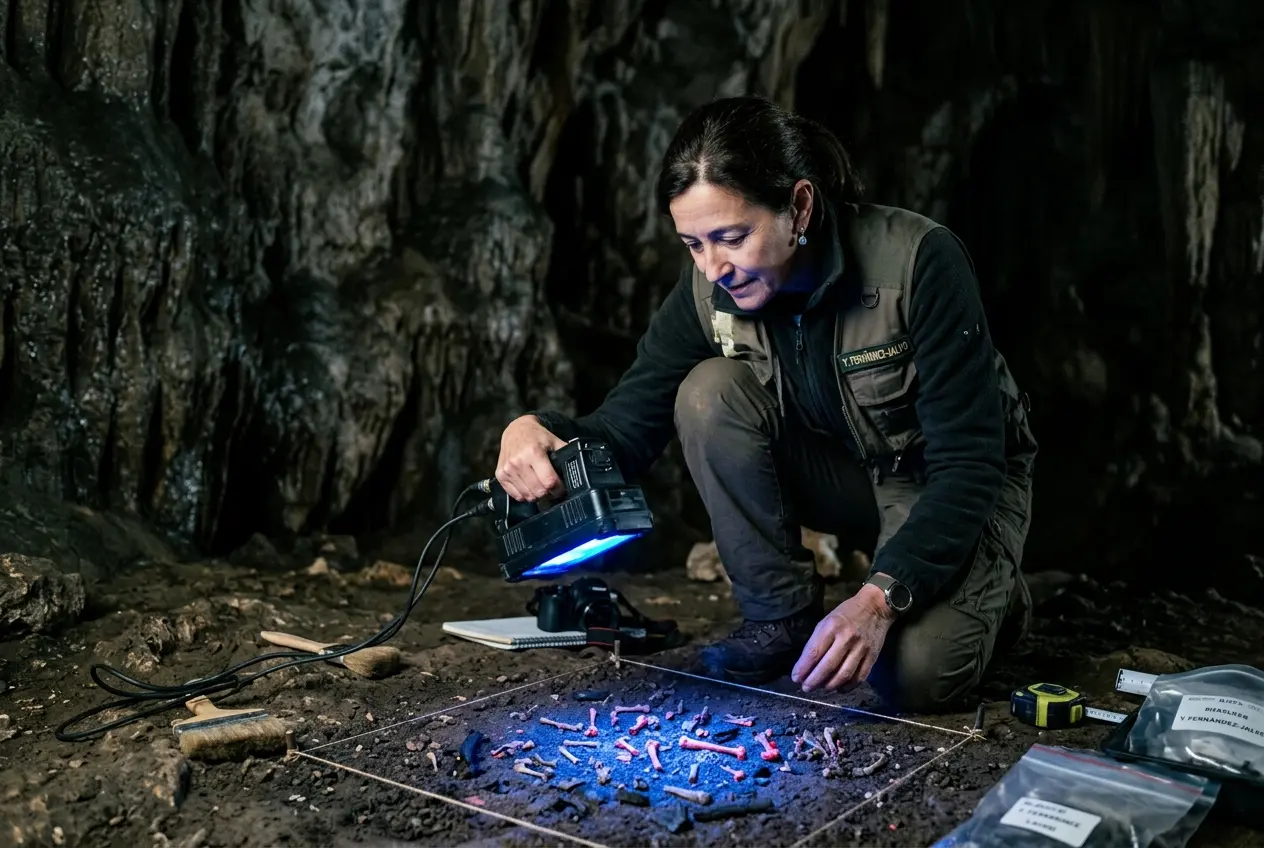
A New Way to Spot Fire in Deep Time
The new evidence rests on a method built on bone luminescence, the way burnt mineral glows under a specific light. When illuminated with a narrow band of blue light at 455 nanometers and viewed through a long-pass red filter, bones that have been exposed to fire emit a faint but distinct red glow, while unburnt bones do not.
The methodology we have developed allows us to distinguish burnt fossils from those that have undergone chemical alterations during fossilization, such as fluoridation or manganese deposition, which can visually mimic the effects of fire. We have improved the resolution with which we can identify burned fossils in very ancient contexts.
Fernández-Jalvo, a researcher at the National Museum of Natural Sciences in Madrid and a co-author of the study, made the comment in the institutional press release. Her team validated the optical results against Fourier-transform infrared spectroscopy, a standard technique for detecting heat-induced structural change in fossil bone. The two methods agreed on the burnt bones from both Stratum 10 and Stratum 11, and the team used that agreement to validate the new protocol on older, more deeply buried material.
Why 30 Meters Inside Rules Out Wildfire
The burnt bones came from deposits at least 30 meters from the cave entrance, a depth the authors use to rule out the obvious alternative explanation. Natural grass fires and bushfires, common in the surrounding savanna biome, do not reach that far into a cave. Lightning strikes might start blazes outside, but their flames cannot travel 30 meters down a passage and then leave neatly scattered patches of burnt micromammal bones on the floor. The location of the damage is the location of whoever carried it in, and the most likely candidates, given the stone tools, are Homo erectus populations.
The team proposes that those hominins took seasonal wildfires from outside and laid them on the carpet of owl pellets. The fur and bone inside the pellets would have smoldered like tinder, holding the fire in a tight spot without spreading it across the cave. Burnt remains appear in multiple stratigraphic levels, separated by tens of thousands of years, which the authors read as evidence of repeated, deliberate placement rather than a one-off accident.
The researchers also tested whether the bones could have been stained black by mineral deposits rather than fire, and showed that fluoridation and manganese staining do not produce the same luminescence signature as genuine burning. The depth of the deposit, the clustering of the damage, and the absence of a credible natural fire source together form the case for human involvement.
Where Wonderwerk Fits in the Fire Timeline
The new date slots into a longer list of contested early fire sites, most of them in Africa. Wonderwerk itself has been central to that debate for years, and the broader Wonderwerk Cave site history and archaeology stretches back to the 1940s. The new finding places fire at 1.07 to 1.79 million years at the same cave, which had previously yielded burnt material dated to roughly one million years at its Stratum 10, where Francesco Berna and colleagues had documented wood ash, burned large-mammal bone, scorched sediment, and heat-fractured stone tools. Other Early and Middle Pleistocene localities in Africa, including Koobi Fora in Kenya at around 1.5 million years and Swartkrans Cave’s Member 3 in South Africa at 1.0 to 1.5 million years, have produced burnt bones or lithics, though in some cases the assemblages sit in secondary contexts and could reflect open-air wildfire activity.
- ~1.79 Ma: Wonderwerk Cave, Stratum 11, South Africa (new evidence, Marin-Monfort et al., 2026)
- ~1.5 Ma: Koobi Fora, Kenya (open-air, natural fire possible)
- ~1.0 to 1.5 Ma: Swartkrans Cave, Member 3, South Africa (in secondary context)
- ~1.0 Ma: Wonderwerk Cave, Stratum 10, South Africa (prior benchmark, Berna et al.)
- ~0.8 Ma: Gesher Benot Ya’aqov, Israel (earliest evidence of fire control / hearths)
The earliest widely accepted evidence for fire control, meaning the repeated use of the same combustion areas over time rather than opportunistic harvesting, sits outside Africa. At Gesher Benot Ya’aqov in Israel, dated to around 0.8 million years, the excavation team described dense patches of repeated burning that they read as deliberate fire management, in the form of hearths. That site remains the benchmark for fire control in the strict sense, and the new Wonderwerk dates do not displace it.
The Wonderwerk dates place the same pattern of burnt material in older, deeper sediment, pushing the line for opportunistic fire use deeper into the Early Pleistocene. Earlier work at Stratum 10, where the bones, ash, and stone tools were all in the same layer, was the basis for the previous benchmark of one million years. The new Stratum 11 evidence, in which the burnt material sits in the same context as Acheulean stone tools, repeats the pattern of fire use seen in the shallower layer. The bones in both layers show fire use, the harvesting and maintenance of natural conflagrations, rather than fire control in the strict sense, the deliberate construction and tending of a hearth. The burnt material is clustered in discrete spots in both layers, a pattern the team reads as repeated placement.
The paper itself frames the new evidence cautiously, with the authors noting that the findings push back the appearance of fire associated with hominins to between 1.07 and 1.79 million years and confirm burnt microfauna at Stratum 11. The push back is in the date, not in the kind of activity, and the authors are careful to keep the two questions separate. The next step, the paper suggests, is to apply the bone luminescence method to other Early Pleistocene sites where burnt material has long been suspected but could not be confirmed.
What the Study Does Not Show
The paper stops short of claiming that Homo erectus knew how to make fire. The dominant interpretation is that the early inhabitants of Wonderwerk harvested natural conflagrations, lightning strikes or seasonal bushfires, and carried embers into the cave, the way many ethnographic hunter-gatherer groups are known to have done more recently. The owl-pellet carpet is the missing piece, since it gave a smoldering ember something to land on without spreading. The fire did not spread, but burnt only where it was placed among the pellets, leaving the unevenly spaced spots of charred micromammal bones that the team mapped in Stratum 11.
Independent expert commentary on the fire interpretation has gone further, questioning whether the fires inside the cave were human-lit at all. The strongest argument for human involvement, that commentator notes, is the depth of the deposits, beyond the reach of any natural wildfire, but that argument is also the only argument.
Fire was not a one-time occurrence because it appears in different stratigraphic layers, separated by tens of thousands of years, which reinforces the idea that they already knew how to transport and maintain fire in protected spaces.
Fernández-Jalvo, the lead taphonomist on the project, made the point in the institutional press release announcing the study. Co-author Michael Chazan of the University of Toronto added that the Stratum 11 context, with no food bones in the assemblage, eliminates the ambiguity sometimes present in burnt bone from hominin meals and points to opportunistic use of fire. The next test is whether the same signal, fire on a fur-rich owl-pellet carpet deep inside a cave, shows up at other Early Pleistocene sites across Africa.
A Method That Could Redraw Other Sites
The luminescence protocol itself may matter more in the long run than the Wonderwerk date. Lead author M. Dolores Marin-Monfort has called the technique fast, non-destructive, and applicable directly to field excavations and to museum collections, opening the possibility of re-examining sites where burning was suspected but could not be confirmed by FTIR alone.
Co-director Liora K. Horwitz, of the Hebrew University of Jerusalem, framed the work as a methodological step the field can build on. Wonderwerk has been part of the early-fire conversation for decades, and the combination of a portable detection method, a deep cave interior, and a fur-rich owl-pellet carpet is, in the words of the lead taphonomist, a very subtle fire. Future work, the authors suggest, will test whether the same signal shows up elsewhere in the Early Pleistocene, and whether the burning of owl pellets was a Wonderwerk quirk or a habit of the broader Homo erectus range. In the meantime, the Wonderwerk record places the first strong case for fire inside a deep cave at the same time Homo erectus was spreading across Africa and into Eurasia.