The World Health Organization’s Global Status Report on Cancer 2026, released on 8 July, projects that annual cancer cases will rise to nearly 35 million by 2050 unless governments move faster on prevention, screening, and access to treatment. The report warns of a future in which the disease’s reach nearly doubles from today’s levels while the gap between rich and poor countries in who survives keeps widening.
Cancer already kills more than 26,000 people a day. An estimated 20.6 million new cases and close to 10 million deaths occur each year, leaving cancer as the second leading cause of death worldwide after cardiovascular disease. Without urgent action, the report says, annual cancer cases are projected to rise to nearly 35 million by 2050.
The 35 Million Trajectory
Nearly 35 million new cancer cases a year by 2050 is the headline projection from the WHO Global Status Report on Cancer 2026. The figure sits inside a decade-long climb the report traces in detail.
Today, the disease kills more than 26,000 people a day. An estimated 20.6 million new cases and close to 10 million deaths are recorded annually, leaving cancer as the second leading cause of death worldwide after cardiovascular disease. The 2050 figure is what those numbers look like if present policies hold.
“Without urgent action,” the report says, “annual cancer cases are projected to rise to nearly 35 million by 2050.” The choice of words is deliberate. The projection is conditional on the response, not a forecast of inevitability. The next sentence ties the projection to the rest of the report: “Reversing this trend will require a fundamental shift towards a people-centred approach.”
Most of the added burden falls on cancers that prevention can already reach. Lung, prostate, and colorectal cancers are among the most common in men; breast, lung, and colorectal cancers drive a large share of the burden in women. Tools exist for most of those, the report notes, including vaccines, screening, and treatment, but uptake and access remain uneven across the world.
Where Someone Is Born Still Decides Whether They Survive
The clearest warning in the report is not the projection; it is the survival gap. The data behind the warning begins where prevention and treatment differ most: five years after a breast cancer diagnosis. The figure in high-income countries runs far ahead of the figure in low-income countries. The shared task at both ends is the same: keep more patients alive for longer. The shared problem is access, and fewer than one in three countries currently include cancer care in their universal health coverage packages.
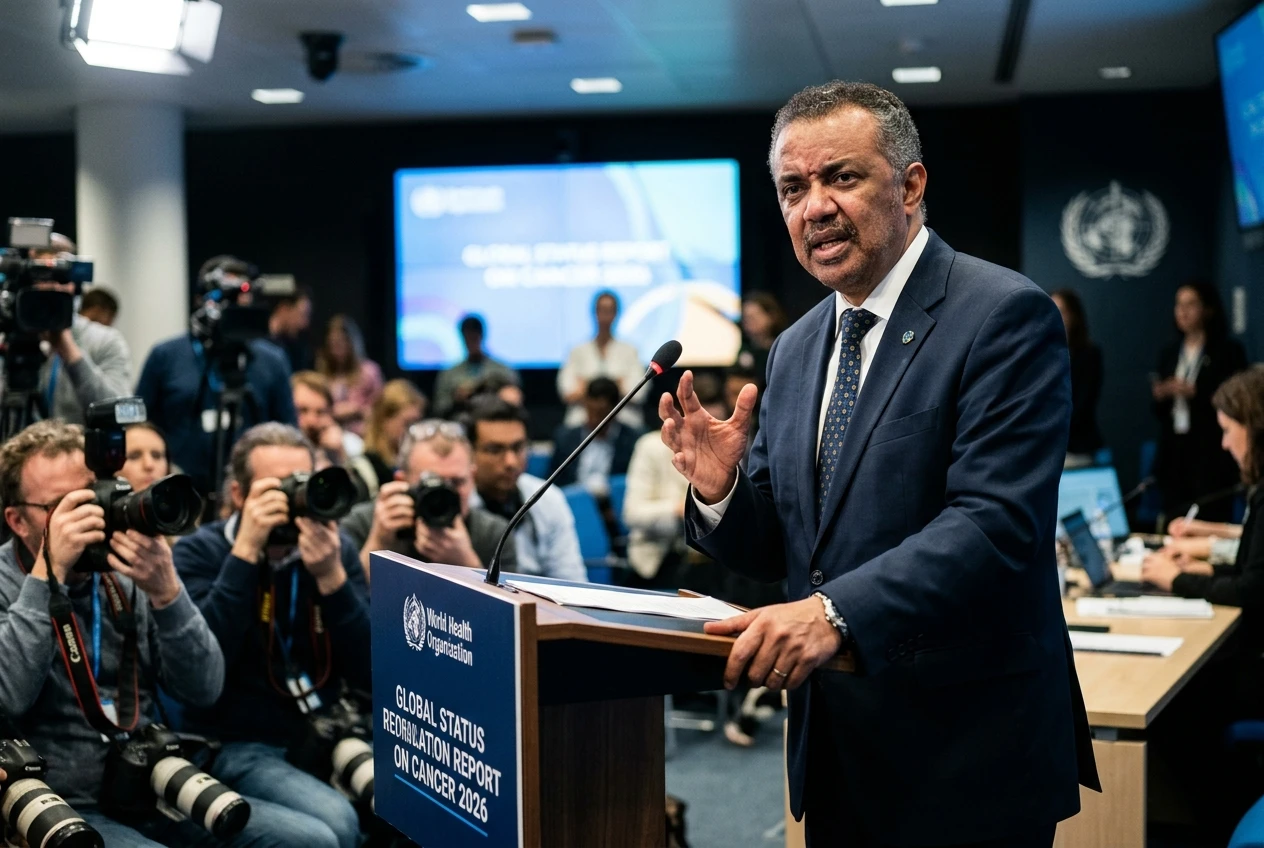
Cancer is a deeply personal disease that touches nearly all of us. But whether a person survives cancer should never depend on where they were born or what they earn. The inequities documented in this report are not inevitable; they are the consequence of choices, and they can be reversed through stronger and unified action.
WHO Director-General Dr Tedros Adhanom Ghebreyesus, at the report launch.
The report traces the gap across the cancer care pathway, from screening to follow-up. On the high end, it points to functional health systems with screening programmes, hospital capacity, and a steady supply of priority medicines. On the low end, it lists missing screening, broken medicine supply chains, and out-of-pocket costs that stop families from starting treatment. Closing the gap, the report argues, comes down to coverage decisions made by ministries of health.
- Five-year breast cancer survival: 87% in high-income countries; about 42% in low-income countries.
- Countries that include cancer care in universal health coverage packages: fewer than 1 in 3.
- Top 20 priority cancer medicines: 9% to 54% availability in low- and lower-middle-income countries; 68% to 94% in high-income countries.
- People affected by cancer reporting financial hardship: at least 45%.
- Registered clinical trials annual growth rate, 2005 to 2021: 7.3%.
How the Cancer Burden Splits Across Regions
Geography is part of the report’s case. The distribution it draws shows where the disease lands hardest. The same data sets up the survival gap and the projection.
The projection is global, but the burden is not evenly distributed. In 2024, the most recent year the report draws on, Asia carried more than half of all cancer cases (50.7%) and a higher share of deaths (56.5%).
| Region | Cases in 2024 | Deaths in 2024 | Context |
|---|---|---|---|
| Asia | 50.7% | 56.5% | Largest share of cases and deaths worldwide. |
| Europe | 21% | 20% | Region holds about 9% of world population. |
| Many countries in Africa and parts of Asia | Lower incidence | Higher mortality | Diagnoses below the global average; outcomes worse. |
Asia’s share of cases reflects its population weight, but its share of deaths runs higher than its share of cases. Europe’s profile looks different. Europe accounts for 21% of cases and 20% of deaths while holding about 9% of the world’s population, a disproportionately high burden carried by a much smaller share of humanity. Many countries in Africa and parts of Asia see fewer diagnoses than the world average but a mortality rate that runs ahead of their incidence.
Lung cancer remains the leading cause of cancer death globally. Among men, lung, prostate, and colorectal cancers drive the most cases; in women, breast, lung, and colorectal cancers account for a substantial share of the burden. In 2024, an estimated 2.4 million women were diagnosed with breast cancer worldwide and 694,000 died of it, a baseline against which the report sets the equity gap.
The Hidden Financial and Mental Toll
Behind every regional number is a household. WHO’s first-ever survey of people affected by cancer, conducted for the report, surfaces a layer of harm that does not show up in incidence or mortality counts. At least 45% of those surveyed said they had experienced financial hardship because of the disease. More than half reported mental health challenges.
Caregivers fared worse. Nearly all of them reported strain: unpaid services, lost work, and social isolation. The burden is not felt equally, the survey found, and it does not stop when treatment does.
The patient experience, the survey finds, runs beyond medicine alone. Clarissa Schilstra, a childhood cancer survivor who led parts of the WHO survey, said the diagnosis touches every part of life and never fully ends. Her account has become part of the agency’s case for treating cancer as a social and economic issue. The financial and mental numbers are especially severe where treatment is least available.
Why Prevention Could Catch Nearly Four in Ten Cases
WHO estimates that nearly four in ten cancer cases globally are linked to preventable risk factors. The list reads like a public-health checklist: infections such as human papillomavirus, hepatitis B and C, and helicobacter pylori; alcohol and tobacco use; high body mass index; and insufficient physical activity. Independent research has begun to narrow what counts as safe: a study linking low alcohol intake to oral cancer risk in Indian men, published in BMJ Global Health in late 2025, challenges the idea of a safe drinking threshold.
While we are seeing reductions in some cancer rates in countries that have implemented prevention policies, progress has been too slow. The cancer profile is evolving, increasingly driven by rising rates of obesity, physical inactivity, unhealthy diets, and air pollution. Cancer prevention must remain a political priority.
Dr Elisabete Weiderpass, the Director of the International Agency for Research on Cancer, made those remarks at the report launch. Weiderpass’s IARC produced much of the underlying data in the report. The report itself records a few policy gains that complicate the urgency. Tobacco use has dropped 27% globally since 2010, and that drop is starting to show up as lower lung-cancer incidence in some regions. Vaccination has cut infection-linked cancers, and the share of countries with national cancer control plans has climbed from 50% in 2010 to 82% now.
What the Report Asks Countries to Change Now
The prescription arrives as three strategic shifts and seven recommendations, written for delivery across governments, international organisations, civil society, and the private sector. The full case, including the link between the report’s equity data and the recommendations, is laid out in the news release on the report’s findings. The seven recommendations are addressed to ministries of health, finance, and trade as a package, not to any one body alone.
- Better capabilities: integrate cancer control into universal health coverage and invest in human capital.
- Better protections: put people with lived experience at the centre of cancer systems, with stronger social protection.
- Better value: align research and innovation with public health needs and ensure equitable access to advances in care.
The first shift, on capabilities, is the one the report frames as the foundation. National cancer control plans are already widespread; the report counts 82% of countries with one, up from 50% in 2010. Capability, in this framing, is what it takes to turn a written plan into a working screening programme, a stocked pharmacy, and a trained workforce. The other two shifts, on protections and value, depend on it.
Scientific innovation is moving fast in some directions. Registered clinical trials grew at an annual rate of 7.3% between 2005 and 2021, the report notes. Cancer prevention must remain a political priority, the IARC’s director said, and the world’s response will be measured by how many patients reach the treatments those studies describe.
Frequently Asked Questions
How many cancer cases does the World Health Organization project globally by 2050?
The World Health Organization projects nearly 35 million new cancer cases per year by 2050. The figure comes from the Global Status Report on Cancer 2026, developed jointly with the International Agency for Research on Cancer, and represents a projected rise from today’s 20.6 million new cases annually. The underlying estimates cover 36 cancer types across 186 countries and territories.
Why is breast cancer survival lower in low-income countries?
The report points to access rather than biology. Five-year survival after a breast cancer diagnosis is 87% in high-income countries and about 42% in low-income ones, a gap the report attributes to differences in screening, surgery, radiotherapy, and the supply of priority cancer medicines. WHO Director-General Dr Tedros Adhanom Ghebreyesus has called such inequities the consequence of choices that can be reversed.
What proportion of cancer cases are preventable?
WHO estimates that nearly four in ten cancer cases globally are linked to risk factors that prevention already reaches. The list includes tobacco and alcohol use, infections such as HPV and hepatitis B and C, high body mass index, and insufficient physical activity. Tobacco use has dropped 27% globally since 2010, the report notes, and that drop is starting to show up as lower lung-cancer incidence in some regions.
When was the WHO Global Status Report on Cancer 2026 released?
WHO released the report on 8 July 2026. It was developed jointly with the International Agency for Research on Cancer and covers 36 cancer types across 186 countries and territories.
Disclaimer: This article is for informational purposes only and does not constitute medical advice. Figures and projections cited reflect World Health Organization publications as of 8 July 2026. For personal health decisions, consult a qualified healthcare professional in your country.