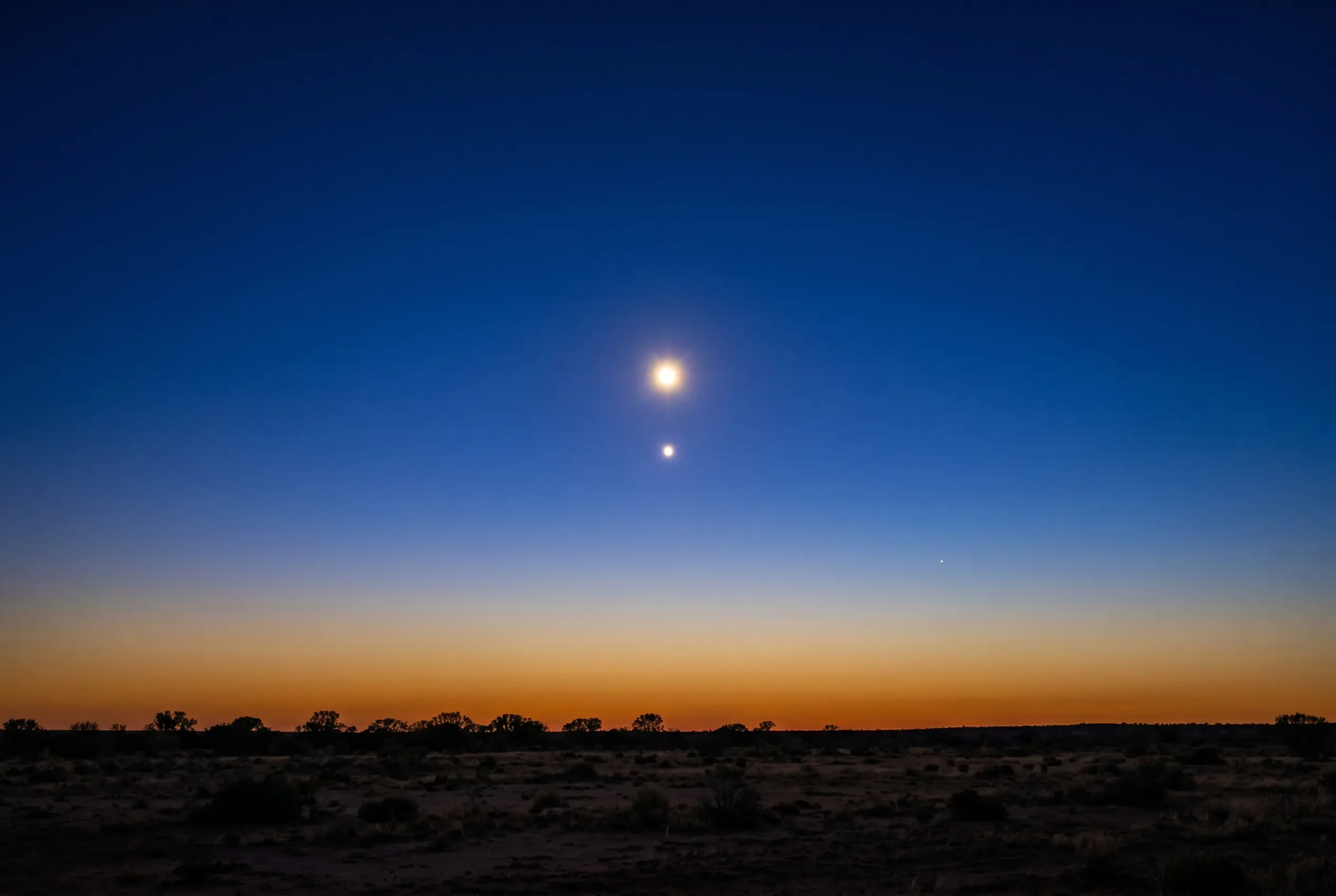
Venus and Jupiter stand 1.6 degrees apart in the western evening sky on June 9, 2026, the closest approach of the sky’s two brightest planets this year. Look west-northwest about 45 minutes after sunset; both worlds blaze well above any star in the neighborhood of the constellation Gemini.
For anyone blocked by cloud cover or city haze, the Virtual Telescope Project 2.0 carries the conjunction live from its observatory in Ceccano, Italy, starting at 19:30 UTC on Tuesday, free through its public webTV page. Mercury will also be visible in the same western field of view, sitting about 13 degrees below the planetary pair.
The Geometry of Tuesday Evening
The closest approach technically peaks at 12:00 UTC, the midday hour for North American viewers, per NASA’s Jet Propulsion Laboratory June skywatching guide. By the time darkness falls across Europe and the Americas that evening, the gap between the two planets has barely shifted; they appear essentially at the same position to any observer.
Venus is the brighter by a clear margin and the easier first find. Jupiter hangs just below and slightly to the south. Hold one finger at arm’s length and both planets fall on either side of the fingertip, with room. With 10×50 binoculars, both drop into the same five-degree field of view, and at that magnification Jupiter also resolves as a tiny disk rather than a point of light. Conjunction data from In-The-Sky.org, computed using the JPL DE440 planetary ephemeris, places both worlds in Gemini about 36 degrees clear of the Sun, well above the thickest sunset haze.
Nearby in Gemini, Pollux and Castor, the constellation’s bright twin stars, sit just above and to the right of Jupiter. Both are outshone completely by the planets, providing a natural scale for how much brighter Venus and Jupiter are than actual stars at the same sky position. Ten-by-fifty binoculars, which frame all four objects in the same wide field, reveal Jupiter as a tiny but real disk, distinct from Venus’s sharper blaze.
Both planets will be about 10 to 15 degrees above the west-northwest horizon at the start of the viewing window, with roughly one hour before they set. An unobstructed horizon free of buildings and trees makes that window count.
- 1.6° – angular separation between Venus and Jupiter at closest approach
- -4.0 – Venus apparent magnitude; no star in the sky matches this brightness
- -1.9 – Jupiter apparent magnitude at the conjunction
- ~13° – Mercury’s approximate angular distance below Venus, also visible in the western sky
Why June 9 Produces an Unusually Good View
A conjunction describes two objects appearing close in Earth’s sky because our line of sight crosses both at nearly the same angle. The planets remain physically far apart in space; the visual closeness comes entirely from the perspective of our vantage point on Earth.
Four days before Tuesday’s conjunction, Venus reached its greatest apparent separation from the Sun in this evening appearance, about 46 degrees. Jupiter, meanwhile, has been dropping toward the horizon with each passing week, heading toward solar conjunction on June 24.
| Venus | Jupiter | |
|---|---|---|
| Disk phase visible | ~49% lit (dichotomy) | Full disk |
| Distance from Earth | ~80 million km | ~900 million km |
| June status | Just past greatest elongation (June 5) | Sliding toward solar conjunction (June 24) |
Venus at Dichotomy
At roughly 49 percent illumination at the time of the conjunction, Venus shows a clean half-phase. Astronomers call this “dichotomy,” where exactly half the planetary disk faces Earth and the other half falls in shadow. Through a telescope at 40 times magnification or higher, the terminator, the boundary between the lit and dark halves, appears razor-sharp. The naked eye sees only a brilliant point; the shape behind it requires an eyepiece to reveal.
Venus’s thick cloud cover reflects a large fraction of incoming sunlight, accounting for much of its brilliance. A Live Science analysis of the conjunction puts Venus roughly 7.5 times brighter than Jupiter at magnitude -4.0 versus -1.9. In the weeks after Tuesday, Venus’s phase will shrink toward a thin crescent as it swings between Earth and the Sun on its way to inferior conjunction later in the summer.
Jupiter and Its Galilean Moons
Jupiter’s magnitude of -1.9 is somewhat below the planet’s best, because it is moving steadily farther from Earth as it heads toward the Sun. It drops a little lower on the horizon with each passing evening.
Binoculars at 10 times magnification resolve four small dots flanking Jupiter’s disk: Io, Europa, Ganymede, and Callisto, the moons Galileo first recorded in 1610. Their arrangement changes from night to night as each moon moves through its own orbit. Through a telescope at 100 times magnification, Jupiter’s two most prominent cloud bands appear as dark parallel stripes across the disk, a detail invisible in binoculars but clear through any modest backyard instrument.
Finding Mercury in the Sunset Glow
Mercury sits roughly 13 degrees below and to the lower-right of Venus on June 9, deep enough in the sunset glow that binoculars help considerably and a clear western horizon makes the search practical. Once Venus is located, sweeping a binocular down and slightly to the right by about two binocular field-widths should bring Mercury into view as a steady, non-twinkling point of light against the fading twilight.
The planet reaches greatest eastern elongation on June 15, about 25 degrees from the Sun, when it will be at its highest above the horizon in this evening appearance. On the conjunction evening, it is still climbing toward that altitude peak, at a magnitude near zero, considerably fainter than Venus and Jupiter but brighter than most stars visible in twilight. Its steady light distinguishes it from background stars, which twinkle noticeably in the turbulent lower atmosphere close to the horizon.
Its apparent diameter from Earth is small enough that even a powerful backyard telescope shows only a tiny crescent at this stage of its orbit. Its presence completes the three-planet western display: Mercury below, Venus and Jupiter close together above, all visible in the same general region of sky on a single evening.
The Virtual Telescope Project’s Free Stream
The Virtual Telescope Project 2.0, operated by astrophysicist Dr. Gianluca Masi from the Bellatrix Astronomical Observatory in Ceccano, Italy, broadcasts through a free public webTV page that requires no login or registration. The June 9 session begins at 19:30 UTC, timed to Italian dusk, roughly one hour after sunset over Ceccano.
That start time translates to 21:30 Central European Summer Time. For viewers in eastern North America, the stream opens at 3:30 pm EDT, well before local sunset. Audiences in the Americas can watch Dr. Masi’s telescope feed as Italy’s sky darkens, then step outside for their own local view of the same conjunction a few hours later at their own dusk.
Previous sessions have covered Venus-Jupiter pairings, including the March 2023 evening conjunction. The Tuesday session will also aim at Mercury in the same western field of view alongside Venus and Jupiter, giving the stream the full triple-planet display visible to clear-sky observers with the naked eye.
- Stream starts at 19:30 UTC on Tuesday (21:30 CEST / 15:30 EDT / 14:30 CDT / 12:30 PDT)
- Free access at virtualtelescope.eu/webtv/ – no account, no subscription required
- Live telescope views planned to include Venus’s half-phase disk and Jupiter’s Galilean moons
After Tuesday, Jupiter Heads for the Sun
The Venus-Jupiter pairing stays photogenic through the rest of the week and into the weekend. Jupiter drops a bit lower toward the horizon each evening as Venus continues climbing, and the gap between them widens steadily.
Mercury achieves greatest eastern elongation on June 15, about 25 degrees from the Sun, its highest evening point in this appearance. On June 16, a thin crescent Moon enters the same region of western sky, sitting between Mercury and Jupiter shortly after sunset. On June 17, the Moon floats alongside Venus; from parts of the United States, Canada, Brazil, and Venezuela, it passes directly in front of the planet in a lunar occultation, making Venus disappear behind the Moon’s limb and reappear minutes later, per the JPL June skywatching guide. NASA cautions explicitly against pointing binoculars or a telescope anywhere near the Sun during this event, since for many viewing locations the occultation happens close to the daytime horizon.
Conjunction cycles between Venus and Jupiter repeat roughly every 10 to 15 months, per Rice University astronomer Patrick Hartigan’s Venus-Jupiter conjunction analysis. Similar evening conjunctions, with both planets well-placed above the horizon, recur on an approximate 39-month rhythm driven by the near-alignment of Venus’s 8/5-year synodic cycle with Jupiter’s 1.09-year synodic period. The March 2023 conjunction was the previous comparable evening instance.
Jupiter reaches solar conjunction on June 24 and exits the evening sky until roughly mid-August. The next Venus-Jupiter conjunction falls on November 10, 2028, a morning event visible before dawn.