Prime Minister Irakli Kobakhidze signed a decree allocating GEL 500,000 from the Finance Ministry’s reserve fund to Telavi Municipality for cleanup after the July 12 mudflow. The transfer, reported on August 17, leaves distribution details unstated and arrives more than a month after the Telaviskhevi River tore through the Kakheti regional capital.
No one died. The bill for what came next is still being tallied in demolished foundations and compensation talks.
The money is a single-municipality line drawn from a central reserve, not a multi-year capital programme. That distinction shapes every claim still pending on the avenues and along the ravine.
What the Overnight Mudflow Left Behind
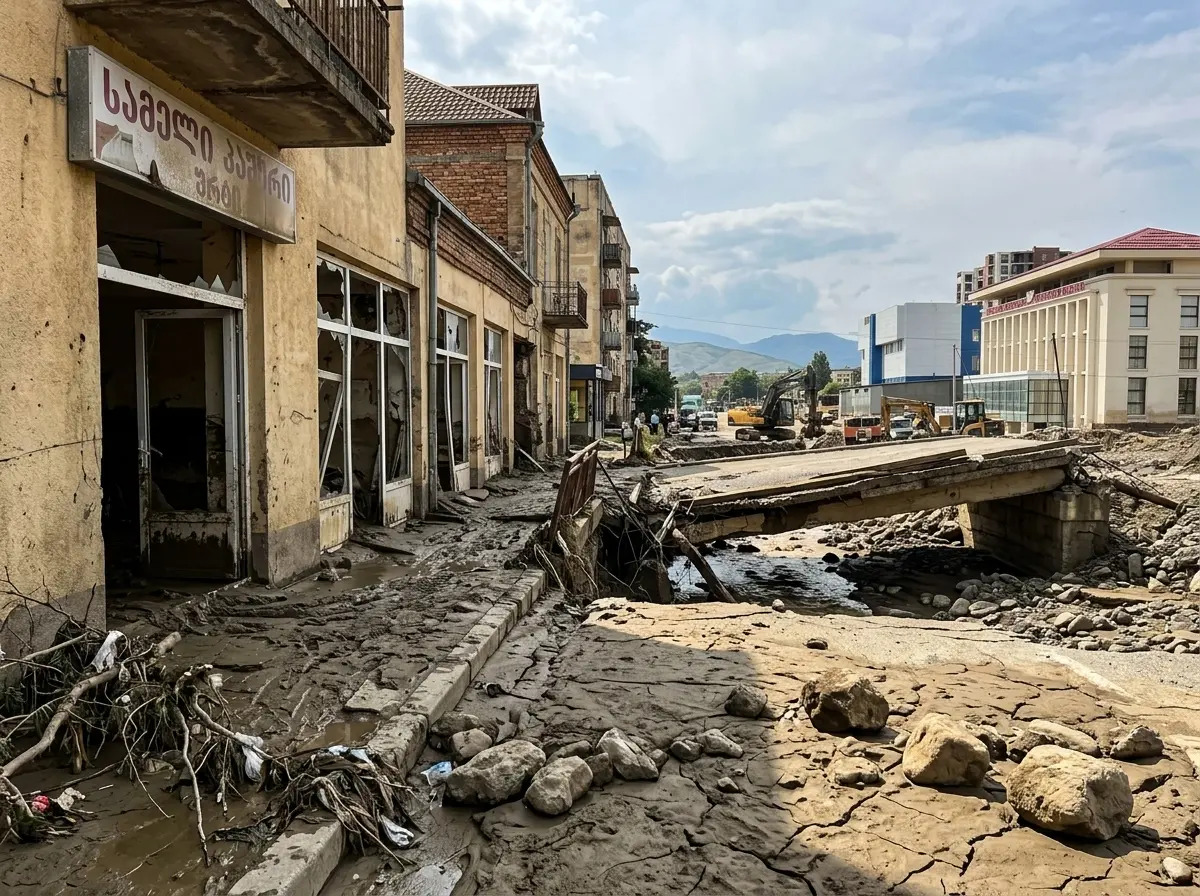
Heavy rain in the early hours of July 12 pushed the Telaviskhevi over its banks. The National Environmental Agency recorded 57.3 mm at the Telavi station, 85 percent of the monthly norm, and 40.1 mm at Ikalto. A mudflow carrying rocks, trees and debris smashed through several streets.
One bridge linking two streets was completely destroyed. Kavkasioni and Alazani avenues took heavy damage. Ground floors of residential blocks, shops, pharmacies and a clinic flooded. Power lines and vehicles were wrecked. Thousands of subscribers lost natural gas and electricity.
- Rainfall: 57.3 mm at Telavi station in hours
- Infrastructure hit: bridge gone, two main avenues compromised
- Utilities: gas and power cut for thousands
- Casualties: none reported
Georgian Dream MP Irakli Kadagishvili, who visited the scene, called the scale unprecedented and said city infrastructure was very seriously damaged. Locals described the river roaring with torn trees, soil and stones. State Representative Platon Kalmakhelidze later said the bulk of debris had been cleared from the epicentre by mid-July, with basement pumping still underway.
The gap between a cleared epicentre and a finished recovery is wide. Streets can be scraped while foundations remain unsafe and utility networks stay patched rather than rebuilt. That is the interval in which the reserve transfer now lands.
Three debris structures held, then the flow went around them
Agency geologists and hydrologists reached the site the same morning. They found that three mid-reach structures known as the Herkheulidze works partially contained the surge. The first trapped large trees. The second caught more wood. The third stopped stones and gravel.
The force still bypassed all three on the left side, following an old dirt road, damaging bank reinforcements and deforming the road surface. Inside the city the riverbed could not hold the volume. Debris piled up in the lower sections near infrastructure. The bulk of the mud settled there.
Partial containment and full bypass are not opposites here. They describe the same event at different points along the channel. Upstream traps did work on wood and stone. The left-side route around the works, and the undersized city bed below, decided where the damage concentrated.
That sequence matters for any redesign talk. Clearing debris treats the deposit. Changing how water and solids move past the mid-reach works and through the urban channel treats the path that produced the deposit.
Warnings from 2020 and a 1977 precedent
Critics immediately pointed to a 2020 Formula TV report featuring hydrologists from the Caucasus Environmental NGO Network. Those experts said Telavi residents were “living on a mine” unless problems with special debris-control dams, built after a similar 1977 disaster, were fixed. They also flagged the narrowing of the riverbed near the city and the construction of businesses along it.
Infrastructure Minister Revaz Sokhadze rejected the attack. He said natural disasters happen everywhere, accused critics of exploiting the event, and stated the dams were last renovated in 2022 and had fulfilled their function. He promised action against illegal or risky builds near the river. Kadagishvili suggested a small bridge had obstructed flow and that the entire riverbed needed redesign.
The pattern is familiar in Georgia’s mountain and foothill zones: heavy rain, rapid mudflow, emergency clearance, then incremental engineering that arrives years later. The 2023 Shovi mudflow in Oni municipality, which killed more than a dozen people, still sits in recent memory as a larger version of the same physics.
Telavi’s July event produced no deaths, yet the underlying chain is the same class of hazard. Rain loads a steep catchment. Debris-laden water seeks the easiest path. Structures and beds that are only partly matched to that path leave the lower town exposed. The argument after each event is whether the last renovation closed that gap or left it open.
How 500,000 GEL stacks against earlier disaster money
The new allocation equals roughly $192,000 at the current mid-market GEL to USD rate. It comes from the government’s reserve fund and goes straight to the municipality. Officials have not published a line-item plan for streets, the bridge, utilities or private property.
| Allocation | Amount (GEL) | Scope | Year |
|---|---|---|---|
| Telavi post-mudflow | 500,000 | Single municipality recovery | 2026 |
| Multi-municipality package | 104,877,000 | 45 municipalities, Telavi share 4,027,000 | 2024 |
That earlier 104.8 million GEL multi-municipality package shows the scale the government can move when it chooses. Telavi’s fresh 500,000 GEL is a fraction of its own prior line and of the damage visible on the avenues.
Reserve-fund transfers are built for speed, not for full capital replacement. They move cash to a mayor’s office while larger bridge, riverbed and relocation costs still need separate budget fights. The missing line-item plan keeps the public from seeing which of those tiers the 500,000 GEL is meant to touch first.
Demolition order for every building inside the 10-meter line
In August, Telavi Mayor Vazha Maghradze announced that every building within a 10-meter radius of the city’s ravine would come down. An assessment by the Levan Samkharauli National Forensics Bureau found the disaster had “undermined the foundations.” Owners of the affected buildings will be offered alternative premises or compensation.
The order turns a flood recovery story into a property and urban-form story. Ground-floor shops and apartments that took the mud now face total loss of structure. The compensation mechanism and the value offered remain unstated in public decrees. That gap matters more to households than the reserve-fund transfer itself.
- Forensic finding: foundations undermined along the ravine
- Action: full demolition inside 10-meter zone
- Remedy promised: alternative premises or cash compensation
- Open question: valuation method and timeline
Similar state decisions over land and structures have appeared elsewhere. Readers following other state property and land transfers will recognise the pattern of official assessment followed by relocation offers whose final fairness is tested only after the fact.
Demolition without a published valuation method leaves owners unable to plan. Alternative premises may or may not match floor space, street frontage or trading conditions. Cash offers may or may not track rebuild cost. Until those rules appear, the 10-meter line is a legal fact and an economic unknown at once.
What the damage means for Kakheti’s wine capital
Telavi sits at the centre of Georgia’s wine country. Streets that flooded and avenues that cracked sit inside a tourism and export economy that had been counting on strong vintages. Any prolonged disruption to access, power or commercial ground floors hits tasting rooms, guesthouses and the small traders who serve them.
The region’s producers have publicly discussed Kakheti wine sector revenue expectations in stronger years. A mud-choked downtown and a strip of demolished buildings do not erase the vineyards, but they change the first impression visitors get and the cash flow of the businesses that take the direct hit.
The disaster is indeed of an unprecedented scale. The city infrastructure has been very seriously damaged.
Irakli Kadagishvili, the Georgian Dream lawmaker on site in July, put that assessment on the record. The infrastructure minister’s later defence of the 2022 dam works and the promise of future prevention sit beside the forensic finding that foundations are already gone.
Wine country economies run on access as much as on grapes. If main avenues stay compromised and ground-floor commerce thins out along the ravine strip, visitors still reach the cellars only after passing a recovery zone. Local traders absorb that friction first. Export bulk is less exposed than walk-in trade, yet both share the same town brand.
A Timeline Runs From Rain to Reserve Cash
The public record already supplies a clear order of events. Placing those dates side by side shows how long emergency work ran before central money was announced, and how much earlier the hazard had been named.
- 1977: A similar disaster led to construction of special debris-control dams on the approach to Telavi.
- 2020: Formula TV aired hydrologists from the Caucasus Environmental NGO Network warning that residents were “living on a mine” unless dam problems, riverbed narrowing and riverside business construction were fixed.
- 2022: The dams received their last renovation, according to Infrastructure Minister Revaz Sokhadze.
- July 12: Overnight rain of 57.3 mm at Telavi and 40.1 mm at Ikalto drove the mudflow; a bridge was destroyed and main avenues were hit.
- Same morning: Agency geologists and hydrologists inspected the Herkheulidze works and the bypass path.
- Mid-July: State Representative Platon Kalmakhelidze reported the bulk of epicentre debris cleared, with basement pumping still under way.
- August: Mayor Vazha Maghradze ordered demolition of every building inside the 10-meter ravine line after the forensics bureau finding.
- August 17: Reporting confirmed Kobakhidze’s decree moving 500,000 GEL from the reserve fund to the municipality.
Weeks of clearance and pumping therefore preceded the reserve transfer. Years of warning and renovation preceded the flood. The timeline separates what emergency crews can finish quickly from what only a redesign and a compensation schedule can close.
Critics and Ministers Split Over the Dams
The July damage produced two competing readings of the same structures and the same rain. Both readings use facts already on the record. They diverge on cause and on what must change next.
| Question | Critics and outside experts | Government line |
|---|---|---|
| Condition of debris-control dams | 2020 warnings said problems left after the 1977-era works still put residents at risk | Dams renovated in 2022 and fulfilled their function |
| Role of the riverbed and builds | Narrowing near the city and businesses along the channel raised exposure | Action promised against illegal or risky builds near the river |
| Immediate flow obstruction | Kadagishvili pointed to a small bridge and called for full riverbed redesign | Natural disasters occur everywhere; critics accused of exploiting the event |
| What the Herkheulidze works did | Bypass on the left side showed the surge was not fully held | Partial trapping of trees, wood, stones and gravel counted as function fulfilled |
Those positions can both acknowledge that three mid-reach structures caught material and still disagree on whether that performance was success or shortfall. The left-side bypass, the destroyed bridge and the undermined foundations are the physical tests each side must answer.
Policy follows the winner of that argument. If the dams fulfilled their function, attention shifts to illegal builds, a small bridge and incremental fixes. If the 2020 warnings still hold, attention shifts to deeper redesign of dams, bed and setback rules. The 500,000 GEL transfer does not decide that dispute. It only funds the cleanup layer beneath it.
The open ledger after the reserve transfer
The 500,000 GEL will help clear remaining debris, restore some surfaces and restart utilities. It will not rebuild a bridge, redesign a riverbed or fund the full cost of relocating every owner inside the 10-meter line. Those larger items will require separate decisions, larger budget lines or insurance and private capital that have not yet been detailed.
Residents who watched the river carry trees and stones through their streets now wait for the compensation schedule. The municipality waits for engineering designs that go beyond emergency clearance. The National Environmental Agency’s on-site work continues. The decree signed by Kobakhidze closes one short chapter and leaves the longer reckoning over river management and riverside building still open.
Until line items, valuation rules and a redesign mandate appear in public, the ledger stays split. One column shows a reserve transfer already signed. The other shows a bridge, a river path and a strip of condemned buildings whose costs remain unlisted. Closing that second column is the work the August decree does not finish.