TECNO launched the POVA 8 Pro 5G in India on August 18 at a starting price of ₹49,999 for the 8GB RAM + 256GB storage model, with the 12GB + 512GB version at ₹54,999. Sales open August 21 on Flipkart and at retail stores nationwide, complete with no-cost EMI options and bank cashback offers.
The phone brings a 6.78-inch 144Hz 1.5K AMOLED, MediaTek Dimensity 7400 Ultimate plus a dedicated P1 graphics chip, 6500mAh battery with self-healing claims, and a rear Alive Matrix of 177 mini LEDs. Those extras land the device in a segment where pure performance phones often undercut it on silicon.
The launch pitch therefore splits the budget across display polish, a rear light matrix, long-life battery language and a full IP stack rather than pouring every rupee into the SoC alone. That mix sets up the tension early buyers will weigh once the Flipkart window opens.
Sale starts August 21 with bank offers
Flipkart lists both variants for the first sale window. Buyers can access no-cost EMI for up to 18 months with installments starting around ₹2,777 per month, plus a ₹3,000 instant cashback on select credit cards, debit cards and UPI.
- 8GB + 256GB: ₹49,999
- 12GB + 512GB: ₹54,999
- Colors: Arc White, Graphite Black, Tundra Green
- Extended RAM: up to 12GB virtual for a claimed 24GB total on higher configs
Pre-launch chatter had positioned the phone under ₹40,000. The final tags sit higher, a point several early posts on X noted immediately after the numbers dropped.
The gap between those earlier expectations and the ₹49,999 floor is large enough that EMI and the ₹3,000 cashback become part of the real shopping math. Retail availability nationwide sits beside the Flipkart listing, so buyers who prefer a store counter are not locked to the online window.
- August 18: India launch and price reveal
- August 21: First sale window on Flipkart and at retail
- Ongoing: No-cost EMI up to 18 months and select bank cashback
144Hz panel meets the rear light show
The front display is a 6.78-inch HyperLux AMOLED at 2644×1208 resolution, 144Hz, up to 4500 nits peak and 1600 nits HBM, protected by Corning Gorilla Glass 7i. Instant touch sampling hits 2800Hz and the panel supports 2592Hz PWM dimming.
Those peak and HBM brightness figures matter outdoors, while the high PWM rate is aimed at low-brightness comfort. The 2800Hz touch sampling pairs with the 144Hz refresh for the gaming claims that appear later on the sheet.
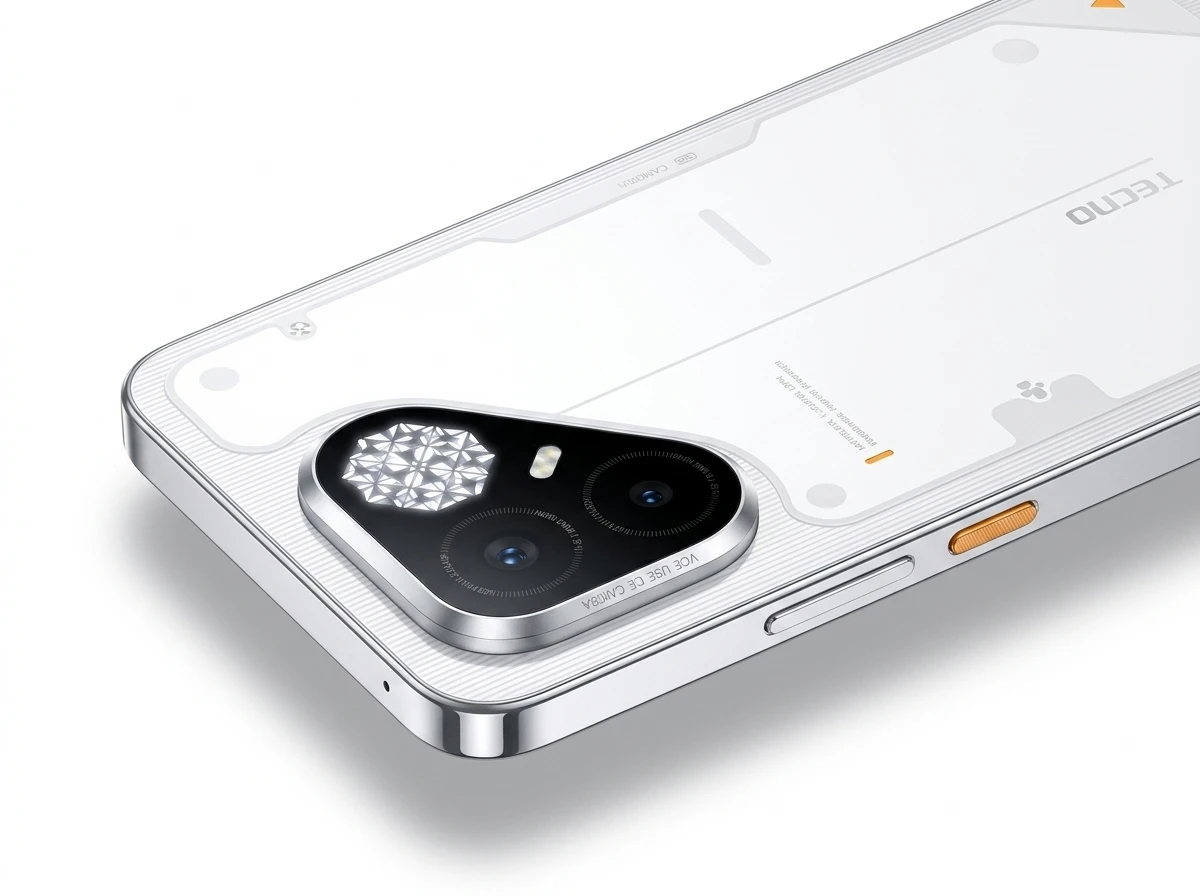
The standout visual is on the back. TECNO integrates an Alive Matrix Display into the triangular camera island using 177 independently controlled mini LEDs. The matrix runs breathing-light animations across more than 49 scenarios covering calls, messages, gaming, file transfers and custom patterns. Users can fully customize it. The handset measures 7.39mm thick and weighs 189 grams.
Official materials describe the design as interstellar spaceship-inspired with flowing lines and the Prism Trinity camera layout. The rear light effect is pure white linear by default.
At 7.39mm and 189 grams the chassis stays relatively slim for a 6500mAh pack, so the matrix and camera island do the visual work without a thick slab profile. Custom patterns turn the rear into a status strip rather than a fixed ornament.
Dual chips aim for 144FPS gaming
Power comes from the MediaTek Dimensity 7400 Ultimate on 4nm (octa-core up to 2.6GHz) paired with TECNO’s P1 Graphic Chip. The company says the combination enables up to 144FPS via frame interpolation in supported titles, specifically calling out PUBG MOBILE Ultra Extreme 144FPS. Additional tools include game super resolution, video super resolution and a 5000mm² vapour chamber.
TECNO quotes an AnTuTu score of 1,010,744 under its test conditions. An X-axis linear motor supplies 4D game vibration and stereo speakers carry Dolby Atmos. Storage is UFS 2.2 with LPDDR5X RAM.
| Feature | Claimed support |
|---|---|
| PUBG MOBILE | Ultra Extreme 144FPS (interpolation) |
| Mainstream FPS | Up to 144FPS |
| Mainstream MOBA | Up to 144FPS |
| Mainstream RPG | Up to 90FPS |
| Cooling | 5000mm² vapour chamber |
MediaTek’s own materials for the Dimensity 7400 gaming and efficiency claims highlight HyperEngine improvements and better sustained play versus prior generations. Independent listings put typical AnTuTu results for the chipset family near 980,000-1.05 million depending on the device.
TECNO’s quoted 1,010,744 score lands inside that family band, so the headline number is less about a surprise jump and more about how the P1 chip and vapour chamber hold frame pacing once interpolation is on. UFS 2.2 is a calmer storage choice than the peak options in the same price band, which is another place the budget shows its priorities.
6500mAh battery with self-healing pitch
Battery capacity sits at 6500mAh with 45W Super Charging. TECNO claims a full charge in 60 minutes, 50% in 27 minutes and 30% in 14 minutes under stated conditions. The pack supports 10W wired reverse charging and all-scenario bypass charging that routes power around the battery during gaming or heavy use to keep temperatures down.
| Charge milestone | Claimed time |
|---|---|
| 30% | 14 minutes |
| 50% | 27 minutes |
| 100% | 60 minutes |
The longevity story is more unusual. The company says the battery is designed for up to six years of health and uses self-healing technology that can restore 1% battery health after every 200 charging cycles under its conditions. DiamondCell architecture mentions low-swelling anode, cathode gallery and electrode tunneling features aimed at density and longevity. Claimed endurance figures include over 32 hours mixed daily use, 13.7 hours MOBA gaming and 11.7 hours FPS gaming in lab tests.
- Mixed daily use: over 32 hours (lab)
- MOBA gaming: 13.7 hours (lab)
- FPS gaming: 11.7 hours (lab)
- Health target: up to six years, with 1% restore per 200 cycles under TECNO conditions
The phone also carries IP66, IP68, IP69 and IP69K dust and water resistance plus an Omni-Shield impact system.
Bypass charging is the practical partner to the 5000mm² vapour chamber when frame interpolation and high refresh are both active. Routing wall power around the cell during heavy sessions is meant to limit heat soak that would otherwise tax both sustained FPS and long-term pack health.
Sony main camera and Android 16 software
The rear setup pairs a 50MP Sony LYTIA 700C primary with OIS and an 8MP ultrawide. The front camera is 13MP. Hybrid OIS+EIS stabilization is listed along with Live Photo support. The Alive Matrix sits in the same triangular island.
Software is HiOS 16 on Android 16 with TECNO AI features and the Ella assistant. Connectivity includes 5G, Wi-Fi 6, Bluetooth 5.4, NFC, IR blaster and under-display fingerprint. FreeLink 2.0 offers short-range device-to-device calling and messaging up to 1500m without network, and a three-year 256GB cloud drive is included.
Full official 6.78-inch HyperLux AMOLED specs and the rest of the sheet match the India listing closely.
Shipping on Android 16 at launch keeps the software floor current for a mid-premium tag. The three-year 256GB cloud drive and FreeLink 2.0 then extend the package beyond the usual app tray, one with storage runway and one with offline reach when towers drop out.
How the price stacks against peers
At ₹50,000 the POVA 8 Pro sits where several phones offer higher-end silicon or faster charging. The Mobile Indian noted that a Motorola Edge 70 Max can bring a Snapdragon 8-class chip and larger battery in the same band, while Nothing’s Phone (4a) Pro range delivers a Glyph-style rear light, metal body and stronger cameras with trade-offs on battery and storage. Poco and Redmi options nearby often prioritize raw GPU and battery size over a mini-LED rear matrix.
| Phone | Starting price band | Notable trade-off vs POVA 8 Pro |
|---|---|---|
| POVA 8 Pro 5G | ₹49,999 | Alive Matrix + IP69K + self-heal claim |
| Typical Poco/Redmi peers | ~₹45k-53k | Often stronger chip or bigger battery, no rear LED matrix |
| Nothing Phone 4a-class | Similar | Glyph lights + metal, smaller battery |
| CMF / midrange alternatives | Lower | See recent CMF Phone 2 Pro midrange launch pricing |
Early reaction on X tracked the same tension. Tech poster Ahsan Kharbai wrote that pricing “is on the higher side in my opinion, was expecting it to be close to ₹42-45K.” Other posts simply listed the numbers and moved on; a few joked about the hit to the wallet. The rear matrix and full IP stack give TECNO a clear visual and durability differentiator, yet the Dimensity 7400 leaves less headroom against devices that spend the budget on the SoC instead.
Shoppers weighing the segment may also watch the Vivo T4 Ultra tipped mid-premium features as another data point in the same rough band.
In short, the POVA 8 Pro asks buyers to value the Alive Matrix, the four-grade IP list and the self-healing battery story as much as raw benchmark headroom. Peers that win on silicon or charge speed usually give up one or more of those extras.
The P1 Chip Stretches Frame Pacing
The Dimensity 7400 Ultimate alone is a mid-premium 4nm part with octa-core clocks up to 2.6GHz. TECNO’s bet is that the separate P1 Graphic Chip can push supported titles toward 144FPS through frame interpolation rather than native rendering alone.
That is why the gaming table lists Ultra Extreme 144FPS for PUBG MOBILE with the interpolation note attached, and why mainstream FPS and MOBA titles share the same up-to-144FPS line while RPGs cap at 90FPS. Super-resolution tools for games and video sit beside that path as image-quality helpers when the panel is already running at 144Hz.
The 5000mm² vapour chamber and X-axis linear motor complete the loop: one for sustained thermals under interpolated loads, the other for 4D vibration feedback tied to game events. Stereo Dolby Atmos speakers round out the session kit without asking the SoC to carry every headline alone.
Buyers who chase native high-frame GPU muscle may still prefer peers that spend more of the ₹50,000 band on silicon. Buyers who want the panel, the motor and the interpolated 144FPS badge get a different stack for the same money.
Four IP Grades Meet the Omni-Shield Claim
Few phones in this band list IP66, IP68, IP69 and IP69K together. The set spans dust tightness, immersion, high-temperature spray and the stricter IP69K profile, which is the durability half of TECNO’s pitch beside the rear light show.
- IP66: dust tight with powerful water jets
- IP68: dust tight with prolonged immersion
- IP69: high-temperature, high-pressure water
- IP69K: the stricter hot-spray grade on the same ladder
Gorilla Glass 7i on the 6.78-inch panel and the Omni-Shield impact system extend that story from water and dust into drop language. Together they give the handset a protection brief that pure performance peers in the ₹45k-53k zone often skip in favour of a hotter GPU or a larger cell.
Paired with the 6500mAh pack’s six-year health target, the IP stack is how TECNO argues the phone should last in daily abuse, not only look busy on the rear island when a match or message arrives.
Frequently Asked Questions
What is the exact India price of the TECNO POVA 8 Pro 5G?
The 8GB RAM + 256GB storage model starts at ₹49,999 and the 12GB + 512GB model is ₹54,999. Both go on sale August 21, 2026 through Flipkart and retail with EMI and bank offers available.
How does the Alive Matrix Display work on the POVA 8 Pro?
It is a rear mini-LED panel of 177 independently controlled beads integrated into the triangular camera island. The system triggers breathing-light animations for more than 49 scenarios such as calls, notifications, gaming and transfers, and users can customize patterns fully.
What battery health claims does TECNO make for the 6500mAh pack?
TECNO states the battery is engineered for up to six years of health and includes self-healing technology that can restore 1% health after every 200 charging cycles under the company’s test conditions. Bypass charging and 45W Super Charge are also listed.
Which chipset and gaming features does the phone use?
It runs the MediaTek Dimensity 7400 Ultimate plus TECNO’s dedicated P1 Graphic Chip for frame interpolation up to 144FPS in supported titles including PUBG MOBILE Ultra Extreme, plus super-resolution tools and a 5000mm² vapour chamber.
What water and dust protection does the POVA 8 Pro 5G carry?
The device is rated IP66, IP68, IP69 and IP69K. TECNO also lists an Omni-Shield impact system and Gorilla Glass 7i on the front.
The first Flipkart sale window opens in three days. Whether the rear light show and battery longevity claims justify the tag against stronger-chip alternatives will be decided by early buyers and the first independent reviews.