Samsung’s 65-inch R95H Micro RGB LED TV measures some of the widest color ranges ever recorded in a consumer set, hitting 2,173 nits peak on an 18 percent HDR white field and nearly 90 percent of BT.2020. At a list price of $3,199.99 it also packs a 4.2.2-channel speaker system and 165 Hz gaming. Yet PCMag’s Will Greenwald found the real viewing experience muted and bloom-prone, calling the flaws potentially fundamental to RGB LED technology and awarding the set just 3.0 out of 5.
For roughly the same money, or less on sale, Samsung’s own S95H OLED looks far better in everyday content and took the Editors’ Choice. The irony sits in the numbers themselves.
Lab numbers that rewrite the color chart
Using a Klein K-10A colorimeter, Murideo generator and Calman software, Greenwald measured full-screen white at 729 nits and the 18 percent window at 2,173 nits in Movie mode with HDR10. A 10 percent window reached 2,267 nits. Those figures improved on the preproduction sample he saw earlier in the year.
Color coverage proved even more striking. In HDR the R95H reached 89.98 percent of BT.2020 on the CIE31 chart and 92.67 percent on CIE76, edging the Hisense UR9 and Sony Bravia 9 II. SDR accuracy stayed high against Rec.709. Samsung itself advertises a VDE-certified 100 percent BT.2020 color area for the Micro RGB lineup, backed by thousands of independently driven red, green and blue micro-LEDs under 100 μm.
| Metric (HDR Movie) | Samsung R95H | Sony Bravia 9 II | TCL QM8L |
|---|---|---|---|
| Full-screen white | 729 nits | 848 nits | 773 nits |
| 18% window | 2,173 nits | 2,588 nits | 3,504 nits |
| 10% window | 2,267 nits | 3,654 nits | 3,956 nits |
| BT.2020 (CIE31) | 89.98% | 87.44% | N/A |
The table makes the split plain. On pure color area the R95H leads the measured pack. On small bright windows the TCL QM8L and Sony Bravia 9 II pull ahead by large margins. Full-screen white stays in a tighter band across all three, with Sony slightly on top.
RTINGS.com later confirmed outstanding SDR and HDR brightness plus deep blacks with almost no conventional halo, though it flagged a blue tint out of the box and color bleed into white areas. That second confirmation matters: two labs saw the same pattern of huge peak output paired with quirks that only show once the pattern generator is put away.
Movie mode with HDR10 was the reference path for these figures. That choice keeps the comparison honest against other sets measured the same way, even when marketing slides lean on the VDE 100 percent BT.2020 claim for the wider Micro RGB lineup.
Why complex scenes mute the gamut
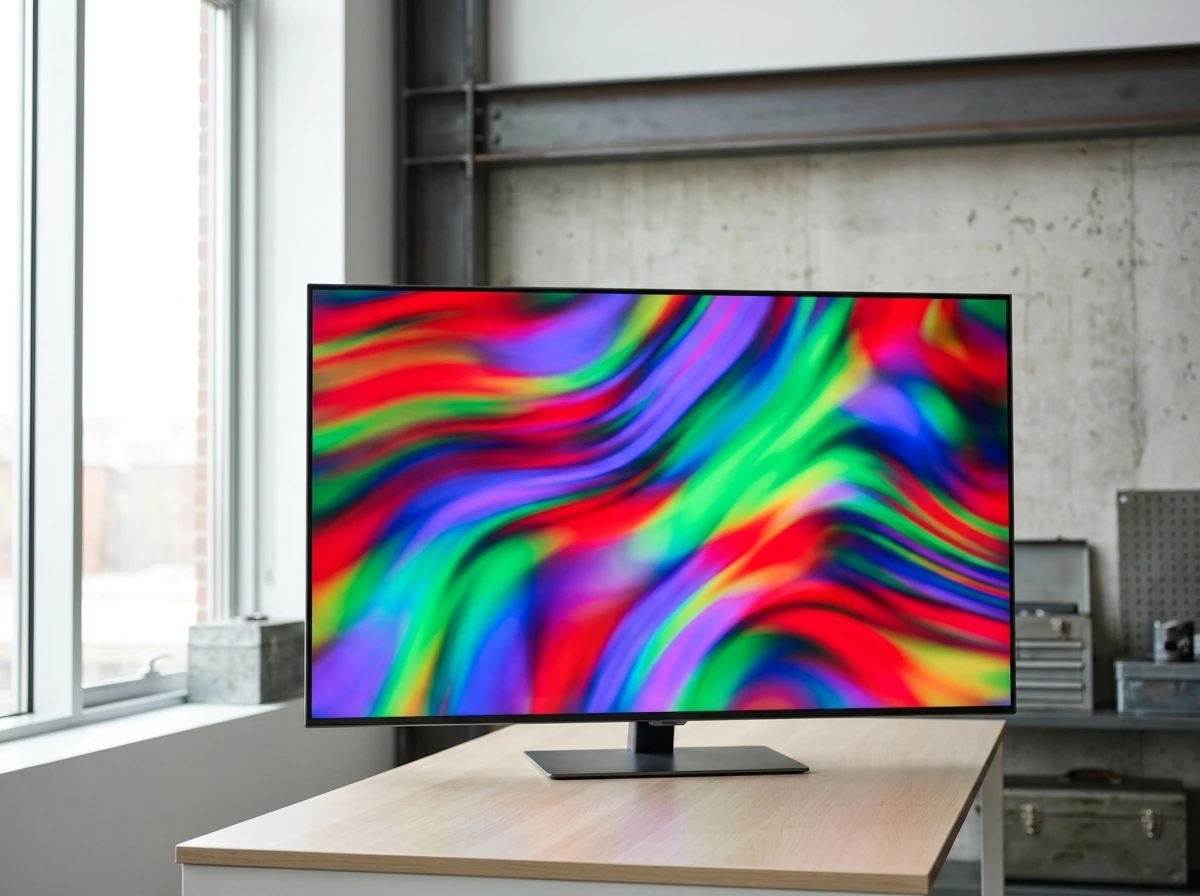
Full-screen flat fields of pure red, green or blue let the RGB backlight pump individual channels hard. That is how the lab numbers climb past ordinary mini-LED or QLED sets that rely on a blue backlight plus quantum-dot film. Real video is different. Adjacent hues of many colors force the system to balance the three LED colors toward neutral white to avoid color bloom, a haze of tinted light along high-contrast edges.
Greenwald saw the effect clearly on Spears & Munsil and Planet Earth II discs. Lush single-hue jungle greens and honey ambers looked vivid and lifelike. Mixed landscapes of yellow sand, blue water and green trees appeared less saturated than on the S95H OLED or even some conventional QLED sets. Evergreen trees against yellow grass looked muted. The R95H lacks a quantum-dot layer, so it cannot fall back on that conversion trick when the RGB channels are dialed back.
- Color bloom appears as tinted haze on high-contrast edges when RGB channels cannot be boosted independently.
- Complex multi-hue scenes trigger white-balance safety that flattens the very gamut the backlight can produce.
- Off-angle seating makes light bloom far more obvious while contrast drops, though color itself holds better than older LCDs.
- Light bloom remains visible on anamorphic letterbox bars and bright objects against black even straight-on.
The mechanism is straightforward once the safety logic is in view. Boost any single primary too far beside a different primary and the edge glows the wrong color. Hold all three near white balance and the chart-topping gamut never reaches the screen. Single-hue passages escape that trap; multi-hue nature photography does not.
Other RGB or Micro RGB sets from Hisense and Sony show similar trade-offs. The architecture that unlocks the record numbers is the same one that throttles them in ordinary content. Early online reactions split between viewers who prize the brightness and burn-in immunity and those who still prefer OLED purity.
Sound and the Tizen loadout that never quite gets out of the way
The built-in 4.2.2-channel system delivers full, clear sound with decent presence on the Death Star trench run. Directional Atmos imaging stays limited; starfighters do not swoop convincingly overhead. Amplify mode opens the sound field more. Object Tracking Sound and Q-Symphony support for multiple Samsung speakers are present.
For a flat panel the speaker count is generous. Dialogue stays intelligible and the low end has enough weight for big action cues without an external bar. The gap shows up in height and precise pans, where a dedicated Atmos setup still wins.
Tizen remains the familiar friction point. Menus bury settings deeper than most platforms. HDMI sources trigger a lengthy identify-and-optimize routine that cannot be disabled. Dolby Vision is absent; the set sticks to HDR10, HDR10+ and HLG. Streaming apps cover the majors, AirPlay and Google Cast work, far-field mics support Alexa and Bixby, and the TV can act as a SmartThings or Matter hub. Wi-Fi 6E and an ATSC 3.0 tuner round out the list. The solar-powered remote with USB-C backup is a genuine convenience.
Missing Dolby Vision will bother buyers who keep a large DV library. HDR10+ covers the Samsung and Amazon side of dynamic metadata, and HLG handles broadcast HDR, so the hole is real but not total. The hub features and modern wireless stack keep the set usable as a household controller even when the picture debate continues.
Gaming stays fast enough for most players
Native 165 Hz with VRR and AMD FreeSync Premium Pro keeps the R95H competitive. Leo Bodnar lag tester results showed 10.5 ms at 4K60 and 7.4 ms at 1080p120, under one frame either way. Four full HDMI 2.1 ports handle modern consoles and PCs. The S95H OLED is quicker still at 9.2 ms and 4.8 ms and took PCMag’s Lab Award for lowest input lag.
Stats snapshot
- 165 Hz native refresh with Motion Xcelerator
- 10.5 ms input lag 4K60
- 7.4 ms input lag 1080p120
- FreeSync Premium Pro and full VRR support
| Input lag | Samsung R95H | Samsung S95H OLED |
|---|---|---|
| 4K60 | 10.5 ms | 9.2 ms |
| 1080p120 | 7.4 ms | 4.8 ms |
Both sets clear the bar for console and PC play. The OLED’s edge is measurable on the Bodnar tester and earned it the Lab Award, yet the R95H’s 165 Hz panel and full HDMI 2.1 quartet still leave headroom for high-frame-rate titles.
RTINGS noted slow pixel response times that produce visible motion blur in fast games and sports, softening edges even when lag is low. Low lag and soft motion can coexist: the signal path is quick, but liquid crystal response still trails the best emissive panels when objects streak across the frame.
Price puts the set against Samsung’s own better OLED
The 65-inch R95H listed at $3,199.99 has already appeared at $2,999 at major retailers. The 75-inch runs $4,499.99 and the 85-inch $6,499.99. Samsung’s S95H OLED lists higher but regularly sells under $3,000 for 65 inches and delivers superior real-world contrast, viewing angles and color consistency without the bloom trade-offs.
| Model | Size | Price point |
|---|---|---|
| R95H Micro RGB | 65-inch | $3,199.99 list, from $2,999 street |
| R95H Micro RGB | 75-inch | $4,499.99 |
| R95H Micro RGB | 85-inch | $6,499.99 |
| S95H OLED | 65-inch | Often under $3,000 street |
TCL’s QM8L and various Hisense mini-LED models undercut the R95H dramatically while matching or beating its brightness in some windows. LG’s own Micro RGB push at CES 2026 and Sony’s True RGB efforts show the entire industry is chasing the same color-volume target. Samsung has also run a high-profile Samsung’s Micro RGB global billboard campaign to seed awareness.
For buyers who watch mostly bright-room sports or want maximum nits without OLED burn-in risk, the R95H has a case. For film and mixed content in controlled lighting, the numbers do not translate into the picture Greenwald and others preferred.
Bright rooms still reward the peak output
The use case that survives the bloom critique is a lit living room aimed at sports, daytime news and mixed streaming. High window peaks and strong full-screen white help HDR highlights punch through ambient light in ways dimmer panels cannot match. Burn-in immunity adds a practical margin for score bugs, news tickers and paused game HUDs that would worry an OLED owner over years of the same layout.
That case narrows once the lights go down. Controlled-light film and series work exposes the muted multi-hue passages and the letterbox bar glow that Greenwald flagged. Viewers who split time evenly between day sports and night movies face the sharper trade-off: keep the nits and accept the haze, or take the S95H OLED’s consistency and live with its lower ceiling in a sunny room.
Street pricing near $2,999 for the 65-inch R95H puts that choice on nearly equal money with the S95H when the OLED is discounted. The decision then turns on room light and content mix rather than a large budget gap. Buyers already inside the Samsung speaker and SmartThings ecosystem gain a little more from Q-Symphony and hub tricks, but those extras do not repair color bloom on a nature documentary.
Rivals chase the same color volume goal
Samsung is not alone on this path. Hisense and Sony have shown their own RGB or Micro RGB sets with the same style of lab strength and real-content compromise. TCL’s QM8L, still on a more conventional mini-LED approach, can out-nit the R95H in the smaller HDR windows while selling for less. The color-volume race is industry-wide; the first-generation tax is too.
LG’s Micro RGB effort highlighted at CES 2026 and Sony’s True RGB work confirm that panel makers see the same end state: wider primaries, higher sustained brightness, and no burn-in. Samsung’s billboard campaign tries to own the phrase before those rivals ship in volume. Awareness spending does not shorten the engineering list Greenwald and RTINGS both hit: zone control, optical design, and the white-balance safety net that still flattens complex scenes.
Until those pieces move, record CIE charts will keep outrunning the living-room image. Shoppers comparing demos should bring mixed footage, not only the single-hue tortures that favor RGB backlights, and sit off-axis long enough to judge bloom and contrast drop for themselves.
What the first-generation architecture still leaves open
Micro RGB is young. Processing power, zone density and optical design will improve. Greenwald’s bottom line remains blunt after full testing.
The Samsung R95H is impressive on paper, but it doesn’t look nearly as vibrant as its test results would indicate, and it suffers from underwhelming color performance on complex video and significant light bloom. These flaws seem endemic to RGB LED TVs as a whole.
Will Greenwald wrote that after measuring the final retail unit. The widest color chart in the lab still collides with the practical limits of driving three LED colors behind an LCD panel. Until the neutralization step can be refined or zone control becomes fine enough to eliminate the compromise, the R95H remains a fascinating proof of concept that most buyers can skip for the OLED sitting one shelf over.