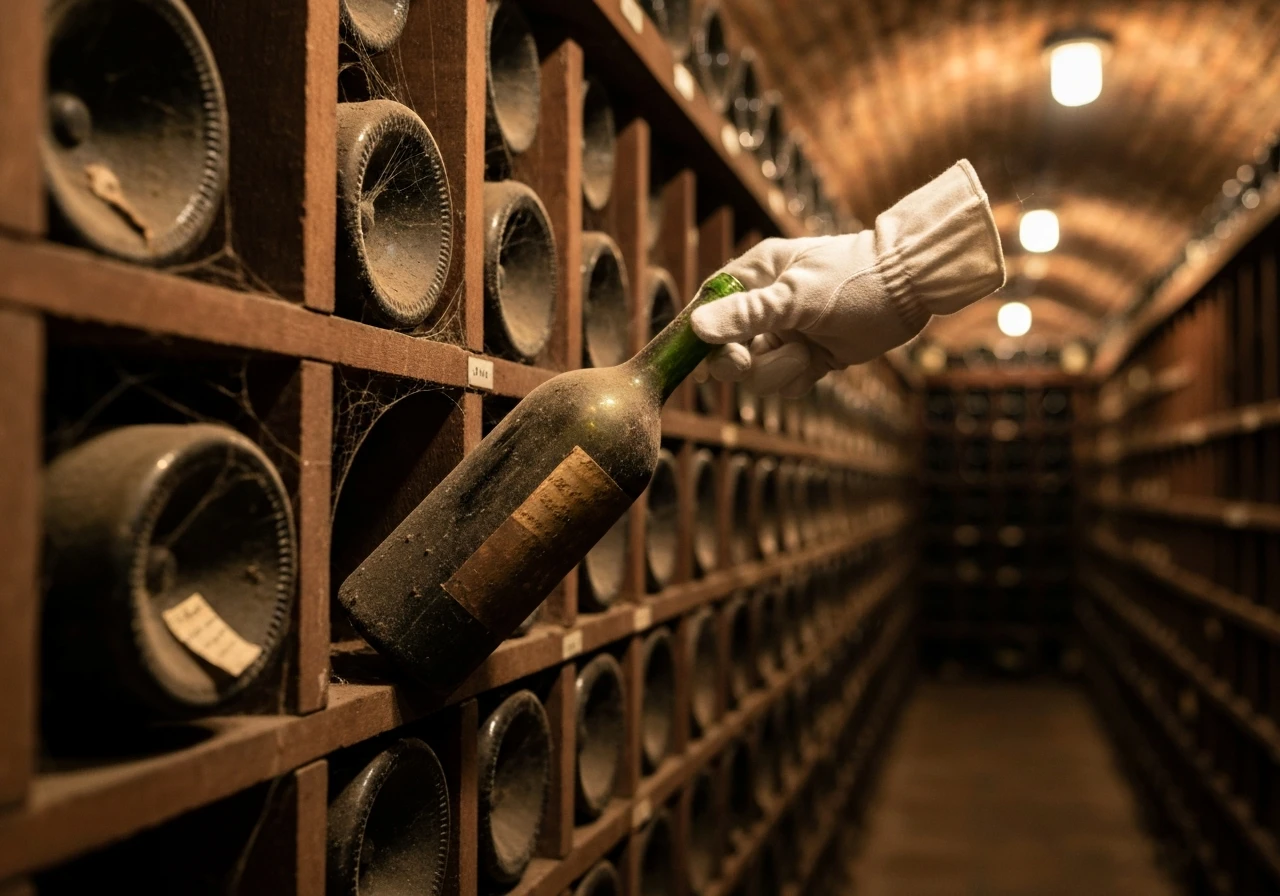
A state-owned cellar beneath Tbilisi’s 19th-century Wine Factory No. 1 reopened late last month as an enoteca, a dedicated wine archive, holding about 20,000 rare bottles. Some are older than 200 years, and a handful are tied to the personal stocks of Napoleon Bonaparte and Joseph Stalin. Prime Minister Irakli Kobakhidze and Agriculture Minister David Songulashvili cut the ribbon.
Officials were just as eager to flag what comes after the ceremony. The National Wine Agency now plans to inventory the cellar, verify each bottle’s origin and age, and steer the rarest lots toward major international auctions.
Inside the Wine Factory No. 1 Cellar
The numbers describe a working archive, not a velvet-rope display. The vault sits in Tbilisi’s Vere district, kept cool and steady so the oldest liquids inside have a fighting chance of surviving another decade.
- 20,000 collectible bottles catalogued so far, a mix of premium Georgian and foreign labels.
- 200 years, roughly the age of the oldest wines and spirits on the racks.
- 120,000 bottles at the cellar’s mid-century peak, per agency estimates, meaning most of the original stock is already gone.
- About 18 degrees Celsius, the holding temperature of the underground rooms.
What remains spans 19th and early 20th century Georgian and European wines, vintage cognacs and aged champagnes. The site itself was financed in the 1800s by David Sarajishvili, a Georgian philanthropist and cognac pioneer, and the building counts as a landmark of national architecture in its own right.
The legal plumbing changed in the background. Ownership of the enoteca passed from the National Agency of State Property to the National Wine Agency for free and indefinite use, a transfer that hands one government body both the asset and the mandate to do something commercial with it.
The Auction Pipeline Behind the Ribbon-Cutting
Strip away the ceremony and the plan is fairly direct. Experts will study the collection bottle by bottle, fix each one’s origin, age and likely collector value, then move the standout pieces toward sale rooms abroad.
Kobakhidze framed the archive as an “instrument of cultural diplomacy,” language that signals intent well beyond a tasting tour. A country that exports wine for a living has just turned a dormant cellar into a marketing exhibit and a future revenue line at the same time.
The guest list reinforced the point. Alongside government ministers, the opening drew international collectors, representatives of major auction houses, and Pierre Lurton, president of the French estate Château d’Yquem. Sweet-wine royalty does not fly to Tbilisi for a routine museum launch.
Some Georgian reports add that proceeds from any eventual sales would seed a wine education school, though officials have not put a figure or timeline on that idea. For now the auction route is the stated destination, and the verification work is the gate it has to pass through first.
The Export Economy the Bottles Are Meant to Lift
The cellar sits on top of an industry having a strong run. Georgia shipped 89.7 million litres of wine worth roughly $267.9 million to 71 countries in 2025, with the average price per litre nudging up from $2.91 to $2.98, according to Georgia’s 2025 wine and spirits export performance data. Early 2026 figures from the trade ministry show exports up about 22% year on year.
That growth rests on volume that is finally getting more expensive. The 2025 harvest processed around 340,000 tonnes of grapes across 730 companies and 22,000 growers, the largest in three decades, and the state has paired that scale with new grape-pricing rules meant to lift quality and push the country up the value ladder. A 200-year-old bottle with a famous owner is the premium end of that same pitch.
| 2025 export market | Value | Year-on-year change |
|---|---|---|
| Poland | $17 million | +2% |
| China | $9.8 million | +6% |
| Germany | $6 million | +1% |
| Japan | $1.13 million | +34% |
| France | $831,000 | +63% |
France growing 63% off a small base matters here. The market that buys the world’s most expensive wine is buying more Georgian bottles, and that is exactly the audience the enoteca is built to court.
Provenance Is the Variable That Decides the Payoff
Here is where the celebration meets a hard wall. A bottle is worth a fortune at auction only when its history is documented and its contents are believed. Georgia’s own plan to verify origins is an admission that, right now, the headline claims are unproven.
The Counterfeit Problem
Top sale rooms have spent years cleaning house. American collector William Koch famously purged his cellar of fakes before consigning it, and that scrubbed reputation became the selling point when his collection moved at Christie’s. Houses such as Sotheby’s wine and spirits auction division, Christie’s and Bonhams now stake their guarantees on authentication, so a Tbilisi bottle labelled as Napoleon’s will face forensic scrutiny long before it reaches an estimate.
For a century-old cellar that lost most of its stock, paperwork is the missing piece. The agency’s catalogue has to establish chain of custody, not just dust off a faded label, or the most romantic bottles stay stuck as exhibits rather than lots.
What Verified Lots Fetch
The upside, when provenance holds, is enormous. Recent sales show the ceiling:
- A 1787 Château d’Yquem sold for about 350,000 euros at Christie’s in Paris in July 2025.
- A 1945 Domaine de la Romanee-Conti went for roughly $558,000 at Sotheby’s.
- A 1900 Château Lafite Rothschild cleared more than $250,000 at Bonhams in New York in May 2025.
- The Koch cellar raised $28.8 million across 1,500 lots at Christie’s in June 2025, nearly double its low estimate.
Sotheby’s reported about 12% growth in its wine and spirits business for 2025, so demand is there for sellers who can prove what they have.
Stalin, Napoleon, and the Names That Move Bidders
The owner attached to a bottle is half the sale. Beyond the two marquee names, the collection reportedly includes wines linked to Russian emperors Alexander III and Nicholas II, a roster that reads like a Caucasus history syllabus.
Georgia has been here before. The reopening follows Georgia’s earlier move on the Stalin-era cellar, a sign the government has settled on famous-owner provenance as its angle into the luxury market. Stalin, born in Gori, gives the story a homegrown hook that no Burgundy estate can copy.
The presence of Château d’Yquem’s chief is a tell about that strategy. The same maker whose 18th-century bottle just cleared a six-figure sum is the kind of name Georgia wants standing beside its racks, lending credibility that an unknown cellar in the Caucasus cannot manufacture on its own.
8,000 Years as the Sales Pitch
Behind the imperial names sits the longer claim Georgia leans on in every market. Winemaking here goes back about 8,000 years, traced to clay-jar fermentation at sites like Gadachrili Gora, and the qvevri method earned a spot on the United Nations Educational, Scientific and Cultural Organization (UNESCO) list of intangible cultural heritage in 2013.
This unique space preserves wines and spirits aged for more than two centuries and once again underscores the significance of Georgia as the cradle of wine.
That was Songulashvili, the agriculture minister, at the opening, and it captures the whole play in one line. The enoteca is a vault, an advertisement, and an auction warehouse stacked into one historic building, sitting in a country that already put two Georgian estates on the World’s Best Vineyards list in 2025.
If the agency’s experts confirm the boldest provenance claims, a few Tbilisi bottles could share a catalogue with Burgundy’s grand crus within a year. If the labels do not survive scrutiny, Georgia still walks away with a restored landmark and a heritage story worth charging visitors to see.